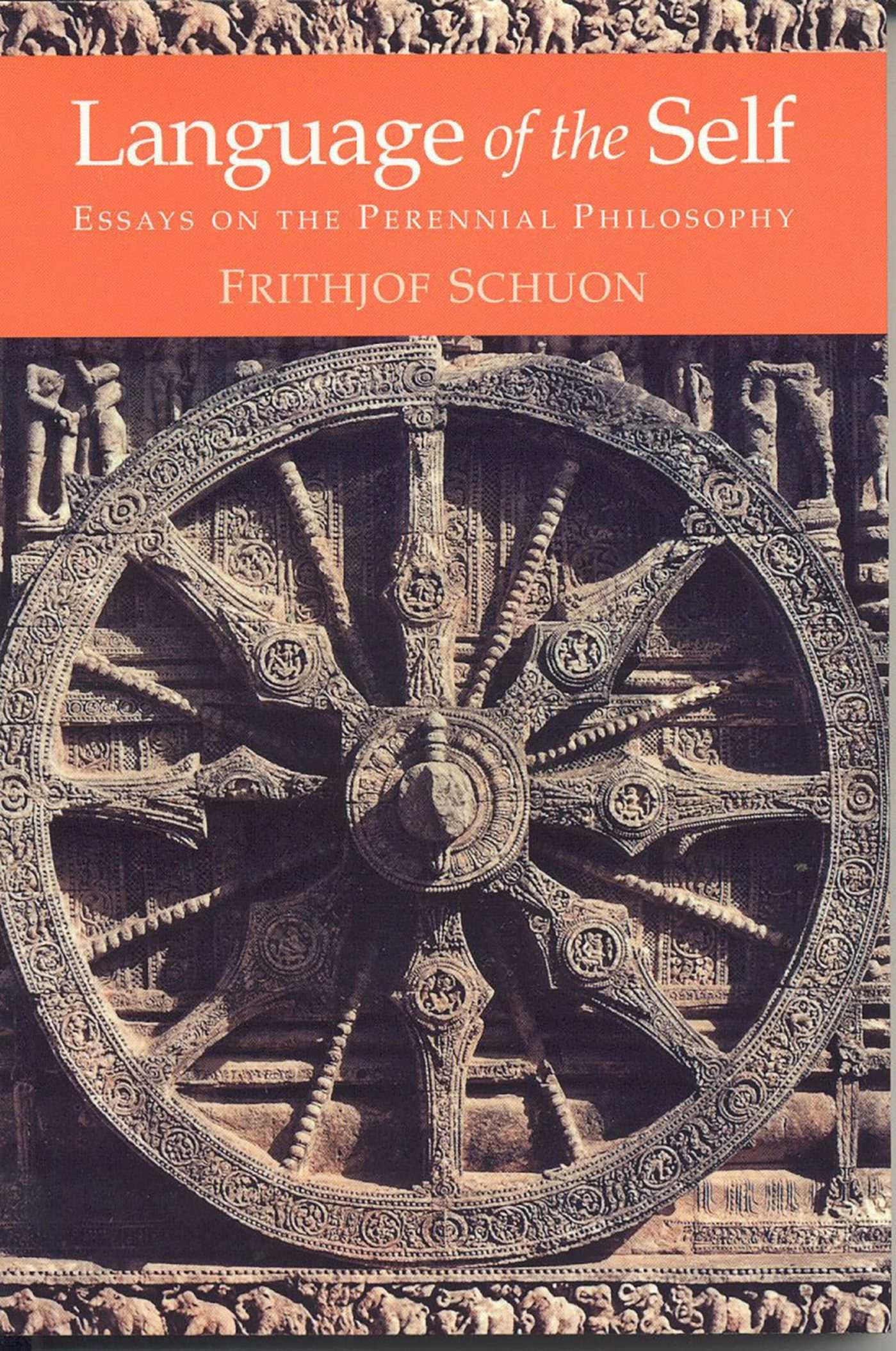



Revised translation of essays elucidating the universal principles of Advaita Vedanta. "Anyone ... who is an artist concerned with the sacred should read him ... I am eternally grateful to him." -- Sir John Tavener, composer and author "Intellectually rigorous in the highest degree ... There is no other voice like that of Schuon." -- Arthur Versluis, Michigan State University "Schuon is unsurpassed--and I would add unequalled--as a writer on comparative religion." -- Martin Lings, former Keeper of Oriental manuscripts at the British Museum, and author of What is Sufism? "The man is a living wonder ... I know of no living writer who begins to rival him." -- Huston Smith, author of The World's Religions and Why Religion Matters "[Schuon] has contributed in a unique way to the true understanding of Hinduism in the West." -- Dr. V. Raghavan (Foreword to the 1959 edition) Frithjof Schuon is best known as the foremost spokesman of the religio perennis and as a philosopher in the metaphysical current of Shankara and Plato. Over the past 50 years, he has written more than 20 books on metaphysical, spiritual and ethnic themes as well as having been a regular contributor to journals on comparative religion in both Europe and America. Schuon's writings have been consistently featured and reviewed in a wide range of scholarly and philosophical publications around the world, respected by both scholars and spiritual authorities. Schuon was born in 1907 in Basle, Switzerland, of German parents. As a youth, he went to Paris, where he studied for a few years before undertaking a number of trips to North Africa, the Near East and India in order to contact spiritual authorities and witness traditional cultures. Following World War II, he accepted an invitation to travel to the American West, where he lived for several months among the Plains Indians, in whom he has always had a deep interest. Having received his education in France, Schuon has written all his major works in French, which began to appear in English translation in 1953. Of his first book, The Transcendent Unity of Religions (London, Faber & Faber) T.S. Eliot wrote: "I have met with no more impressive work in the comparative study of Oriental and Occidental religion." The traditionalist or "perennialist" perspective began to be enunciated in the West at the beginning of the twentieth century by the French philosopher Rene Guenon and by the Orientalist and Harvard professor Ananda Coomaraswamy. Fundamentally, this doctrine is the Sanatana Dharma--the "eternal religion"--of Hindu Vedantists. It was formulated in the West, in particular, by Plato, by Meister Eckhart in the Christian world, and is also to be found in Islam with Sufism. Every religion has, besides its literal meaning, an esoteric dimension, which is essential, primordial and universal. This intellectual universality is one of the hallmarks of Schuon's works, and it gives rise to many fascinating insights into not only the various spiritual traditions, but also history, science and art. The dominant theme or principle of Schuon's writings was foreshadowed in his early encounter with a Black marabout who had accompanied some members of his Senegalese village to Switzerland in order to demonstrate their culture. When the young Schuon talked with him, the venerable old man drew a circle with radii on the ground and explained: "God is in the center, all paths lead to Him." Foreword to the Revised Translation At the beginning of the twentieth century, a school of thought arose with René Guénon and Ananda Coomaraswamy which has focused on the enunciation and explanation of the Philosophia Perennis; this philosophy is the timeless metaphysical truth underlying the diverse religions, and whose written sources are the revealed Scriptures as well as the writings of the great spiritual masters. Because these truths are permanent and universal, the point of view may thus be called "Perennialist." Frithjof Schuon is by far the pre-eminent spokesman and exponent of the "Perennialist Perspective," having written more than twenty books on this subject; these books as a whole can be said to contain the Perennialist Philosophy. The first edition of Language of the Self appeared in 1959, published by Ganesh and Co. in Madras. Since that time, the importance of this perspective has become all the more clear in a world increasingly dominated by conflicting confessional fanaticisms and by unbelief. It is in the light of the Philosophia Perennis, which views every religion "from within," that may be found the keys for an adequate understanding which, joined to the sense of the sacred, alone can safeguard the irreplaceable values and genuine spiritual possibilities of the great religions. Schuon's outlook is very much that of the Sanâtana Dharma, and his message has three main dimensions: comprehension, concentration, conformation. Comprehension of the Truth; concentration on the Truth through methodical a