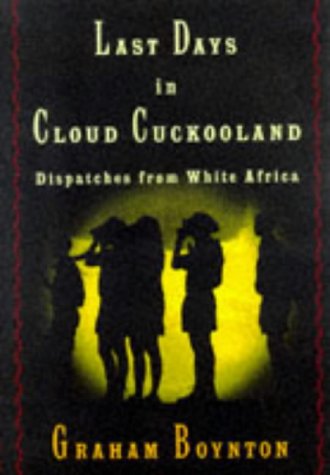



"Anyone who thinks that the ANC is going to run the government of South Africa is living in Cloud Cuckooland." --Margaret Thatcher, 1987 Seven years after the British prime minister confidently dismissed the idea of the African National Congress coming to power, Graham Boynton was in Johannesburg for South Africa's first democratic elections. The ANC was about to take over the government after all, and he was "watching the clock run down on white rule." Boynton, who grew up in Rhodesia, now Zimbabwe, is a member of the last wave of white Europeans to rule over a fast disintegrating colonial empire, and even though he welcomed the new democracy, he had mixed feelings about the demise of the old order. "The speed, capriciousness, and magnitude of the changes that swept through the continent in the last three decades of the twentieth century and brought us to that night in Johannesburg," he writes, "are hard for anyone raised in the orderly, evolving democracies of the West to imagine." Last Days in Cloud Cuckooland is Boynton's account of the final gasps of white culture on the continent, from the flight of the Belgian refugees from the Congo in 1960 through the first years of Nelson Mandela's presidency in South Africa. In a series of graphic accounts of the human dramas marking this disorderly retreat, he illuminates the complexity and ambiguity of the role of the whites in Africa. They "were never a unified gang of coldhearted supremacists," he writes, "any more than the blacks in Africa have been a saintly group of idealists and altruists." It is an evocative story, and as it unfolds the author is drawn toward a controversial conclusion. If the white colonials did a rather poor job of making Africa work, he argues, then their African successors have done considerably worse. "It was in Africa that my identity was forged," Boynton writes. "Somewhere amid the rapid dismemberment of colonial rule, the wars, and the triumph of black nationalism, I became a white African, and will remain so for the rest of my life, wherever I live." But he will probably not live in Africa, which has been changed forever. As Britain began to divest itself of its African colonies, insecure whites began to move southward to the more welcome clime of apartheid South Africa, where the Boers, who had been there since 1652, felt they were "Africans" and were determined to retreat no further. Margaret Thatcher stated in 1987 that anyone who thought Mandela's African National Congress would govern South Africa was living in "Cloud Cuckooland." Revealing how wrong Thatcher was, Boynton, a former anti-aparthied journalist, explores the end of white rule in Africa. Unfortunately, many books on this topic are already available, including Patti Waldmeir's excellent Anatomy of a Miracle: The End of Apartheid and the Building of a New South Africa (LJ 3/1/97). Boynton adds nothing new but has some interesting insights on Rhodesia, now Zimbabwe, where he grew up. For large collections. -?Louise F. Leonard, Univ. of Florida Libs., Gainesville Copyright 1997 Reed Business Information, Inc. A white expatriate African journalist looks at the present devastation in parts of Africa with pessimism and doubt. Will South Africa go the same way? What is to be done about the overwhelming unemployment? Raised in Rhodesia, now living in New York City, Boynton focuses only on the white minority. He interviews a wide range of Afrikaans and English citizens in South Africa as well as the former leaders of Southern Rhodesia (now Zimbabwe). He is also worried about the conservation of elephant and rhino. Despite the distortion of his narrow focus, his strength is that he is as open about the failures of white rule as he is concerned about the present crime and corruption, and whether readers agree with him or not, they will find this a fair reporting of the views of most whites in southern Africa, those who live there and those who have left. His opinions are sure to fuel the prevailing conservative arguments that colonialism wasn't really such a bad thing. Hazel Rochman The undertone of this book ... is one of loss and longing for an Africa that no longer exists. And despite his proper liberal credentials ... Boynton offers admittedly reactionary observations about the decline of the continent and its future without whites. -- The New York Times Book Review, Mary Ellen Sullivan who thinks that the ANC is going to run the government of South Africa is living in Cloud Cuckooland." --Margaret Thatcher, 1987 Seven years after the British prime minister confidently dismissed the idea of the African National Congress coming to power, Graham Boynton was in Johannesburg for South Africa's first democratic elections. The ANC was about to take over the government after all, and he was "watching the clock run down on white rule." Boynton, who grew up in Rhodesia, now Zimbabwe, is a member of the last wave of white Europeans to rule over a fast disintegra