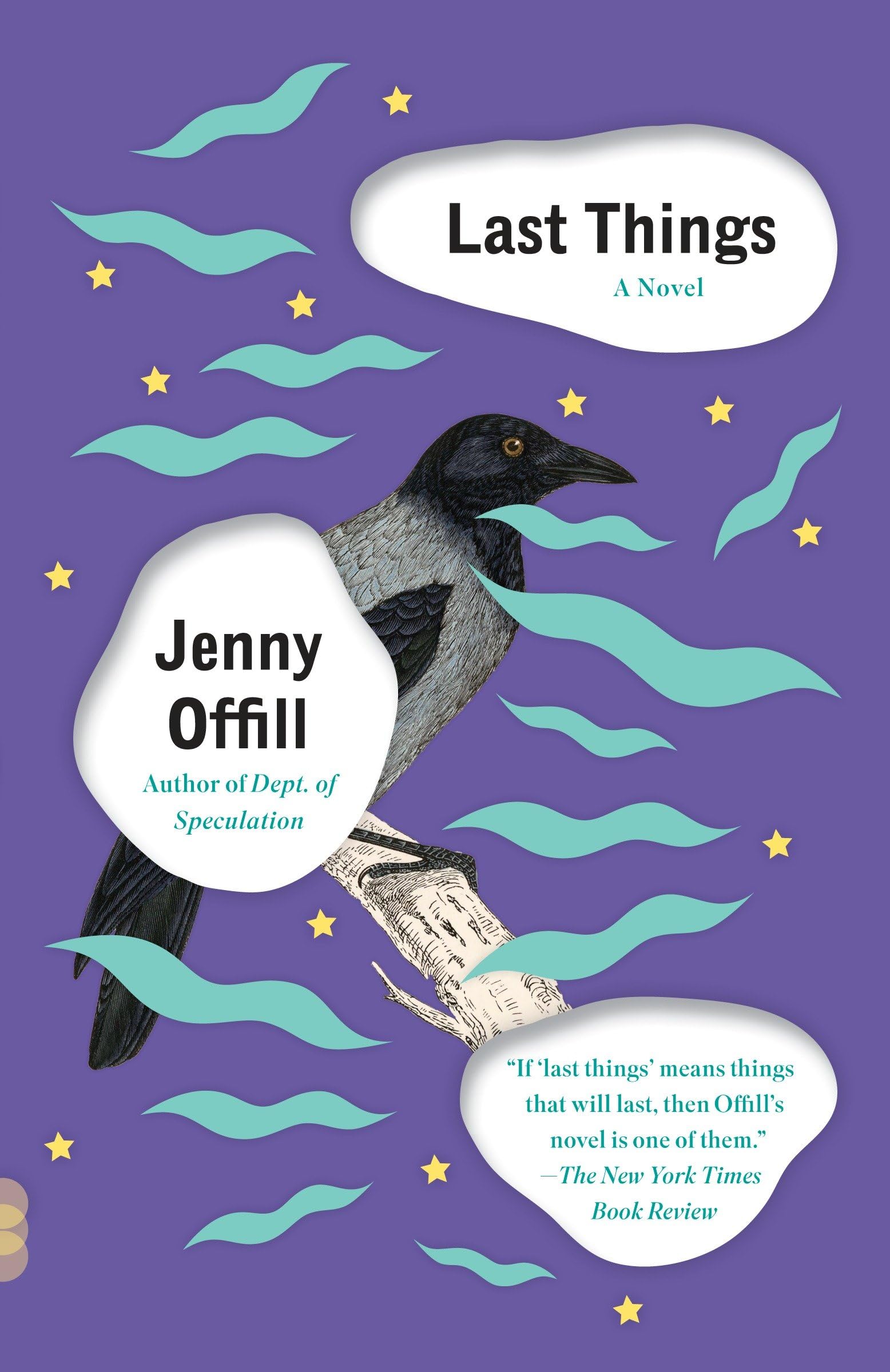



To eight-year-old Grace Davitt, the world is full of strange wonders. Through the eyes of her mother, Anna—an ornithologist who speaks five languages—their small lakeside town in Vermont becomes a glittering mystery filled with secret tongues, monsters in the lake, and birthday parties for the Earth. Anna’s untamed spirit stands in sharp contrast to that of Grace’s father, a chemistry teacher who examines his surroundings through the lens of rationalism and order. As Grace’s family begins to fall apart and she finds that she must choose between her parents, her conflicting loyalties take her on a remarkable journey that spans all corners of the country—and of her own boundless imagination. “Remarkable. . . . If ‘last things’ means things that will last, then Offill’s novel is one of them.” — The New York Times Book Review “Beautiful. . . . A gently funny tragedy about childhood and madness. . . . Pokes at the boundaries between reason and imagination.” — Newsday “Sparse, elegant, and inviting. . . . Jenny Offill . . . has created a fantastical family, at times loving and sweet, sorrowful and dangerous.” — The Boston Globe “Offill’s deceptively simple prose, her exquisite sense of metaphor and her ear for humor capture the subtle perceptions of this wise child so that we feel to the bone her burgeoning awareness.” — Chicago Tribune “ Last Things mines an interval of childhood before the division of intellectual labor. In this state of innocence, science, philosophy, mythology, bunk, wonder, and sorrow are all one. Jenny Offill’s complicated and arresting farewell to this dangerous time is compelling as few recent novels on the subject have been.” —Rick Moody “Truly delightful.” — The Baltimore Sun “Stunning. . . . Dazzling. . . . A delightful novel, rich for its voracious eye onto real and imaginary moments of quandary in the lives of its characters and in the larger life of the universe.” — Ploughshares “[A] gem of a first novel.” — Los Angeles Times “Mesmerizing. . . . Pitch-perfect. . . . [Offill] writes with a heartbreaking clarity.” — The Times (London) “Offill’s debut is a rare feat of remarkable constraint and nearly miraculous construction of a most unique family.” — Publishers Weekly (starred) Jenny Offill is the author of two novels, Dept. of Speculation, which was chosen as one of the ten best books of the year by The New York Times, and Last Things , which was a New York Times Notable Book and a finalist for the Los Angeles Times First Book Award. She teaches in the writing programs at Queens University, Brooklyn College, and Columbia University. 1 "Once," my mother said, "there was no true darkness. Even at night, the moon was as bright as the sun. The only difference was that the light was blue. You could see clearly for miles and miles and it was never cold. And this was called twilight." "Why twi?" I asked. "Because it rhymes with sky," my mother said. "It’s a code word for blue." Code blue was what they said when someone died, I remembered, and this, too, had to do with the sky. One day God called the bat to him and gave him a basket to carry to the moon. The basket was filled with darkness, but God didn’t tell him what it was. Instead, he said, “Take this to the moon. I’ll explain everything when you return.” So the bat set off for the moon with the basket on his back. He flew toward the sky, but the moon saw him and hid behind a cloud. The bat grew tired and stopped for a rest. He put down the basket and went off to find something to eat. While he was gone, other animals came along. (Dogs and wolves mostly, also a badger with a broken paw.) These animals thought there might be food in the basket and pried the cover off, but inside there was only darkness, which they had never seen before. The dogs and wolves tried to pull it out and play with it, but it slipped away between their teeth and slithered off. Just then, the bat returned. He opened the basket and found it empty. The other animals disappeared into the night. The bat flew off to try to recapture the darkness. He could see it everywhere, but he couldn’t fit it back inside his basket, no matter how he tried. And that is why the bat sleeps all day and flies all night. He’s still trying to catch the dark. “Which part of the story was the part about Africa?” I wanted to know. I had asked my mother to tell me about Africa and instead she had told me about the bat. “It’s all about Africa,” my mother said, frowning. “Everything except the part about God.” When my mother was very young, she lived in Tanzania and studied birds. It was there that she met my father. He had come to Africa to set up a fishery and she had taught him some Swahili and that was that. “Before you were born, I met him,” my mother said. “Before you were even a gleam in my eye.” This made her laugh. I laughed too. I had seen a picture of my parents in Africa, standing on the beach, holding a giant silver fish betwe