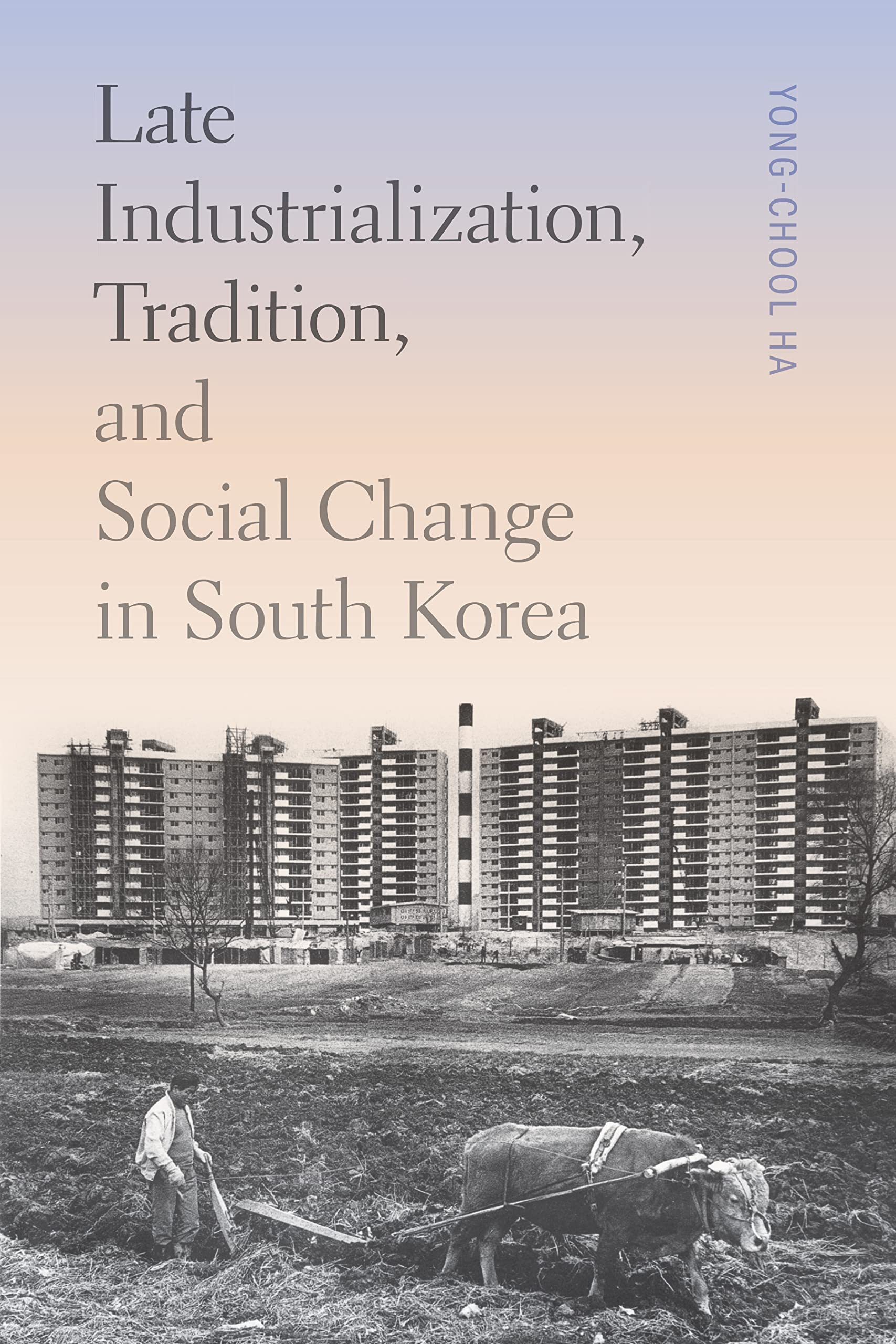
Late Industrialization, Tradition, and Social Change in South Korea (Korean Studies of the Henry M. Jackson School of International Studies)
$35.00
by Yong-Chool Ha



Examines how primary social ties fueled economic growth South Korea's rapid industrialization occurred with the rise of powerful chaebǒl (family-owned business conglomerates) that controlled vast swaths of the nation's economy. Leader Park Chung Hee's sense of backwardness and urgency led him to rely on familial, school, and regional ties to expedite the economic transformation. Late Industrialization, Tradition, and Social Change in South Korea elucidates how a country can progress economically while relying on traditional social structures that usually fragment political and economic vitality. The book proposes a new framework for macro social change under late industrialization by analyzing the specific process of interactions between economic tasks and tradition through the state's mediation. Drawing on interviews with bureaucrats in the Ministry of Commerce and Industry as well as workers and others, Yong-Chool Ha demonstrates how the state propelled industrialization by using kinship networks to channel investments and capital into chaebǒl corporations. What Ha calls "neofamilism" was the central force behind South Korea's economic transformation as the state used preindustrial social patterns to facilitate industrialization. Ha's account of bureaucracy, democratization, and the middle class challenges assumptions about the universal outcomes of industrialization. Late Industrialization, Tradition, and Social Change in South Korea is also available in an open access edition, DOI 10.6069/9780295753249 "Analyzes the inner dynamics of the developmental state in South Korea using the theory of neofamilism. It is a must-read for anyone who wants to understand the social dynamics of the state and business in South Korea."―Uk Heo, coauthor of The Evolution of the South Korea–United States Alliance "Making a masterful intervention in quintessential paradigms of industrialization, this book reorients our inquiry toward the social beyond the conventional focus on the state, ideology, and geopolitics. This brilliant study of familial and local ties as the central constituent of state-business-society relations is a must-read for anyone interested in development, democratization, and postcolonial politics. It makes a landmark contribution to the comparative studies of industrialization and its spatiotemporal unevenness."―Hyun Ok Park, author of The Capitalist Unconscious: From Korean Unification to Transnational Korea "Building on a lifetime of research, Yong-Chool Ha brilliantly analyzes how a distinctive Korean state-society relationship―neofamilism―was forged out of the crucible of colonialism and late-industrialization. He then deftly analyzes how this neofamilial amalgam of regional, kinship and school ties has underpinned Korean democratization and state-business relations."―Christopher Ansell, University of California, Berkeley "This book speaks across multiple disciplines in East Asian studies. It should be read by all those who wish to engage with the role of tradition at a deep level in late industrializing economies. The understudied role of tradition in the industrialization of East Asia adds a necessary dimension to the methodology of science and technology studies in general."― H-Net Reviews "Ha's Late Industrialization will be of interest to scholars in a broad range of disciplines of Korean Studies. The methodological approach and theoretical rigor shown in this book will provide a useful template for those trying to systematically make sense of a widespread social phenomenon that has defied comprehension."― Seoul Journal of Korean Studies Examines how primary social ties fueled economic growth Yong-Chool Ha is Korea Foundation Professor of Korean Social Science at the University of Washington. He is editor of International Impact of Colonial Rule in Korea, 1910–1945 .