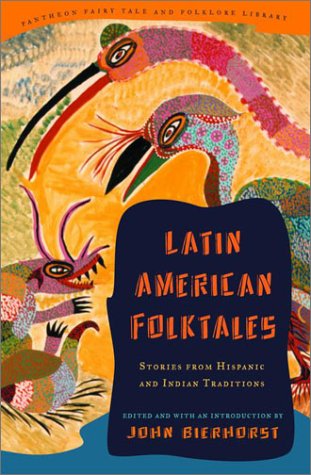
Latin American Folktales: Stories from Hispanic and Indian Traditions (Pantheon Fairy Tale & Folklore Library)
$58.97
by John Bierhorst



The wisdom and artistry of Latin America's storytellers preserve one of the world's richest folktale traditions--combining the lore of medieval Europe, the ancient Near East, and pre-Columbian America. Among the essential characters are the quiet man's wife who knew the Devil's secrets, the tree daughters who robbed their father's grave, and the wife in disguise who married her own husband--not to mention the Bear's son, the tricksters Fox and Monkey, the two compadres, and the classic rogue Pedro de Urdemalas. Gathered from twenty countries, including the United States, the stories are here brought together in a core collection of one hundred tales arranged in the form of a velorio , or wake, the most frequent occasion for public storytelling. The tales are preceded by a selection of early Colonial legends foreshadowing the themes of Latino folklore and are followed by a carefully chosen group of modern Indian myths that replay the basic stories in a contrasting key. Riddles, chain riddles, and folk prayers, part and parcel of the velorio along with folktales, are introduced at appropriate junctures. The collection is unprecedented in size and scope, and most of the tales have not been translated into English before. The result is the first panoramic anthology of Hispano-American folk narratives in any language--meant to be dipped into at random or read straight through from "Once and twice makes thrice upon a time" to "They were happy as the dickens and ate chickens." Adult/High School-Latin American culture has had myriad influences, many of which are reflected in this sizable collection of more than 100 folktales. Here Christianity sits comfortably next to animism, God has a sister, and royalty is both European and indigenous. A section of early Colonial tales opens the book, with the remainder being stories gathered during the 20th century. Containing selections collected from 20 different countries, the book travels all over the Western Hemisphere. Indigenous cultures tapped include the Zuni, Maya, and Quechua as well as the lesser-known Kogi and Tacana. Tales are short, typically no more than a couple of pages long. Moods run from silly to serious, from delightful to scary and disturbing. A couple of short sections containing riddles are thrown in as an extra treat. As though at a tasty buffet, casual readers will gain maximum enjoyment by picking out whatever strikes their fancy. More serious readers will find the "Register of Tale Types and Selected Motifs" useful in guiding their selections. Most of the stories in this entertaining volume have never before been translated into English, making it worthy of any collection. Sheila Shoup, Fairfax County Public Library, VA Copyright 2002 Cahners Business Information, Inc. These two works are similar in origin but different in genre. Bierhorst's features over 100 stories in a more traditional style from Mexico, Central America, the American Southwest, and South America. Many read like traditional European fairy tales, which should not be surprising since they reflect a strong Spanish Colonial influence, even though they have sprouted from the seedbed of indigenous folklore. The first part of this book contains Aztec and Inca legends but not very ancient ones; most date from the time just prior to or during the Conquest. The second part of the book features dynamic tales reflecting all short story or folktale genres: comic, anecdotal, moral, heroic, and religious. The tales are short and pithy and often pack a surprise punch line, making for extremely interesting reading. Fantasmas is a collection of stories by 19 well-known or emerging Mexican American writers whose inspirations seep from the cuento de fantasmas literally "ghost stories" but more a unique blend of folklore and faith, superstition and the supernatural. These tales and urban legends are modern, with a nod make that a bow to current pop culture's fascination with horror and the paranormal. They run the gamut from the grotesque ("Cantinflas," "Lilith's Dance") to those displaying gracia, that elusive, heart-lightening quality that divides art from craft ("Beyond Eternity," "Michelle's Miracle"). Still others, such as "The Gift," would make excellent X-Files material, although a strong moral is attached. Fascinating but disturbing, these tales may reflect the authors' need to purge themselves of personal or cultural fears. Public library patrons will enjoy the richness of the folktales and the sheer thrills transmitted by the fantasmas. And academic library patrons will have materials for cultural and ethnic studies now compiled into two convenient anthologies. Recommended for both types of libraries. Nedra C. Evers, Sacramento P.L. Copyright 2001 Reed Business Information, Inc. Bierhorst, a folklore specialist and prolific author for all ages, has collected and translated more than 100 folktales from the Spanish oral tradition as practiced in the Americas, from New Mexico to Nicarag