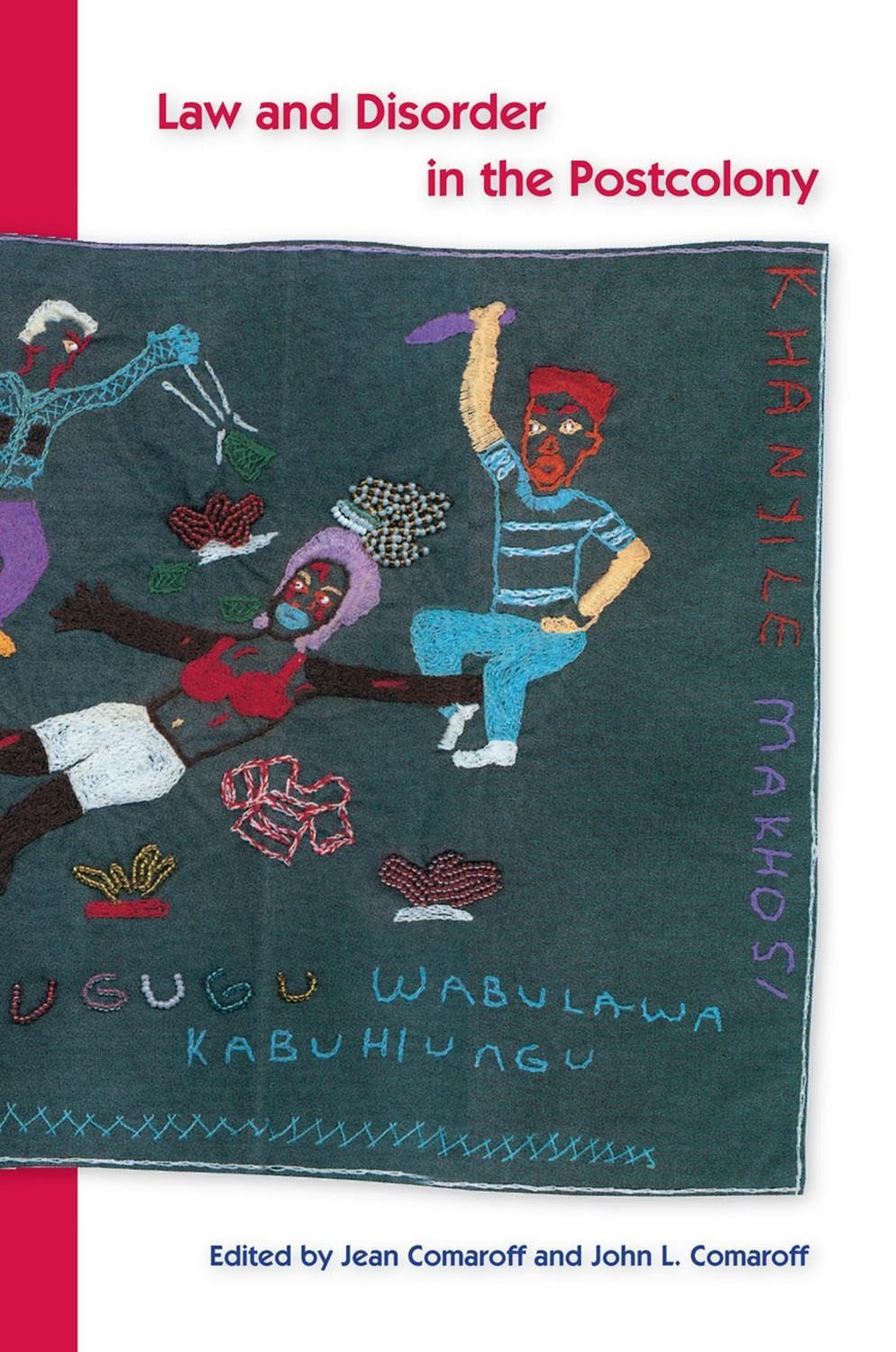



Are postcolonies haunted more by criminal violence than other nation-states? The usual answer is yes. In Law and Disorder in the Postcolony, Jean and John Comaroff and a group of respected theorists show that the question is misplaced: that the predicament of postcolonies arises from their place in a world order dominated by new modes of governance, new sorts of empires, new species of wealth—an order that criminalizes poverty and race, entraps the “south” in relations of corruption, and displaces politics into the realms of the market, criminal economies, and the courts. As these essays make plain, however, there is another side to postcoloniality: while postcolonies live in states of endemic disorder, many of them fetishize the law, its ways and itsmeans. How is the coincidence of disorder with a fixation on legalities to be explained? Law and Disorder in the Postcolony addresses this question, entering into critical dialogue with such theorists as Benjamin, Agamben, and Bayart. In the process, it also demonstrates how postcolonies have become crucial sites for the production of contemporary theory, not least because they are harbingers of a global future under construction. Are postcolonies haunted more by criminal violence than other nation-states? The usual answer is yes. In Law and Disorder in the Postcolony, Jean and John Comaroff and a group of respected theorists show that the question is misplaced: that the predicament of postcolonies arises from their place in a world order dominated by new modes of governance, new sorts of empires, new species of wealth&;an order that tends to criminalize poverty and race, entraps the &;south&; in relations of corruption, and displaces politics into the realms of the market, criminal economies, and the courts. As these essays make plain, however, there is another side to postcoloniality: while many postcolonies show signs of endemic disorder, they also fetishize the law, its ways and its means. How are we to explain the coincidence of disorder with a fixation on legalities? Law and Disorder in the Postcolony addresses this question, entering into critical dialogue with such theorists as Jean-François Bayart ,Walter Benjamin, and Giorgio Agamben. In the process, it also demonstrates how postcolonies have become crucial sites for the production of contemporary theory, not least because they are harbingers of a global future under construction. Are postcolonies haunted more by criminal violence than other nation-states? The usual answer is yes. In Law and Disorder in the Postcolony, Jean and John Comaroff and a group of respected theorists show that the question is misplaced: that the predicament of postcolonies arises from their place in a world order dominated by new modes of governance, new sorts of empires, new species of wealth—an order that tends to criminalize poverty and race, entraps the “south” in relations of corruption, and displaces politics into the realms of the market, criminal economies, and the courts. As these essays make plain, however, there is another side to postcoloniality: while many postcolonies show signs of endemic disorder, they also fetishize the law, its ways and its means. How are we to explain the coincidence of disorder with a fixation on legalities? Law and Disorder in the Postcolony addresses this question, entering into critical dialogue with such theorists as Jean-François Bayart ,Walter Benjamin, and Giorgio Agamben. In the process, it also demonstrates how postcolonies have become crucial sites for the production of contemporary theory, not least because they are harbingers of a global future under construction. Jean Comaroff is the Alfred North Whitehead Professor of African and African American Studies and of Anthropology and an Oppenheimer Fellow in African Studies at Harvard University. For more information, visit https://www.jeancomaroff.com/. John L. Comaroff is the Hugh K. Foster Professor of African and African American Studies and of Anthropology and an Oppenheimer Fellow in African Studies at Harvard University. He is also an Affiliated Research Professor at the American Bar Foundation. For more information, please visit https://www.johncomaroff.com/.