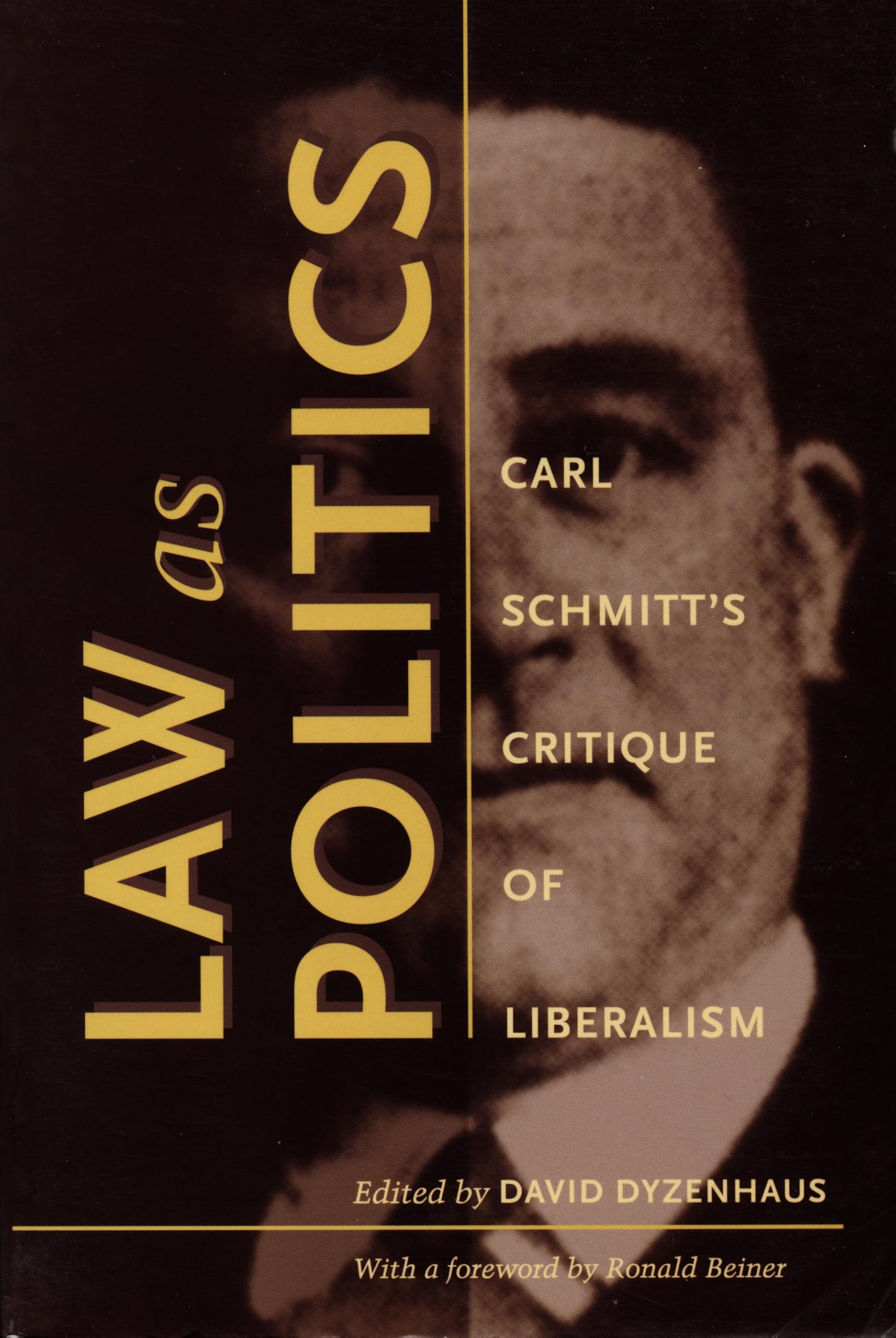



While antiliberal legal theorist Carl Schmitt has long been considered by Europeans to be one of this century’s most significant political philosophers, recent challenges to the fundamental values of liberal democracies have made Schmitt’s writings an unavoidable subject of debate in North America as well. In an effort to advance our understanding not only of Schmitt but of current problems of liberal democracy, David Dyzenhaus presents translations of classic German essays on Schmitt alongside more recent writings by distinguished political theorists and jurists. Neither a defense of nor an attack on Schmitt, Law as Politics offers the first balanced response to his powerful critique of liberalism. One of the major players in the 1920s debates, an outspoken critic of the Versailles Treaty and the Weimar Constitution, and a member of the Nazi party who provided juridical respectability to Hitler’s policies, Schmitt contended that people are a polity only to the extent that they share common enemies. He saw the liberal notion of a peaceful world of universal citizens as a sheer impossibility and attributed the problems of Weimar to liberalism and its inability to cope with pluralism and political conflict. In the decade since his death, Schmitt’s writings have been taken up by both the right and the left and scholars differ greatly in their evaluation of Schmitt’s ideas. Law as Politics thematically organizes in one volume the varying engagements and confrontations with Schmitt’s work and allows scholars to acknowledge—and therefore be in a better position to negotiate—an important paradox inscribed in the very nature of liberal democracy. Law as Politics will interest political philosophers, legal theorists, historians, and anyone interested in Schmitt’s relevance to current discussions of liberalism. Contributors. Heiner Bielefeldt, Ronald Beiner, Ernst-Wolfgang Bockenforde, Renato Cristi, David Dyzenhaus, Robert Howse, Ellen Kennedy, Dominique Leydet, Ingeborg Maus, John P. McCormick, Reinhard Mehring, Chantal Mouffe, William E. Scheuerman, Jeffrey Seitzer “ Law as Politics reveals the full force of Schmitt’s challenge to the pieties of liberal thought, as well as providing ample ammunition for those eager to meet it. In so doing, it significantly elevates the level of the English-language discussion of this powerful and troubling thinker.”—Martin Jay, University of California at Berkeley “Everybody interested in the workings of the modern state in good and hard times and its prospects for the future will profit from reading these essays on this famous and infamous German legal theorist.”—Winfried Bruger, Universität Heidelberg "Everybody interested in the workings of the modern state in good and hard times and its prospects for the future will profit from reading these essays on this famous and infamous German legal theorist."--Winfried Bruger, Universitat Heidelberg David Dyzenhaus is Professor of Law and Philosophy at the University of Toronto and author of Legality and Legitimacy: Carl Schmitt, Hans Kelsen, and Hermann Heller in Weimar . Law as Politics Carl Schmitt's Critique of Liberalism By David Dyzenhaus Duke University Press Copyright © 1998 Duke University Press All rights reserved. ISBN: 978-0-8223-2244-3 Contents Foreword, Acknowledgments, Introduction: Why Carl Schmitt?, Part I Political Theory and Law, Carl Schmitt's Critique of Liberalism: Systematic Reconstruction and Countercriticism, The Concept of the Political: A Key to Understanding Carl Schmitt's Constitutional Theory, From Legitimacy to Dictatorship—and Back Again: Leo Strauss's Critique of the Anti-Liberalism of Carl Schmitt, Hostis Not Inimicus: Toward a Theory of the Public in the Work of Carl Schmitt, Pluralism and the Crisis of Parliamentary Democracy, Liberalism as a "Metaphysical System": The Methodological Structure of Carl Schmitt's Critique of Political Rationalism, Carl Schmitt and the Paradox of Liberal Democracy, Part II Legal Theory and Politics, Carl Schmitt on Sovereignty and Constituent Power, The 1933 "Break" in Carl Schmitt's Theory, The Dilemmas of Dictatorship: Carl Schmitt and Constitutional Emergency Powers, Revolutions and Constitutions: Hannah Arendt's Challenge to Carl Schmitt, Carl Schmitt's Internal Critique of Liberal Constitutionalism: Verfassungslehre as a Response to the Weimar State Crisis, Notes on Contributors, Index, CHAPTER 1 Carl Schmitt's Critique of Liberalism Systematic Reconstruction and Countercriticism Heiner Bielefeldt Preliminary Remarks Critique of liberalism has a long tradition. However, those launching critical attacks against liberalism frequently turn out to be liberals themselves who are concerned, for instance, about the common equation of liberalism with a bourgeois attitude of "possessive individualism" or with the reduction of liberal politics to an empty proceduralism. The recent debate between liberalism and com