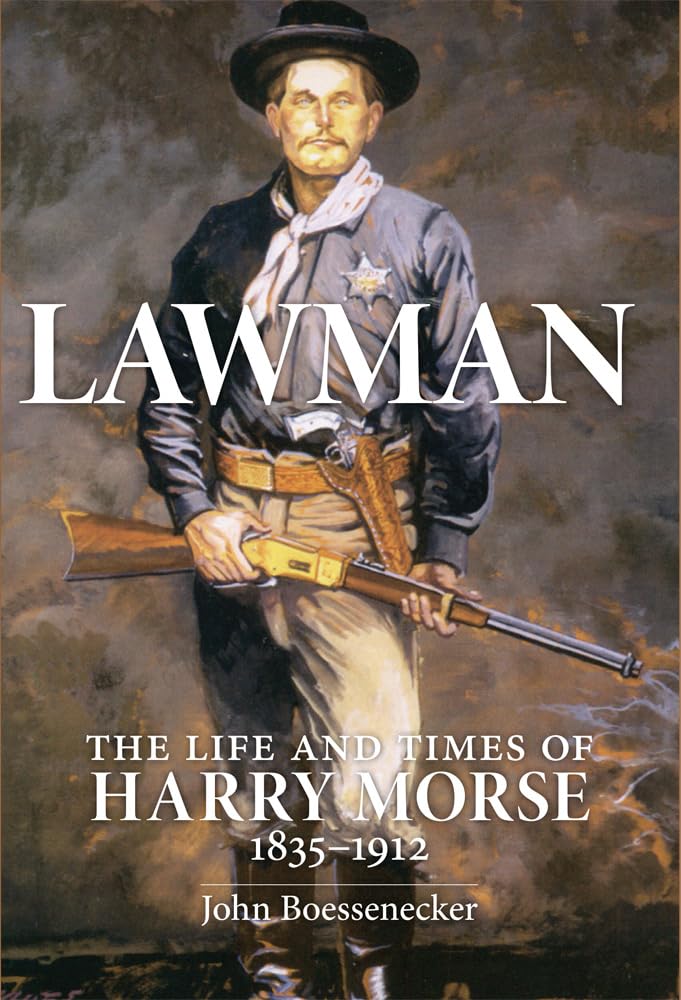



Harry Morse - gunfighter, manhunter, and sleuth - was among the West’s most famous lawmen. Elected sheriff of Alameda County, California, in 1864, he went on to become San Francisco’s foremost private detective. His career spanned five decades. In this gripping biography, John Boessenecker brings Morse’s now-forgotten story to light, chronicling not only the lawman’s remarkable adventures but also the turbulent times in which he lived. Armed only with raw courage and a Colt revolver, Morse squared off against a small army of desperadoes and beat them at their own game. He shot to death the notorious bandidos Narato Ponce and Juan Soto, outgunned the vicious Narciso Bojorques, and pursued the Tiburcio Vasquez gang for two months in one of the West’s longest and most tenacious manhunts. Later, Morse captured Black Bart, America’s greatest stagecoach robber. His exploits were legendary. Drawing on Morse’s diaries, memoirs, and correspondence, Boessenecker weaves the lawman’s colorful accounts into his narrative. Rare photographs of outlaws and lawmen and of the sites of Morse’s exploits further enliven the story. Boessenecker (Badge and Buckshot: Lawlessness in Old California, Univ. of Oklahoma, 1988), a San Francisco-based attorney, offers a biography of the California pioneer and famous Western lawman Harry Morse. As a sheriff and private detective, Morse captured or killed some of the most notorious California outlaws, including Black Bart, the poet highwayman, and was entangled in the investigation of the death of Mrs. Leland Stanford. Tracing the growth and maturation of Morse's career, the book also reflects the various stages of California history, with special emphasis on its Hispanic traditions and the ensuing clash of cultures as Anglos conquered the region. Essays written by Morse in the 1880s enliven the narrative, offering a colorful, contemporary picture of a vanished way of life. A significant contribution to the study of the multicultured West; recommended for academic libraries and western Americana collections.?Patricia Owens, Wabash Valley Coll., Mt. Carmel, Ill. Copyright 1998 Reed Business Information, Inc. Morse, once sheriff of Alameda County, California (which includes Oakland and its environs), conducted arduous manhunts for desperadoes, cornered and shot it out with hardened killer Juan Soto, and could barely bring himself to spring the trapdoor in the hanging of a desperate criminal--all of this in post^-gold rush California. Boessenecker's personal fascination with the day-to-day police work of Morse and his admiration for the overriding integrity of the lawman shines through. Morse is portrayed as a beacon of justice amid overwhelming racism toward Hispanics in nineteenth-century California; his diligence in bringing criminals to justice through private detective work after his sheriffing days (including fascinating chapters about the debonair Black Bart, a stagecoach bandit, and the "crime of the century," a brutal double slaying and mutilation) shows Morse the lawman at his best. Boessenecker has included lengthy excerpts from Morse's own personal diaries, and his occasionally reverential tone involves the reader in the story of a less-legendary but no less riveting Old West personality. Joe Collins Six-shooter justice in a Golden Gate setting. Attorney Boessenecker (Badge and Buckshot: Lawlessness in Old California, 1988) complains that California lawmen are largely unknown outside California because moviemakers located the Wild West in places like Wyoming and Texas. There's no doubt that Harry Morse's exploits could fuel a screenplay or two; as a lawman in Alameda County, just across the bay from San Francisco, Morse had his share of facedowns, shoot-'em-ups, and dry- gulchings. Boessenecker chronicles Morse's life and times, drawing heavily on the lawman's carefully self-serving, sometimes published accounts, which are invariably more interestingly written than his biographer's. Fans of law-enforcement history will enjoy reading about Morse's single-handedly busting up rings of savage desperadoes and ill-tempered banditos, who seemed to be legion in Alameda; some of the details of mass murders and gang killings could be taken from today's headlines. Boessenecker does a good job of separating invention from reality, and he's combed the archives to provide details about the usually forgotten bad guys. He's also careful to maintain that Morse was less racist than the run of Anglo California cops of the time; although Morse usually referred to the Hispanic citizens of Alameda as ``greasers,'' Boessenecker notes that Morse's intervention helped acquit a Mexican-American falsely accused of murder, and that he employed many Mexican-Americans as deputies. That some-of-my-best-friends defense aside, Boessenecker is content to regale his readers with tales of murder and mayhem, the best among them his account of Black Bart, the gentleman-poet stagecoach robber whose intriguing life wo