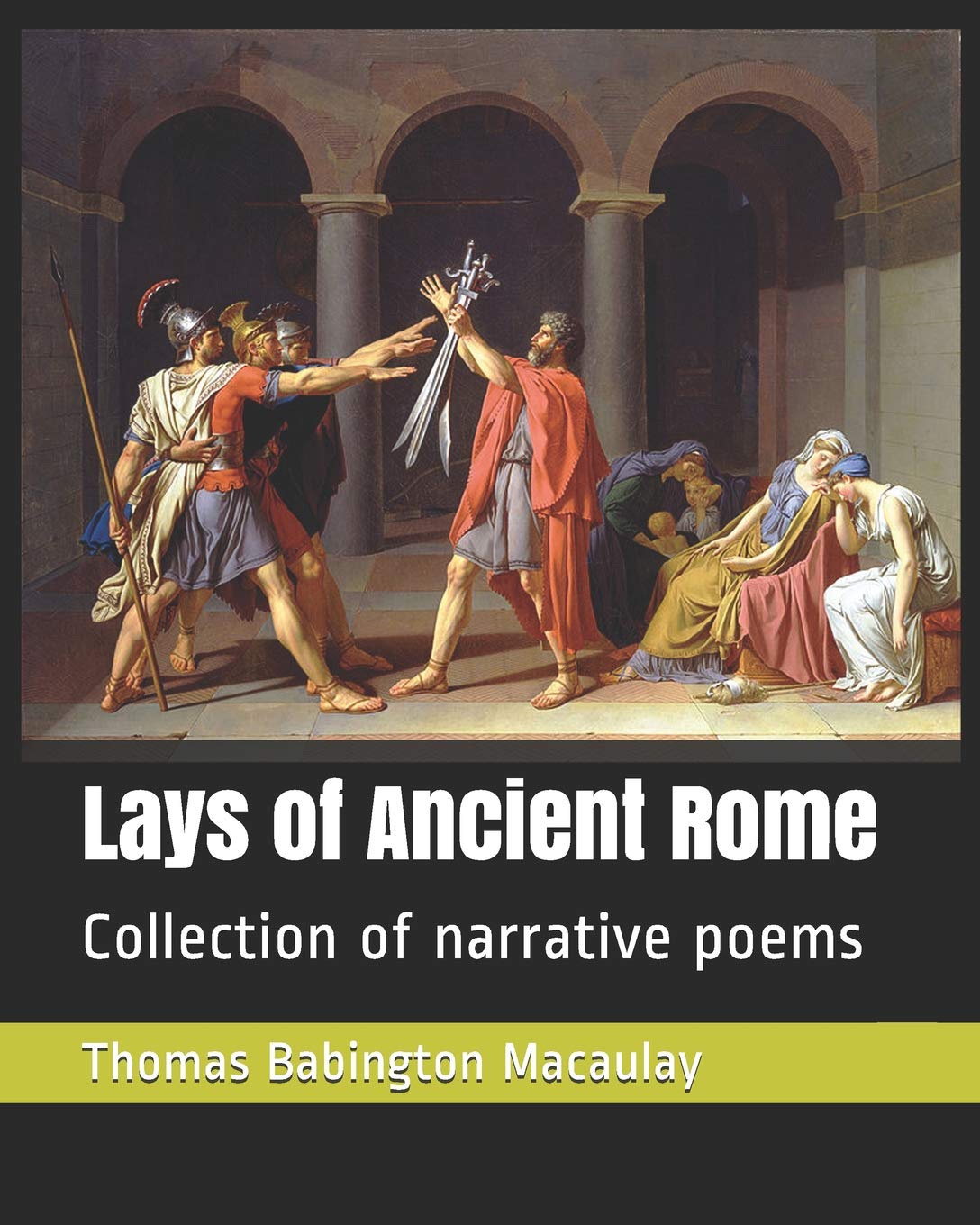



Lays of Ancient Rome is a collection of narrative poems, or lays, by Thomas Babington Macaulay. Four of these recount heroic episodes from early Roman history with strong dramatic and tragic themes, giving the collection its name. Macaulay also included two poems inspired by recent history: Ivry (1824) and The Armada (1832).HoratiusThe first poem, Horatius, describes how Publius Horatius and two companions, Spurius Lartius and Titus Herminius, held the Sublician bridge against the Etruscan army of Lars Porsena, King of Clusium. The three heroes are willing to die in order to prevent the enemy from crossing the bridge, and sacking an otherwise ill-defended Rome. While the trio close with the front ranks of the Etruscans, the Romans hurriedly work to demolish the bridge, leaving their enemies on the wrong side of the swollen Tiber.This poem contains the often-quoted lines:Then out spake brave Horatius,The Captain of the Gate:"To every man upon this earthDeath cometh soon or late.And how can man die betterThan facing fearful odds,For the ashes of his fathers,And the temples of his Gods."Lartius and Herminius regain the Roman side before the bridge falls, but Horatius is stranded, and jumps into the river still wearing his full armor. Macaulay writes,And when above the surgesThey saw his crest appear,All Rome sent forth a rapturous cry,And even the ranks of TuscanyCould scarce forbear to cheer..Thomas Babington Macaulay, 1st Baron Macaulay, FRS FRSE PC (25 October 1800 – 28 December 1859) was a British historian and Whig politician. He wrote extensively as an essayist, on contemporary and historical sociopolitical subjects, and as a reviewer. His The History of England was a seminal and paradigmatic example of Whig historiography, and its literary style has remained an object of praise since its publication, including subsequent to the widespread condemnation of its historical contentions which became popular in the 20th century.Macaulay served as the Secretary at War between 1839 and 1841, and as the Paymaster-General between 1846 and 1848. He played a major role in the introduction of English and western concepts to education in India, and published his argument on the subject in the "Macaulay Minute" in 1835. He supported the replacement of Persian by English as the official language, the use of English as the medium of instruction in all schools, and the training of English-speaking Indians as teachers. On the flip side, this led to Macaulayism in India, and the systematic wiping out of traditional and ancient Indian education and vocational systems and sciences. Macaulay divided the world into civilised nations and barbarism, with Britain representing the high point of civilisation. In his Minute on Indian Education of February 1835, he asserted, "It is, I believe, no exaggeration to say that all the historical information which has been collected from all the books written in the Sanskrit language is less valuable than what may be found in the most paltry abridgement used at preparatory schools in England".He was wedded to the Idea of Progress, especially in terms of the liberal freedoms. He opposed radicalism while idealising historic British culture and traditions.