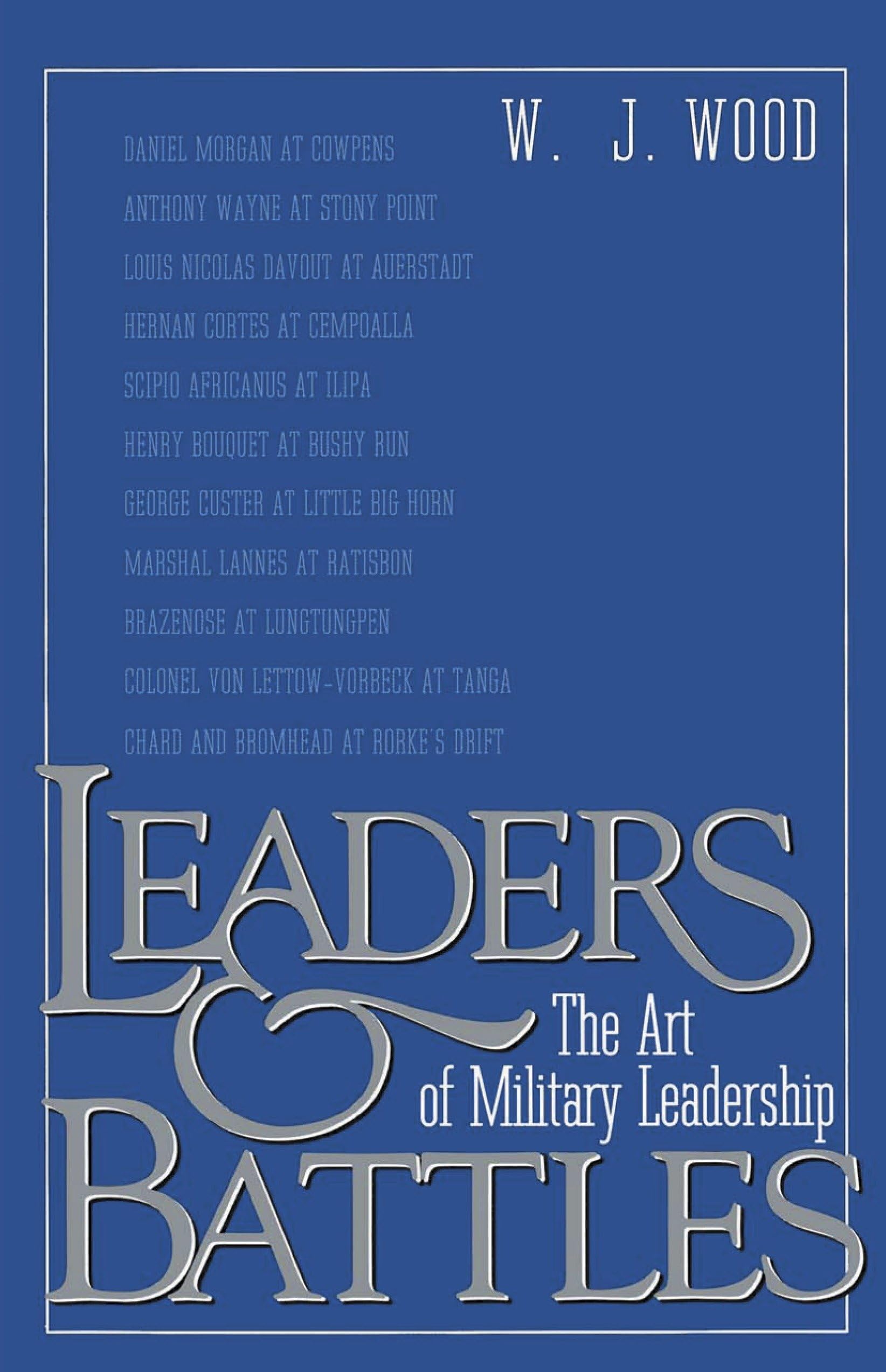



No one man can win a battle by himself, but battles have been won and lost because of the strength or failings of one individual: the leader. What went on in the minds and hearts of a select group of military leaders at critical moments in battle is the theme of this book. In Leaders and Battles, W. J. Wood re-creates ten battles from history, depicting the action in vivid detail—the brilliant formations, charging horses, clanking bayonets. The point of view is always that of the commanding officer. The particular quality of leadership that won—or lost—the encounter is very clear. For Mad Anthony Wayne at Stony Point, it was courage that won the day. For Scipio Africanus at Ilipa, it was imagination. Custer’s judgment at the Little Big Horn was definitely in question. When the French stormed Ratisbon, it was the inspiration of Lannes that broke the impasse. At the battle of Bushy Run, Bouquet could never have outwitted Pontiac had he lacked flexibility. The dynamics of battle as well as the strategy and tactics involved are equally well demonstrated. Though the means of fighting varied as much as the time and the civilizations involved, the lessons learned are just as applicable today. Men no longer fight with drawn swords, make barricades out of mealie bags, or use a swarm of bees as a weapon. But that is part of this book’s fascination. Leaders and Battles is a remarkable retelling of fighting engagements for the armchair strategist, the leader in training, the history buff, and the general reader. It will take time before the major wars and low-intensity skirmishes of this century can be written about with the historical detachment and understanding that the author displays here. In the meantime, we can all profit from these lessons of history. Physical Courage Facing up to fear, to danger, is the focus of our interest as we consider men and their fears in battle. At the outset let us dispose of an encumbrance, the “fearless man.” We have all heard of such men or have seen them in the movies, but fortunately they are about as scarce as politicians on the battlefield. I say “fortunately” because I have known (and known of) such men, and I wouldn’t want them around in combat, much less leading men whose lives were my responsibility. Let us see how one great mind has dealt with the idea of courage as opposed to fearlessness. Plato in the Laches has Nicias present his view of the issue: “I do not call animals … which have no fear of dangers, because they are ignorant of them, courageous, but only fearless or senseless … There is a difference, to my way of thinking, between fearlessness and courage. I am of the opinion that thoughtful courage is a quality possessed by very few, but that rashness, and boldness, and fearlessness, which has no forethought, are very common qualities possessed by many men, many women, many children, many animals … my courageous actions are wise actions.” Plato is seconded by Aristotle when he observes that “drunken men often behave fearlessly and we do not praise them for their courage.” In the light of such observations it is apparent that defining courage in the leader must embrace the concept of “thoughtful courage,” the ability to distinguish between the danger itself, and the necessity to get the job done in spite of it. For the leader to make decisions in battle he should be expected to act or react with thoughtful courage while being guided by his professional values. Consequently we can disregard the “fearless man” and concentrate on the great majority of men, men who acknowledge fear while realizing they must act positively in spite of it. This lies at the core of the enigma that confronts the soldier in battle. Unfortunately he has neither the time nor the environment to study his problems and arrive at reasonable solutions, as we can do so calmly in these pages. It is the soldier and his fears that demand attention before we can refocus on his leaders. My own experience tells me that it would take a lifetime of research to do justice to the combat soldier’s travail. We are in luck, however, in being able to rely on the findings of two men who have delved deeply into the subject and whose writings are universally respected. The first, Col. Ardant du Picq, was mortally wounded by a German artillery shell while leading his regiment into its baptism by fire at Longville-les-Metz in the Franco-Prussian War. A professional infantry officer in the French Army and a veteran of three campaigns, du Picq was the first nineteenth-century writer to investigate the behavior of men in battle. His early researches made him an unpopular fellow with his brother officers, for his original approach was based on a questionnaire which he circulated among them. According to John Keegan in The Face of Battle: “The questionnaire was not a success, most who received it finding its tone impertinent or its completion tedious. But his questions were int