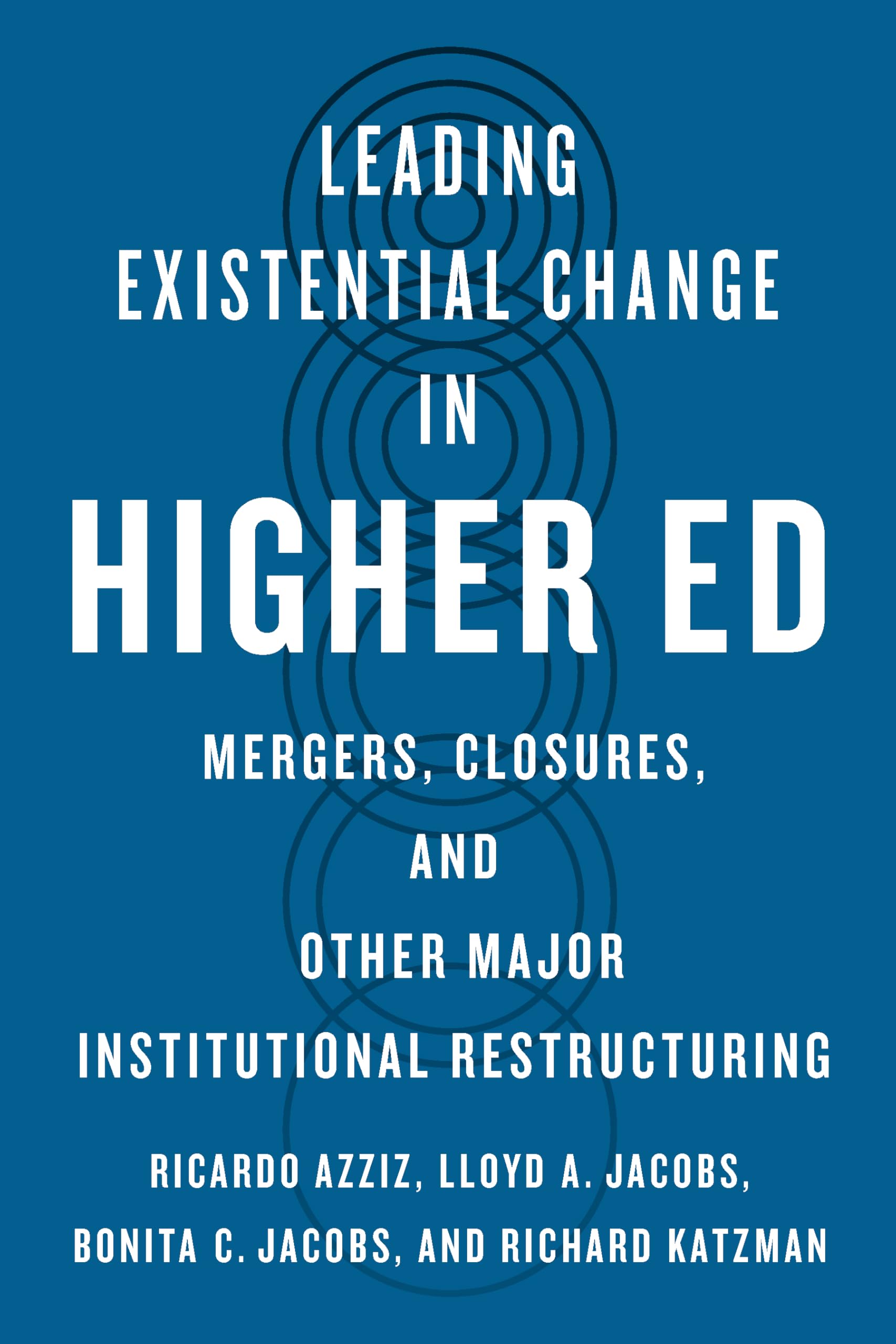
Leading Existential Change in Higher Ed: Mergers, Closures, and Other Major Institutional Restructuring
$59.95
by Ricardo Azziz



A guide on how to strategically lead institutions of higher education through mergers and other major institutional restructurings. Higher education is at a crossroads. With demographic shifts, financial constraints, shrinking enrollments, and the demand for institutional innovation, universities and colleges are grappling with monumental challenges. In Leading Existential Change in Higher Ed , Ricardo Azziz, Lloyd A. Jacobs, Bonita C. Jacobs, and Richard Katzman offer invaluable insights into how institutional leaders can successfully navigate mergers, closures, and other large-scale transformations. The authors explore the critical components of successfully leading institutional restructuring―such as pacing change, managing resistance, and harnessing the power of early adopters―while also recognizing the obstacles leaders face. Using vivid examples from real mergers in higher education, this book demonstrates how and why versatile leadership is essential as colleges and universities face an increasingly uncertain future. Whether managing a complex merger, preparing for potential closure, or undertaking other major institutional restructuring, leaders must be willing to embrace difficult decisions and act decisively before institutional decline becomes irreversible. Drawing on decades of leadership experience and research, this book provides actionable strategies for higher education leaders to take charge of change, rather than be swept away by it. Leading Existential Change in Higher Ed is an essential guide for college and university presidents and chancellors, trustees, policymakers, and other executives and stakeholders who seek to lead and guide institutions of higher education through turbulent times. A scintillating collection of analysis and recommendations on an important topic by practitioners who know the ins and outs of mergers and closures. ―William G. Tierney, Founding Director, Pullias Center for Higher Education, University of Southern California This book lays out a well-thought-out process regarding the steps to consider and the leadership skills needed to implement a plan for merging, consolidating, or closing an institution in today's world. It combines practical ideas with historical theories to do the job well. A must-read for every president of an institution of higher learning whether their institution is in danger of closing or not. ―Belle S. Wheelan, President/CEO, Southern Association of Colleges and Schools Commission on Colleges At a time when higher education must look closely at changing its operating model to adapt to the needs of students and employers, this book provides an important guide to achieving large-scale change. I wholeheartedly recommend it to leaders who are committed to engaging in major restructuring efforts. ―Mark Ojakian, Former President, Connecticut State Colleges and Universities Major organizational change is challenging in any environment, but it is particularly difficult in higher education with so many different constituencies―faculty, staff, students, alumni, donors, and in public institutions, elected officials. Until now, there have been no guidebooks to help leaders navigate these complicated waters. Leading Existential Change in Higher Ed draws from the personal experiences of the authors and other pioneers in this space, providing a valuable resource for those brave enough to stand upon their shoulders. ―Raymond S. Greenberg, President Emeritus, Medical University of South Carolina Finally! A book that tackles head-on the existential threats to higher education with solutions and a path forward. Azziz et al. clearly articulate the problems and challenges facing higher education and offer leadership and organizational solutions to help leaders navigate through the churn. ―Philip E. Dearborn, President, Association for Biblical Higher Education Accurately portraying the crisis occurring in higher education, this book lays the groundwork that needs to occur in order for colleges and universities to survive. As the authors state, 'the type of leadership that brought us here, generally can't get us there.' Every week we read about a college president resigning or being terminated and another institution closing its doors. In order to change the trajectory of these misguided institutions and establish a new transformational course, the authors have coined the term 'Big Scary Change (BSC).' The BSC concept starts with the proper leadership (administration and board). This book outlines in great detail how higher education institutions need to rethink their trajectory if they are to survive and how they need to transform their institutions going forward. A highly recommended read! ―Donald E. Tuttle, Chairman of the Board, Lindenwood University The changing landscape of higher education over the next few years will require bold and decisive leadership. Many institutions will face what the authors call 'Big Scary Change.' Chief among tho