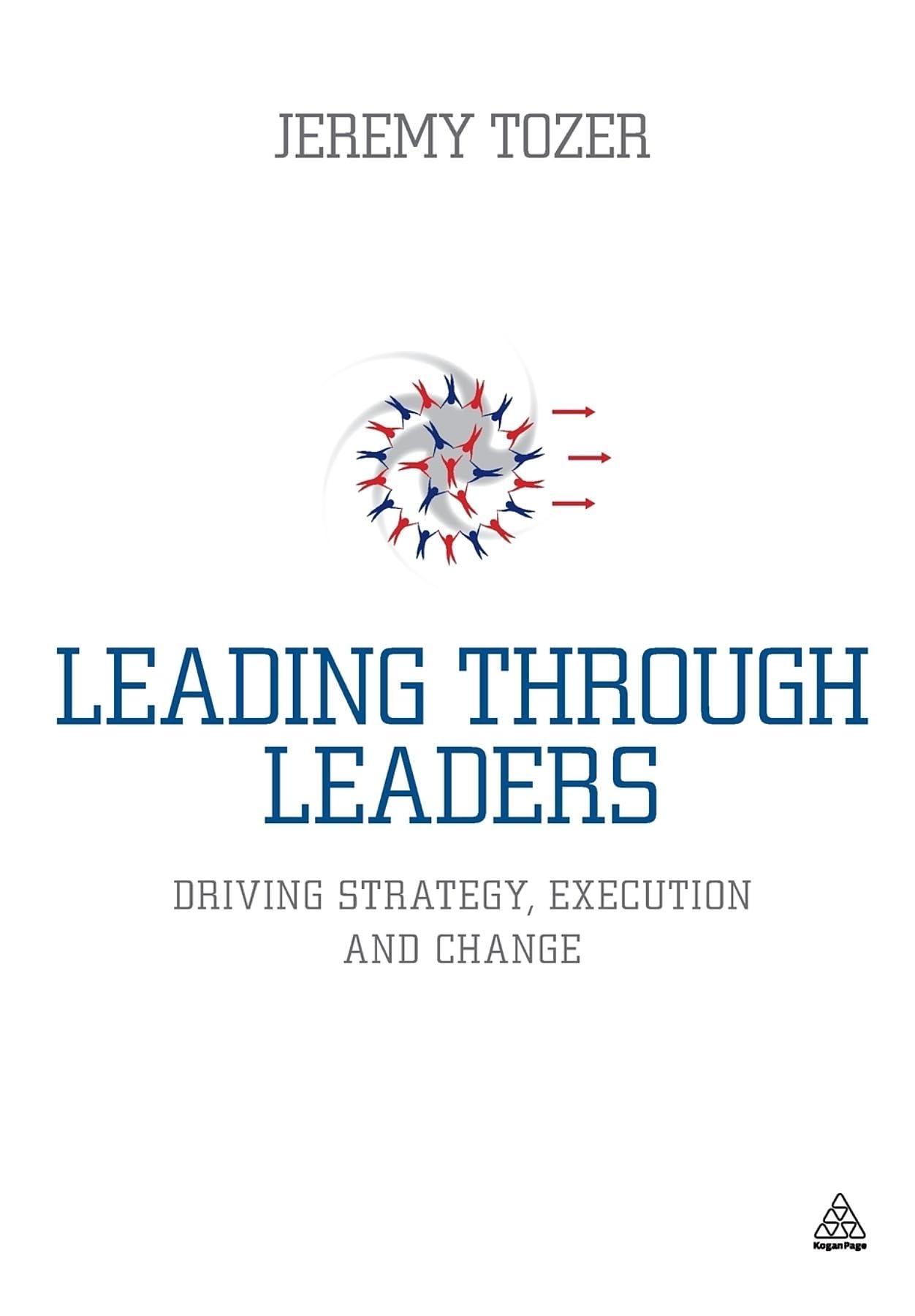



Leading Through Leaders: Driving Strategy, Execution and Change will help you improve your business results by overcoming the challenges of uncertainty, complexity, imperfect decision-making and communication, and staff disengagement. Whilst focused on building collective leadership as a strategic capability, the author provides the means for effective individual leadership: a coherent framework of principles, process and behaviour to create the conditions for success, and the systemic and dynamic integration and alignment of leaders and engaged teams at all levels. Based on the author's 27 years of leadership and consulting experience, and illustrated with case studies and learning from clients such as Cisco, Best Western, ABN AMRO, Pfizer and the NHS, this book provides unique insights into 'effective leadership' in some of the world's best known enterprises. Leading Through Leaders presents an integrated suite of proven and durable principles and tools, and the leadership psychology, that may be adapted and used by any leader. It provides businesses with the intellectual firepower to rise above the fog and clutter of operational issues and focus on strategic priorities, with the confidence that junior leaders and their teams are fully engaged and aligned at the tactical level. " My attention was captured after reading just a few pages. What Jeremy has to say is intuitively sensible, clearly practical and well-proven, and much of it resonates instantaneously. Having 'leadership' stripped of fads, then structured, simplified and explained so clearly - codified if you like - makes it possible not only to 'keep doing it better' but more importantly to have a framework for concurrently developing both other leaders and your organization." You won't be disappointed with this book." Fru Hazlitt, Managing Director, ITV Commercial and Online For optimal, sustainable performance, Leaders at all levels are responsible for ensuring the ACE conditions in which their teams may be successful: developing ABILITY, creating CLARITY, shaping the ENVIRONMENT. To develop ABILITY, leaders need to have a basic knowledge of psychology, effective interpersonal communication, emotional intelligence, and a coaching and feedback conversation structure to hand. Most performance improvements are achieved through improved 'clarity'. To lead change and to develop and execute strategy effectively in dynamic, uncertain environments, leaders require CLARITY creating methods which: * Continuously align and integrate thought and action across levels, functions, units and locations. * Ensure employee engagement and accountability. * Align accountability with delegated authority and resources to empower people. * Adapt plans and actions in light of actual progress and new circumstances. * Avoid reliance on key individuals and force of personality to get things done. To shape the ENVIRONMENT, at a personal level, leaders need to set an example and develop their self-awareness and emotional intelligence. This assumes greater importance with seniority as executive leaders' behaviours are `signal actions' to the rest of the organization. At an organizational level leaders need to know how to design and embed the framework of purpose, values, structure, policy, process and organizational `doctrine' (or business and leadership philosophy) which work in alignment with and reinforce each other, and empower people to give of their best. Based on the author's 27 years leadership and consulting experience and illustrated with case studies from enterprises like Cisco, MCI, Best Western, ABN AMRO, Rothschild, Macquarie Bank, Philips, Pfizer, Roche, Colgate and the NHS, this book enables different levels of leadership in organizations to be integrated by identifying the features common to all levels of leader while allowing level-specific features to be understood `in context'. The `concepts and tools' are based upon `first principles' applied at different levels of complexity and a deep understanding of the nature of `human nature and human capability'. They are intended for intelligent application by a leader exercising discretion. Thus the approach may be embedded systemically and will endure and adapt over time. The book may be read as a logical progression of chapters, although each chapter is clear enough to stand alone and be used as an `how to' reference as and when needed. Incredibly practical and built around real world case studies, Leading Through Leaders is based on an understanding of people and is structured for undergraduate and postgraduate management courses (the content is the core of an MSc the author created for a University in the UK), while being very relevant for practicing managers and executives as the CEO reviews suggest. Leading Through Leaders: Driving Strategy, Execution and Change will help you improve your business results by overcoming the challenges of uncertain