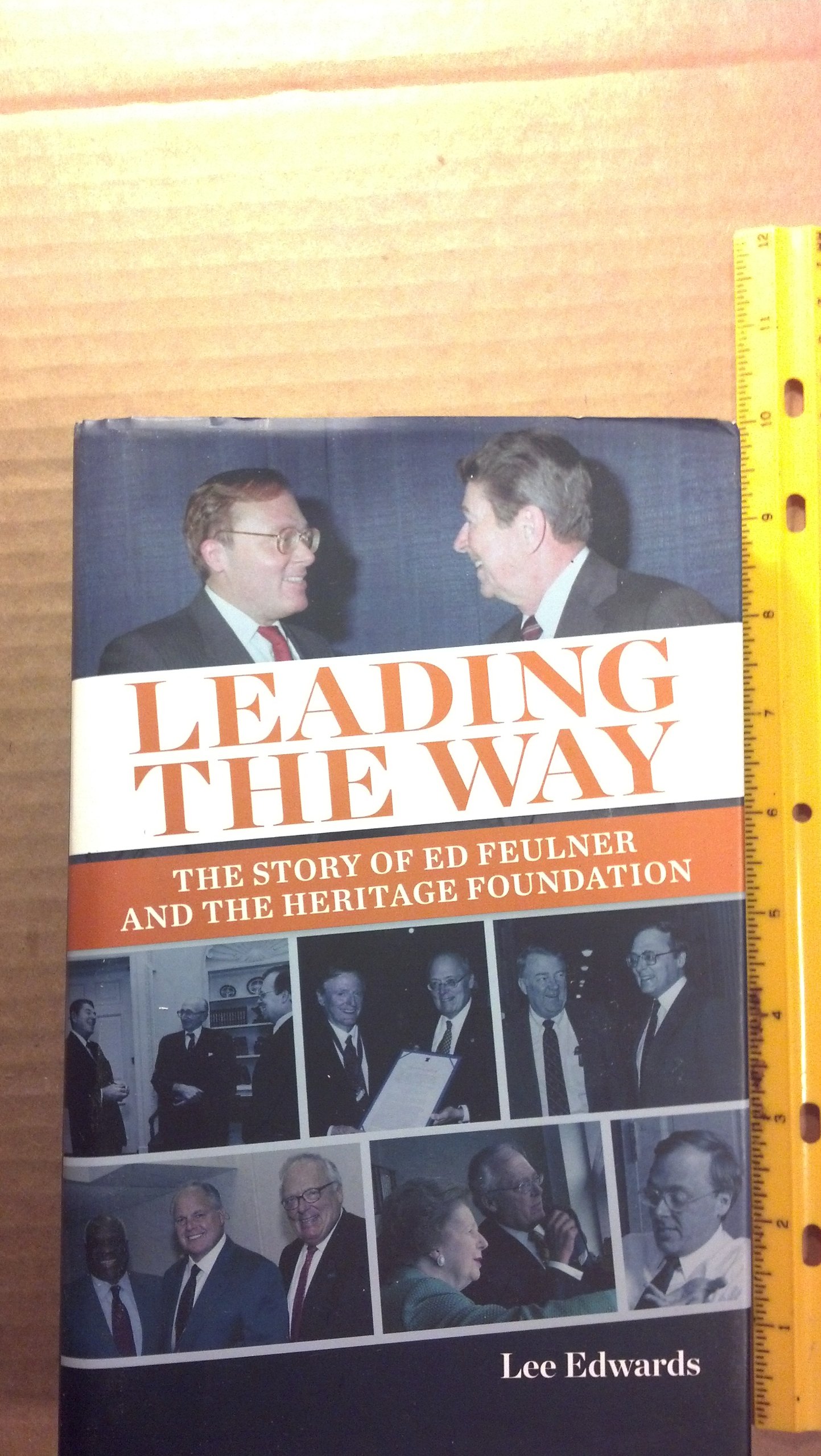



The remarkable history of The Heritage Foundation, its influential founder, and the conservative movement in America. Leading the Way tells the story of how Ed Feulner has transformed policymaking in Washington and has led The Heritage Foundation into becoming the most influential conservative think tank in the nation. Under Ed Feulner and for 36 years, Heritage has shaped politics with conservative solutions for such critical issues as entitlements, national security, missile defense, health care, welfare reform, immigration, free trade, energy, and the role of the family and religion in society. Today, with over hundreds of thousands of members and an annual budget of more than $80 million, Heritage is a permanent Washington institution and the leading exponent of conservative ideas in America and around the world. The man who made it happen is Ed Feulner, intellectual entrepreneur, hands-on manager, legendary fundraiser, presidential adviser, bestselling author, and world traveler--a man who never stops and was described by The Economist as "one of the most influential conservatives in America." LEE EDWARDS is a leading historian of the conservative movement, having written The Conservative Revolution , acclaimed biographies of William F. Buckley, Ronald Reagan, and Barry Goldwater, among many other books. He is the distinguished fellow in conservative thought at The Heritage Foundation and an adjunct professor of politics at Catholic University. chapter 1 Growing Up Right Edwin John Feulner, Jr., was born on August 12, 1941, in Evergreen Park, a tiny suburb on the far southwest side of Chicago, the broad-shouldered city of the Daley political machine and the University of Chicago school of economics. He was the first child and only son of Edwin John and Helen Joan (Franzen) Feulner, also born on the South Side, and whose grandparents came to America from Germany in the 1870s. Ed Jr.—he was called “Bud” within the family—would be followed by three sisters—Mary Ann, Joan, and Barbara. Tall and an outstanding athlete in his youth, Edwin Feulner, Sr. (“E.J.”), was outgoing and easy with people, always ready with a story in the office or at a party. He had a good position in the real estate department of the Continental Illinois Bank and a promising future there. Pretty and as gregarious as her husband, Helen Feulner ran the household with a firm but loving hand. Eddie was her favorite child, according to his sisters. The Feulners were members of America’s largest self-identified nationality: German Americans represented about one-sixth of the population. Since Baron von Steuben and the American Revolution, Americans of German descent had been influential in every aspect of U.S. society. There had been military leaders like Jack Pershing, business leaders like John D. Rockefeller, renowned scientists like Albert Einstein, and presidents like Herbert Hoover. Like all immigrants, the Feulners had been enticed by the promise of the American Dream, to have the freedom to be whatever they wanted to be, to rise as fast and as far as their talents and ambition could take them. Because they worked harder and longer and with more purpose, German Americans prospered more than almost any other ethnic group.1 The Feulners were different in one aspect from many other German Americans—they were devout Roman Catholics. All three of Helen Feulner’s brothers were parish priests, whose examples deepened the Catholicism of their family members. Uncle Peter’s parish was on the South Side, and he would visit his sister and her family several times a month. For the Feulners, saying grace before meals and praying the rosary were as natural as going to mass on Sunday, which they did without exception. In fact, Ed and Helen usually went to Saturday-morning mass as well. “Mom and Dad had a great love of Mary,” recalls Barbara Lackey. “When the clouds would start to come and it would start to rain, we took the rosary out. When we were in the car, we took the rosary out. It was very much a natural part of our growing up,” says Joan Barry.2 Edwin Feulner, Sr., was the first in the family to receive a college degree, earning a BS from DePaul University in the late 1930s by attending classes at night while working at the Continental Bank during the day. He endured without complaint the long days and nights, understanding that a degree would advance his career and help him provide for his family. During World War II he got a draft deferment because of his family status. Shortly after the end of the war, E.J. left the security of his bank job and started his own realty firm located on State Street and later on Wabash Avenue on the near North Side. (His office was above a go-go club.) He decided to deal primarily in commercial real estate. It was a risk but a calculated one. The war was over, Chicago was beginning to boom, and office space was at a premium. He played a significant part in assembling the parcels of land tha