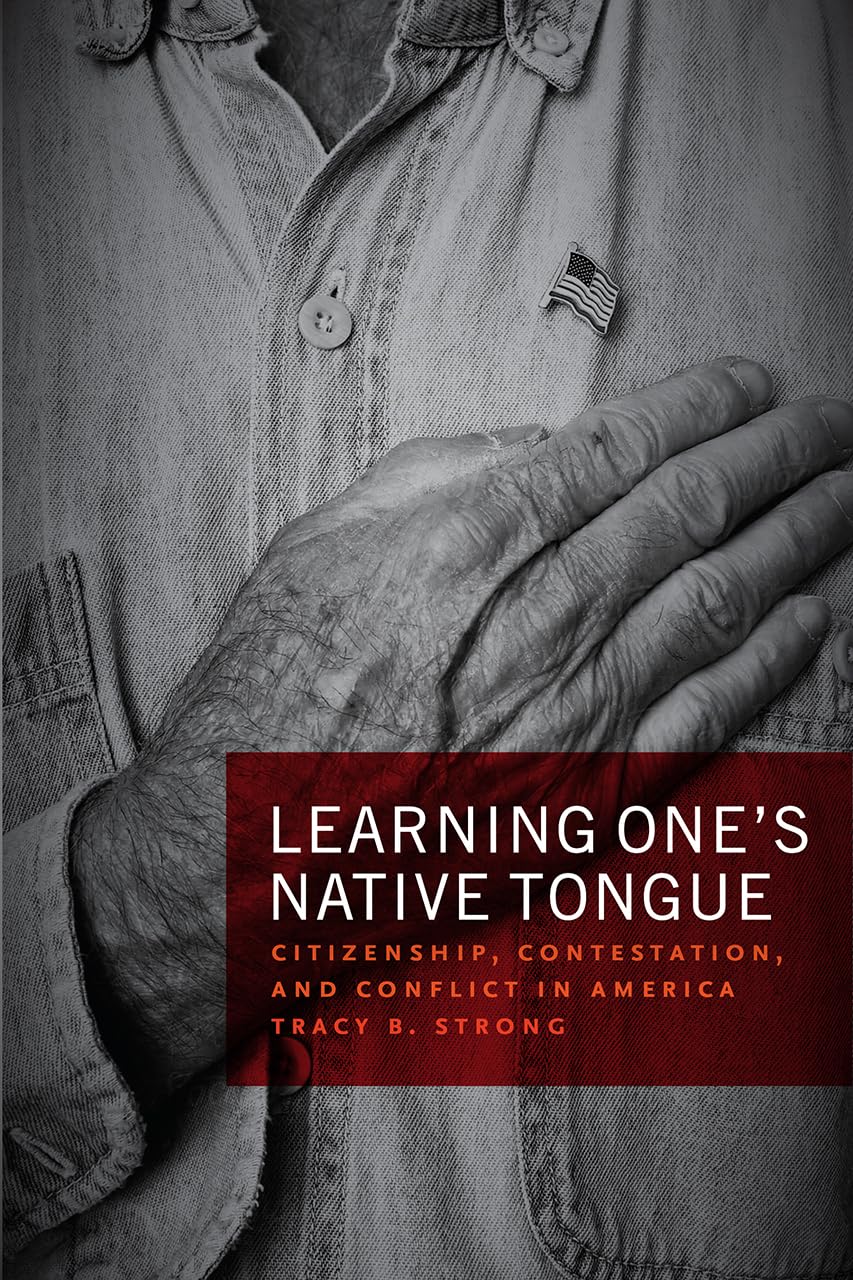
Learning One's Native Tongue: Citizenship, Contestation, and Conflict in America
$29.85
by Tracy B. Strong



Citizenship is much more than the right to vote. It is a collection of political capacities constantly up for debate. From Socrates to contemporary American politics, the question of what it means to be an authentic citizen is an inherently political one. With Learning One’s Native Tongue , Tracy B. Strong explores the development of the concept of American citizenship and what it means to belong to this country, starting with the Puritans in the seventeenth century and continuing to the present day. He examines the conflicts over the meaning of citizenship in the writings and speeches of prominent thinkers and leaders ranging from John Winthrop and Roger Williams to Thomas Jefferson, Nathaniel Hawthorne, Abraham Lincoln, Frederick Douglass, and Franklin Roosevelt, among many others who have participated in these important cultural and political debates. The criteria that define what being a citizen entails change over time and in response to historical developments, and they are thus also often the source of controversy and conflict, as with voting rights for women and African Americans. Strong looks closely at these conflicts and the ensuing changes in the conception of citizenship, paying attention to what difference each change makes and what each particular conception entails socially and politically. "What does it mean to be an American citizen? We might immediately answer this question in terms of suffrage, a right that represented much of the historical struggle for inclusion. . . In Learning One's Native Tongue: Citizenship, Contestation, and Conflict in America , Tracy B. Strong cautions against such an answer. American citizenship, Strong emphasizes, is a political matter about “what or who one is,” its criteria open to contestation, dispute, and redefinition. Learning One’s Native Tongue is a conceptual history of citizenship that highlights these disputes from the Puritans to the present." ― The Review of Politics "Writing at the nexus of literature, history, philosophy, and politics, Strong takes a historical jaunt, interspersed with literary quotes, that elucidates the US's changing criteria for citizenship and forces the reader to grapple with conceptualizations of what citizenship actually means in the US." ― Choice "The theses of Consensus scholarship have long since collapsed from decades of critique and revision. What power Consensus School interpretation still holds in the humanities lies in its scope and its ability to craft grand narratives and tell big stories. Challenges to Consensus thought since the 1970s have been, by and large, as atomized and fractious as the society and academy that produced them. Tracy Strong seeks to re-impose grand narrative in his new volume, Learning One’s Native Tongue , a marvelous synthesis of history and political science on the question of what it means to be an American citizen... Strong offers his readers a subtle but important revision of Consensus thought. For the author, there is no grand bargain or agreement at the heart of the American experience, and, therefore, no steady and certain advance of liberty and equality. The author’s view encompasses historical episodes and strains of American thought not easily handled by Consensus literature." ― New Mexico Historical Review Tracy B. Strong is professor of political theory and philosophy at the University of Southampton, UK, and distinguished professor emeritus in the Department of Political Science at the University of California, San Diego. He is former editor of Political Theory and the author or editor of many books, including most recently, Politics without Vision .