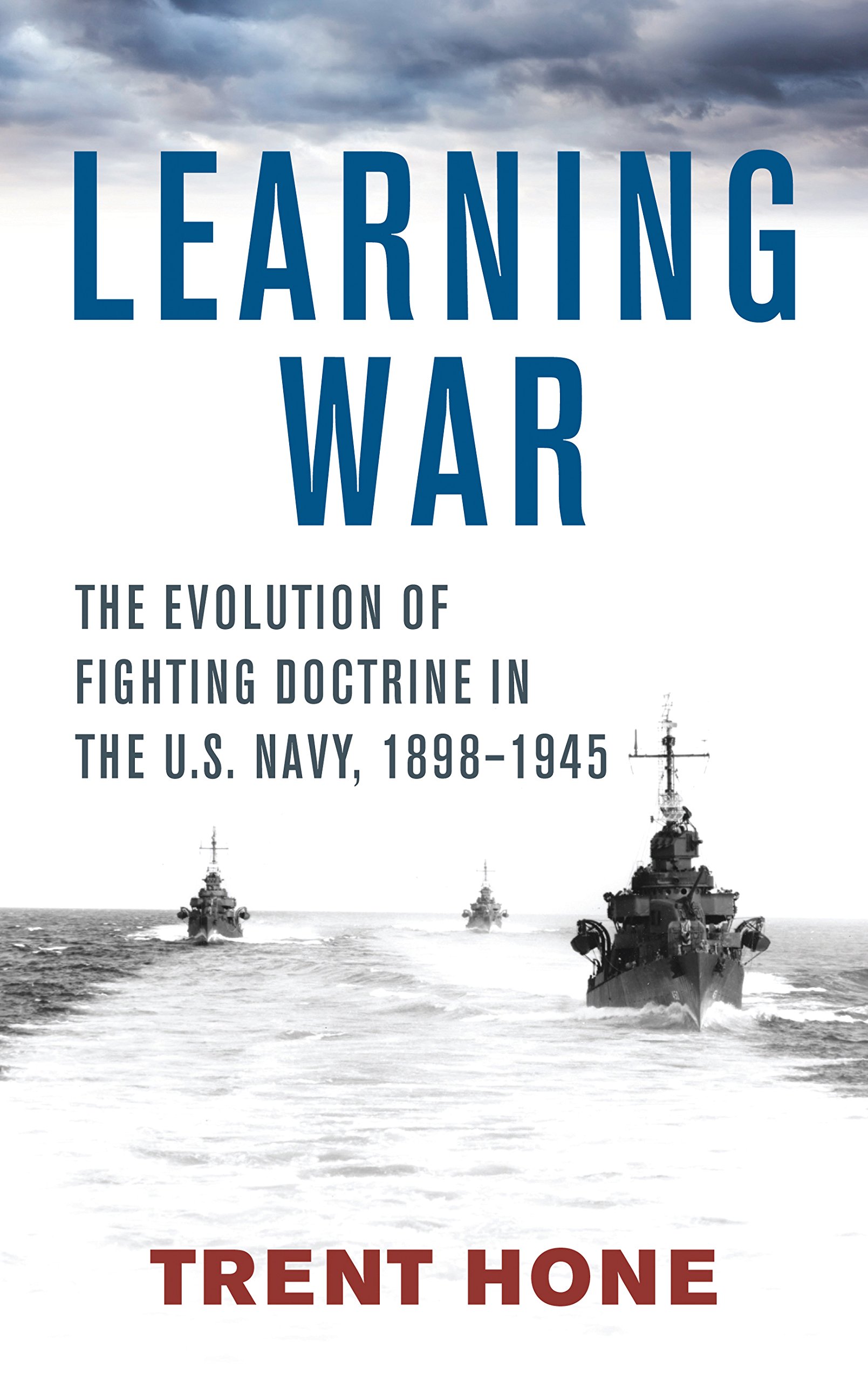
Learning War: The Evolution of Fighting Doctrine in the U.S. Navy, 1898-1945 (Studies in Naval History and Sea Power)
$28.62
by Trent Hone



Selected for the CNO's Reading List Learning War examines the U.S. Navy's doctrinal development from 1898–1945 and explains why the Navy in that era was so successful as an organization at fostering innovation. A revolutionary study of one of history‘s greatest success stories, this book draws profoundly important conclusions that give new insight, not only into how the Navy succeeded in becoming the best naval force in the world, but also into how modern organizations can exploit today‘s rapid technological and social changes in their pursuit of success. Trent Hone argues that the Navy created a sophisticated learning system in the early years of the twentieth century that led to repeated innovations in the development of surface warfare tactics and doctrine. The conditions that allowed these innovations to emerge are analyzed through a consideration of the Navy as a complex adaptive system. Learning War is the first major work to apply this complex learning approach to military history. This approach permits a richer understanding of the mechanisms that enable human organizations to evolve, innovate, and learn, and it offers new insights into the history of the United States Navy. 2020 Marine Commandant’s Reading List “Hone tells the story of the 1942-43 Guadalcanal campaign particularly well…. The most intriguing chapter is Hone’s study of a critical but largely unrecognized reorganization that transformed Navy operations beginning in late 1942.” — The New York Times “ Learning War represents one of the most profound contributions to the discussion of high-velocity learning in a naval setting in print. Few historians have captured the past in a way that raises so many ideas and challenges for the present. As a result, no serious consideration of the U.S. Navy in World War II will be complete without reference to this volume. Quite simply, if you are a serving officer and propose to read even one work of naval history ... this book should be the one.” — Naval War College Review "The book flows smoothly." — Manhattan Book Review “Trent Hone’s Learning War is not only an assessment of the time of Evolution of Fighting Doctrine in the U.S, Navy between 1898 —1945, but also a good source for Relearning the ways of fighting naval wars in the 21th century.” — Deutsches Maritimes Kompetenz Netz “ Learning War is a valuable addition to the naval literature of World War II, especially as it provides additional scholarship in the area of surface warfare. Trent Hone deftly blends a traditional historical narrative with a study of doctrinal development as seen through the lens of modern complexity theory. This work will be of interest to naval historians, naval professionals, and anyone with an interest in organizational development and innovation.” — Cercles “The work is a welcome addition to the research on U.S. Navy history and is highly recommended.” — Militärgeschichtlichen Zeitschrift “ Learning War is a complex book full of detailed technical naval information, military jargon, and acronyms. Yet, it offers a unique and important window on naval history…. An excellent choice particularly for former naval officers, and a conduit for insight into the complexity of naval warfare for officers of sister services.” — The Northern Mariner/Le marin du nord “A good read … [and] a technical journey into complexity science!” — The NAVY Magazine “ Learning War explains the US Navy’s development of doctrine from 1898 to 1945, and reveals how the Navy embraced innovation, eschewing the dreadnoughts and big guns that had lulled senior naval professionals and an isolationist nation into complacency. Hone describes how the Navy created a sophisticated learning system that revolutionized warfare tactics and doctrine. The emergence of new ship types—destroyers, aircraft carries, and submarines—along with dynamic technological changes—radar, radio, and analog fire-control computers—and new officer education and organizational structure permitted the navy to learn, innovate, and evolve, which enabled incredible and rapid structural change after the disaster of December 7, 1941. Through repeated and regular cycles of learning, the Navy embraced rapid evolution, and after Pearl Harbor, it quickly changed from a centralized battleship fleet to a collection of mutually supporting carrier task forces. In doing so, by the end of World War II the US Navy had grown from a second-tier force to the most advanced and strongest naval force in the world. Yet, Hone contends, that change embodied more than size; it occurred because of the Navy’s ability to learn and innovate.” — CHOICE “This book can be read both as naval history and as a case study of how organizations reinvent themselves and then put in place the structure that allows them to continue evolving so they can stay at the top of their field…. I highly recommend Learning War to anyone interested in the United States Navy as an institution an