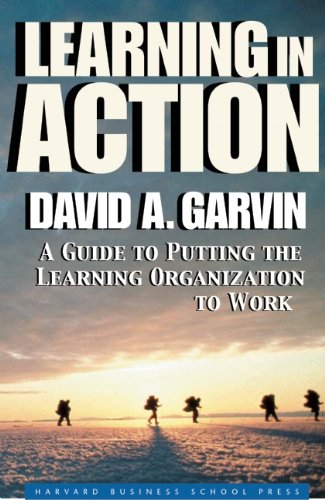
Learning in Action: A Guide to Putting the Learning Organization to Work
$11.02
by David A. Garvin



Most managers today understand the value of building a learning organization. Their goal is to leverage knowledge and make it a key corporate asset, yet they remain uncertain about how best to get started. What they lack are guidelines and tools that transform abstract theorythe learning organization as an idealinto hands-on implementation. For the first time in Learning in Action , David Garvin helps managers make the leap from theory to proven practice. Garvin argues that at the heart of organizational learning lies a set of processes that can be designed, deployed, and led. He starts by describing the basic steps in every learning processacquiring, interpreting, and applying knowledgethen examines the critical challenges facing managers at each of these stages and the various ways the challenges can be met. Drawing on decades of scholarship and a wealth of examples from a wide range of fields, Garvin next introduces three modes of learningintelligence gathering, experience, and experimentationand shows how each mode is most effectively deployed. These approaches are brought to life in complete, richly detailed case studies of learning in action at organizations such as Xerox, L. L. Bean, the U. S. Army, and GE. The book concludes with a discussion of the leadership role that senior executives must play to make learning a day-to-day reality in their organizations. Today's business leaders must always know what their stakeholders are thinking--be they customers, employees, constituents, or competitors--and act upon that information in a timely and appropriate manner. How companies collect, decipher, and utilize this knowledge, in fact, may be the real determinant of their long-term viability. Harvard Business School professor David A. Garvin's Learning in Action authoritatively dissects these activities as practiced by so-called learning organizations, then clearly outlines the steps necessary to build one of them. "Sweeping metaphors and grand themes are far less helpful than the knowledge of how individuals and organizations learn on a daily basis," Garvin writes. "The key to success is mastery of the details, coupled with a command of the levers that shape behavior." His book's core offers a practical examination of the three primary routes to corporate learning: collecting intelligence from outside sources (via interview and observation, for example); accumulating data through targeted actions (such as postproject reviews and special programs); and experimenting with alternative outcomes by manipulating variables (including prototype creation and exploratory design testing). Combining research from myriad fields, detailed studies of successful models such as Xerox and the U.S. Army, and snapshots of specific practices at additional firms such as Intel and Wal-Mart, he succeeds in providing "a broad, integrated view of the topic that is grounded in scholarship." --Howard Rothman "Garvin gives managers a rich set of action-oriented tools and procedures. This is a very helpful guide for translating the learning organization into action." -Thomas Schmidheiny, Chairman and CEO, Holderbank Financire Glaris, Ltd. "Garvin has crafted the book on learning how to learn. It's full of smart research insights and superb practical wisdom. The experimentation chapter alone is worth the price." -Kathleen M. Eisenhardt, Coauthor of Competing on the Edge and Professor of Strategy and Organization at Stanford University "Garvin has done managers and scholars a great service by drawing upon a wealth of perspectives on learning, placing them in a coherent framework, and bringing the framework to life through an array of engaging, practical examples. If you are interested in how organizations can improve in the knowledge game, you mustn't miss Learning in Action. " -Donald Hambrick, Samuel Bronfman Professor of Democratic Business Enterprise, Columbia Business School "One of the characteristics of today's successful organization is its ability to improve performance by learning on a continuing basis. Learning in Action provides an in-depth discussion of not only the types of learning necessary for success, but also the techniques for leading this process. An excellent addition to the modern manager's library." -Doug Ford, Chief Executive, Refining and Marketing, BP Amoco PLC "Garvin's new book is a tremendous achievement. The wealth of examples on how organizations and individuals can learn more effectively is truly impressive. Learning in Action will be very useful for both managers and general readers." -Michael A. Cusumano, Sloan Management Review Distinguished Professor at the MIT Sloan School of Management and Coauthor of Competing on Internet Time and Microsoft Secrets "Garvin combines a comprehensive intellectual perspective with rich data to produce a compelling case for organizational learning. Learning in Action, generous in spirit and positive in outlook, is an exciting, action-oriented guide