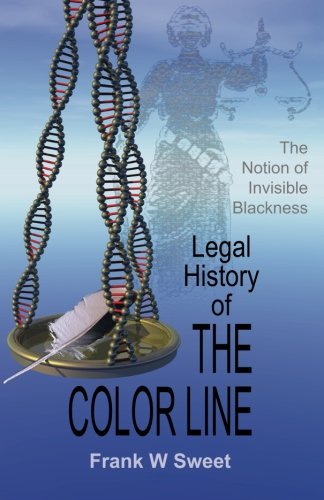
Legal History of the Color Line: The Rise and Triumph of the One-Drop Rule
$36.95
by Frank W Sweet



Every Year, 35,000 Black-Born Youngsters Redefine Themselves as White. About 1/3 of "White" Americans have detectable African DNA. Genealogists were the first to learn that America's color line leaks. Black researchers often find White ancestry. White genealogists routinely uncover Black ancestry. Molecular anthropologists now confirm Afro-European mixing in our DNA. The plain fact is that few Americans can truly say that they are genetically unmixed. Yet liberals and conservatives alike agree that so-called Whites and Blacks are distinct political "races." When did ideology triumph over reality? How did America paint itself into such a strange corner? Americans changed their concept of "race" many times. Eston Hemings, Jefferson's son, was socially accepted as a White Virginian because he looked European. Biracial planters in antebellum South Carolina assimilated into White society because they were rich. Intermarried couples were acquitted despite the laws because some courts ruled that anyone one with less than one-fourth African ancestry was White, while others ruled that Italians were Colored. Dozens of nineteenth-century American families struggled to come to grips with notions of "racial" identity as the color line shifted and hardened into its present form. This 542-page book tells their stories in the light of genetic admixture studies and in the records of every appealed court case since 1780 that decided which side of the color line someone was on. Its index lists dozens of 19th-century surnames. It shows that: The color line was invented in 1691 to prevent servile insurrection. The one-drop rule was invented in the North during the Nat Turner panic. It was resisted by Louisiana Creoles, Florida Hispanics, and the maroon (triracial) communities of the Southeast. It triumphed during Jim Crow as a means of keeping Whites in line by banishing to Blackness any White family who dared to establish friendly relations with a Black family. This analysis of the nearly 300 appealed court cases that determined Americans' "racial" identity may be the most thorough study of the legal history of the U.S. color line yet published. Used Book in Good Condition