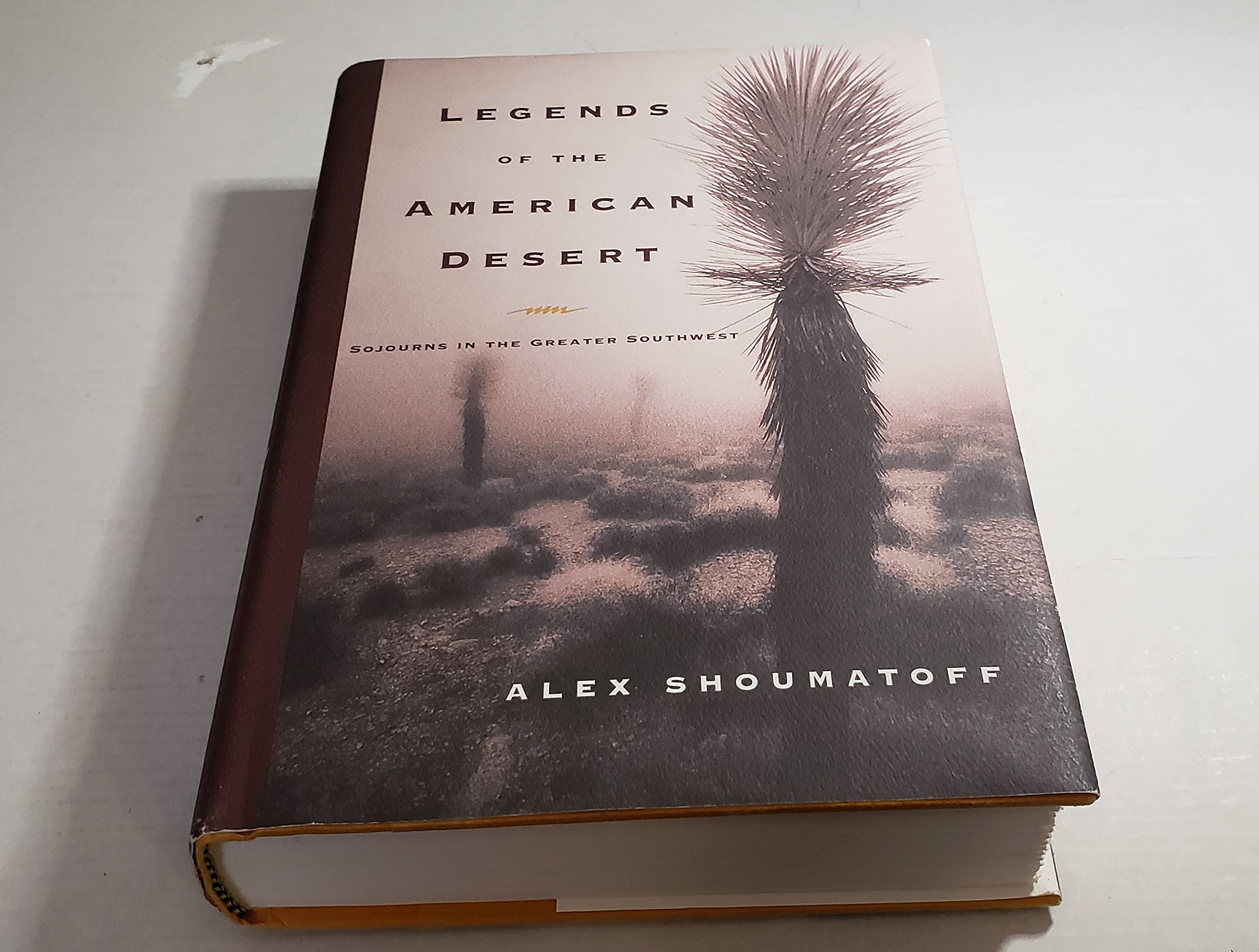
Legends of the American Desert: Sojourns in the Greater Southwest
$17.00
by Alex Shoumatoff



For his brilliant reportage ranging from the forested recesses of the Amazon to the manicured lawns of Westchester County, New York, Alex Shoumatoff has won acclaim as one of our most perceptive guides to the oddest corners of the earth. Now, with this book, he takes us on a kaleidoscopic journey into the most complex and myth-laden region of the American landscape and imagination. In this amazing narrative, Shoumatoff records his quest to capture the vast multiplicity of the American Southwest. Beginning with his first trip after college across the desert in a station wagon, some twenty-five years ago, he surveys the boundless variety of people and experiences constituting the place--the idea--that has become America's symbol and last redoubt of the "Other. From the Biosphere to the Mormons, from the deadly world of narcotraffickers to the secret lives of the covertly Jewish conversos, Shoumatoff explores the many alternative states of being who have staked their claim in the Southwest, making it a haven for every brand of refugee, fugitive, and utopian. And as he ventures across time and space, blending many genres--history, anthropology, natural science, to name only a few--he brings us a wealth of information on chile addiction, the diffusion of horses, the formation of the deserts and mountain ranges, the struggles of the Navajo to preserve their culture, and countless other aspects of this place we think we know. Full of profound sympathy and unique insights, Legends of the American Desert is a superbly rich epic of fact and reflection destined to take its place among such classics of regional portraiture as Ian Frazier's Great Plains. Alex Shoumatoff has created an exuberant celebration of a singularly American reality. Shoumatoff (The World Is Burning, LJ 8/90) has a great deal of fine writing to his credit, so it's a disappointment to find his latest?and longest?effort to be such a scattered, uneven work. His work misleads with its title and confuses as Shoumatoff changes roles?from raconteur to scholar to "hip" journalist. The book is divided into three loosely themed parts, beginning with water (or the lack of it) in the Southwest and ending with the author's acknowledgment of his self-serving attachment to Native American causes. In between, the subjects Shoumatoff covers range from the travels of Cabeza de Vaca to contemporary society in Los Alamos, New Mexico. Shoumatoff provides an explanation for the book's lack of cohesion in his acknowledgments (he's worked with eight different editors and three publishers since beginning the work in 1985). This title is easily enjoyed in bits and pieces but not as a whole. Recommended for larger public libraries.?Janet N. Ross, Sparks Branch Lib., Nev. Copyright 1997 Reed Business Information, Inc. Shoumatoff has accrued a considerable reputation for varied and perceptive travel writing, and his latest book will not disappoint his avid fans. His focus now is on the American Southwest, where "everything comes down to the dryness." Through the many but fast-moving pages, the author immerses his fortunate readers in "hydrohistory," which charts the evolution of the southwestern environment, a place where water is at a premium, from prehistory to just yesterday. Shoumatoff focuses on past and present conditions of human, animal, and plant habitation--all in the face of the need to adapt to the scarcity of water. Elevating his account to superior travel writing, Shoumatoff smoothly blends geology, geography, history, economics, and even paleontology into a complete course in the American desert's story from the time of immigrant Native Americans coming over from Asia on the frozen Bering Sea to the kingdom of the cowboys in the nineteenth century to today's influx of retirees. Much richness to be mined here. Brad Hooper A masterfully written study of a region that is at once familiar and utterly foreign, by a journalist who has written for the New Yorker, Vanity Fair, and other magazines. Little eludes the grasp of Shoumatoff (The World Is Burning, 1990, etc.) in this roughly chronological account of the Southwest's earliest peoples, its conquest and settlement by Spain, its later flood of Anglo immigrants and its most recent incarnation as a region of water-guzzling ``urban oases.'' While the history has already been told (and Shoumatoff acknowledges as much), the author here puts it into a highly vibrant context as he crisscrosses the land, pursuing its ancient and more modern history. Shoumatoff travels to the remotest precincts of northern Mexico's Sierra Madre, whose spectacular silver-veined canyons are now ruled by violent drug lords who have routinely murdered scores of uncooperative Tarahumara Indians. He jourrneys to the ruins of one of the supposed Seven Cities of Cibola in New Mexico, where the Zuni people, who wiped out a Spanish expedition over four centuries ago, still reside. With the mother of Navajo and former marine Clayt