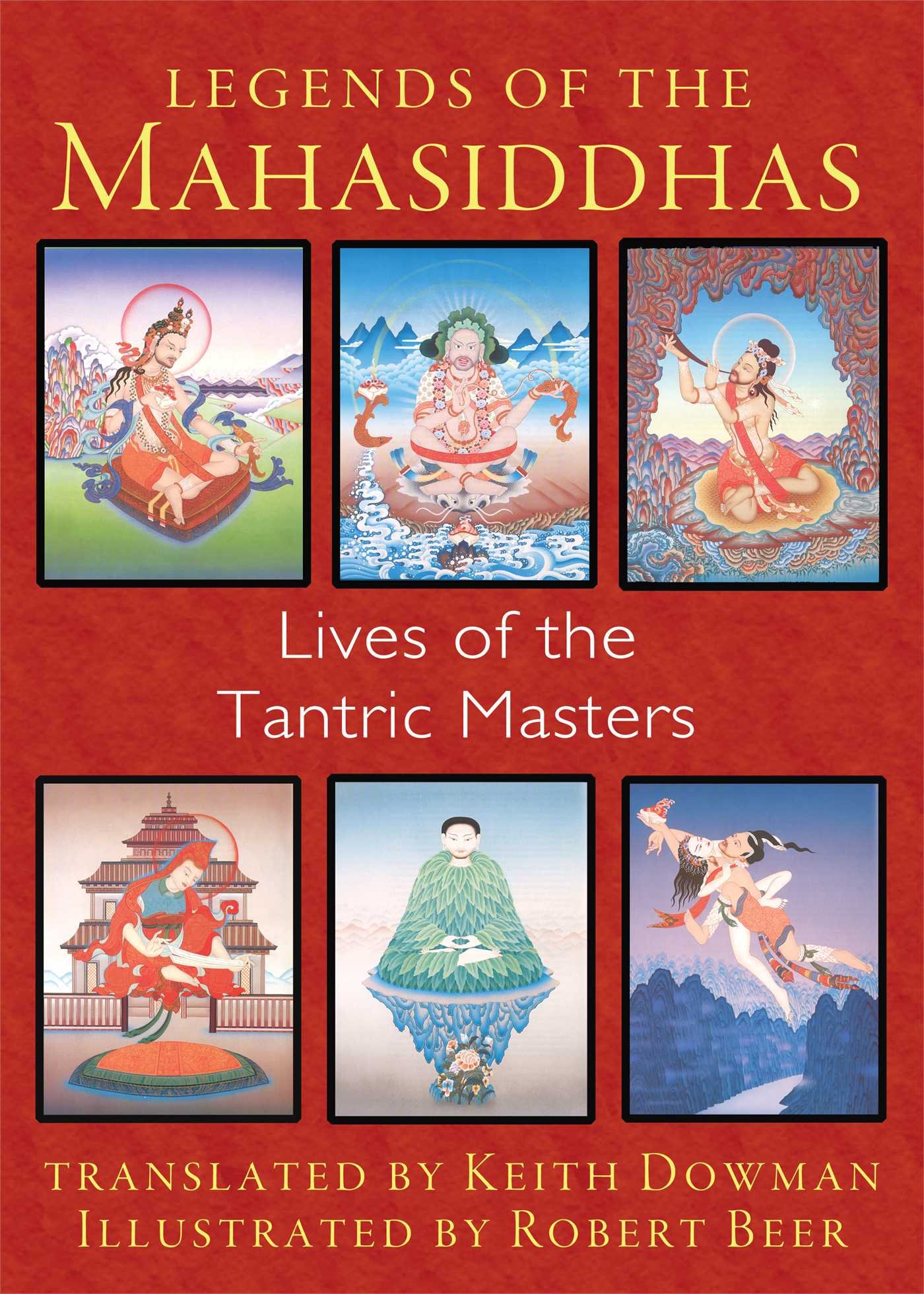



A richly illustrated collection of stories about the mahasiddhas, spiritual adventurers who attained enlightenment and magical powers by disregarding convention • A modern translation of ancient legends that reveals the human qualities of the rebellious saints known as siddhas and the vital elements of their philosophy • Recounts stories of enlightened masters from all walks of life, including a washerman, a thief, a conman, a gambler, and a whore, and the magical and “crazy” deeds of each, such as walking through walls, flying, talking with birds, and turning people to stone • Richly illustrated with paintings of the tantric saints by artist Robert Beer Offering a modern translation of “The Legends of the Eighty-four Mahasiddhas,” a 12th-century Tibetan text, translator Keith Dowman shares stories of the spiritual adventurers, rebellious saints, and enlightened tantric masters of ancient India known as “siddhas.” He shows how the mahasiddhas arose from the grassroots of society and represented an entire spectrum of human experience. Counted among the greatest of the siddhas are a washerman, a cowboy, a thief, a conman, a gambler, and a whore, all extraordinary men and women who attained the goal of their meditations, as well as enlightenment and magical powers, by disregarding convention and penetrating to the core of life. Recounting the magical and “crazy” deeds of the mahasiddhas, such as walking through walls, flying, talking with birds, and turning people to stone, Dowman reveals the human qualities of the tantric masters and the vital elements of the siddhas’ philosophy of nonduality and emptiness. Richly illustrated with paintings of the tantric saints by artist Robert Beer, these stories of the mahasiddhas show us a way through human suffering into a spontaneous and free state of oneness with the divine. “Robert Beer is a master. His own story of being rescued by Tibetan art is almost as amazing as the stories of the Mahasiddhas.” ― Frank Olinsky, Tricycle Magazine “A powerful enticement to Eastern thought.” ― Mensa Bulletin "These are extraordinary, riveting tales. . . a book of high merit and high adventure, a marvel of inspired creation. . . stories through whose cosmic transparency shines the illimitable Buddha-nature." ― Small Press Keith Dowman is a longtime initiate of Dzogchen and a teacher of radical Dzogchen around the world. He is the author of several Dzogchen translations, most recently Natural Perfection and Dzogchen . He lives in Kathmandu. Robert Beer began studying and practicing Tibetan thangka painting in 1970 while living in India and Nepal and still continues this research from his home in Oxford. He is the author and illustrator of The Encyclopedia of Tibetan Symbols and Motifs and The Handbook of Tibetan Buddhist Symbols . THAGANAPA Master of the Lie To release water in the ear, Inject water into the ear. To see truth, Contemplate all phenomena as a lie. Thaganapa was born into a low-caste family in eastern India. Early on, he showed criminal tendencies, and in time his entire life and livelihood came to depend upon exploitation and deception. One day, he was sitting on a log at the edge of a town plotting a beautiful con job, when a wise monk chanced to pass by. “Why are you so deep in thought, my friend?” asked the monk. “It’s a long story, venerable sir,” Thaganapa began. But the monk interrupted. “You’re about to tell me a lie, aren’t you? Haven’t you learned that the more you lie, the more you believe lying is normal, and the more your habit of lying will be strengthened. If you continue on this way, when your karma matures, you will be reborn in hell. Thaganapa turned pale and began to tremble. “Lying has physical effects as well, you know,” the monk went on. “Your tongue gets furrowed, your breath stinks, and your speech becomes ineffectual and unconvincing. A liar’s karma makes all fields infertile and the seeds you sow dry and impotent.” Thaganapa had not heard the doctrine of karma applied to lying before, and the monk’s apt analysis hit home. “You’ve seen right through me,” he admitted. “They call me Thaganapa because I cannot speak so much as a hundredth part of a hairsbreadth of truth. I lie to everybody--no exception. But what can I do about it?” “Do you think you’re capable of practicing a sadhana?” asked the monk. “Well, I suppose I could try,” said Thaganapa doubtfully. “But I’ve been lying for so long I don’t know if I can stop.” “You’re not the only liar since time began,” said the monk kindly. “There are precepts even for those such as you.” “All right then,” said Thaganapa, relieved. “Go ahead.” The monk began to give Thaganapa instruction in the yoga called “removing water in the ear by means of water”--a meditation that uses deception as an antidote to deception. Next, he gave him the initiation that matures the immature mindstream. And then the monk taught him these precepts: “All that you see, hear, touch, thi