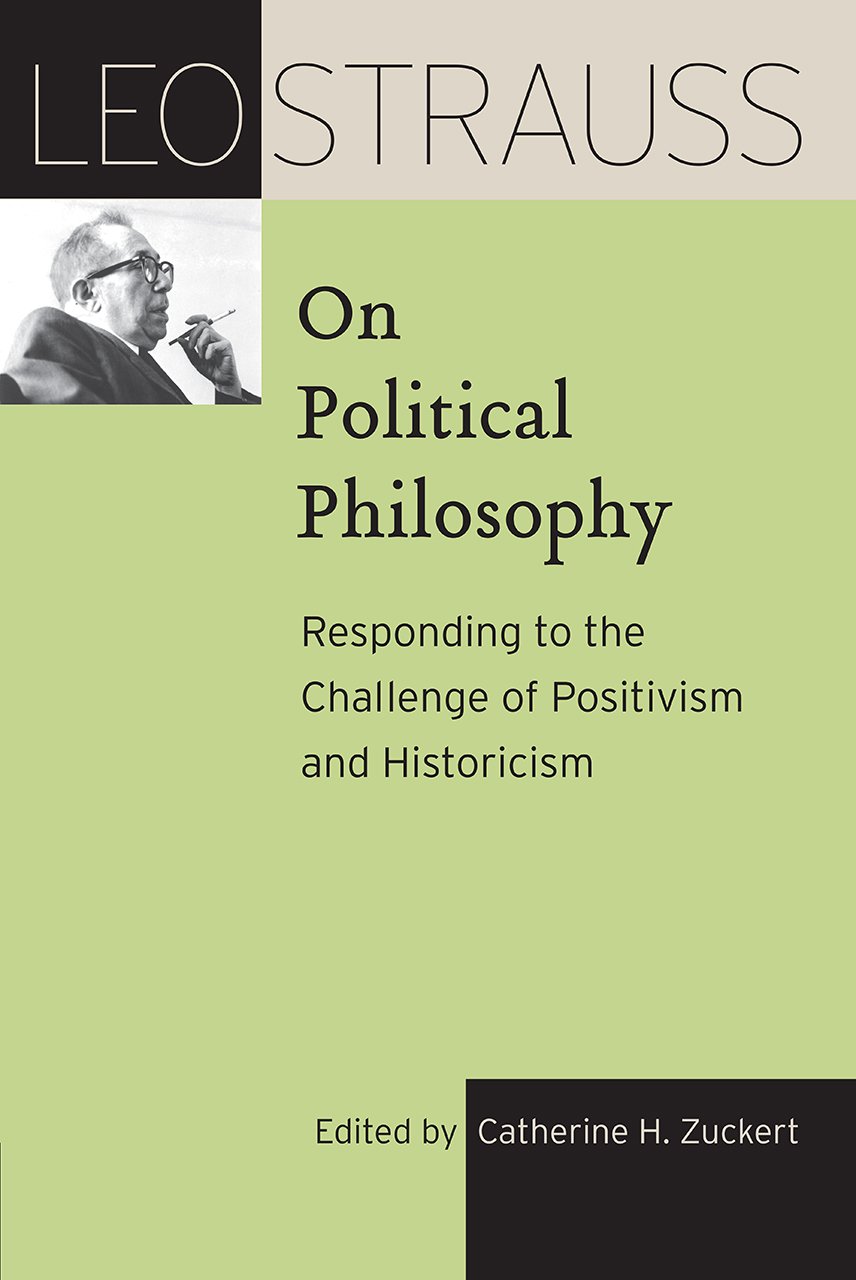
Leo Strauss on Political Philosophy: Responding to the Challenge of Positivism and Historicism (The Leo Strauss Transcript Series)
$48.00
by Leo Strauss



Leo Strauss is known primarily for reviving classical political philosophy through careful analyses of works by ancient thinkers. As with his published writings, Strauss’s seminars devoted to specific philosophers were notoriously dense, accessible only to graduate students and scholars with a good command of the subject. In 1965, however, Strauss offered an introductory course on political philosophy at the University of Chicago. Using a conversational style, he sought to make political philosophy, as well as his own ideas and methods, understandable to those with little background on the subject. Leo Strauss on Political Philosophy brings together the lectures that comprise Strauss’s “Introduction to Political Philosophy.” Strauss begins by emphasizing the importance of political philosophy in determining the common good of society and critically examining the two most powerful contemporary challenges to the possibility of using political theory to learn about and develop the best political order: positivism and historicism. In seeking the common good, classical political philosophers like Plato and Aristotle did not distinguish between political philosophy and political science. Today, however, political philosophy must contend with the contemporary belief that it is impossible to know what the good society really is. Strauss emphasizes the need to study the history of political philosophy to see whether the changes in the understanding of nature and conceptions of justice that gradually led people to believe that it is not possible to determine what the best political society is are either necessary or valid. In doing so, he ranges across the entire history of political philosophy, providing a valuable, thematically coherent foundation, including explications of many canonical thinkers, such as Auguste Comte and Immanuel Kant, about whom Strauss did not write extensively in his published writings. "Essential. Upper-division undergraduates through faculty." ― Choice Leo Strauss (1899–1973) was one of the preeminent political philosophers of the twentieth century. He is the author of many books, among them The Political Philosophy of Hobbes , Natural Right and History , and Spinoza’s Critique of Religion , all published by the University of Chicago Press. Catherine H. Zuckert is the Nancy R. Dreux Professor of Political Science Emeritus at the University of Notre Dame and the author or coauthor of many books, including, most recently, Machiavelli’s Politics . Leo Strauss on Political Philosophy Responding to the Challenge of Positivism and Historicism By Catherine H. Zuckert The University of Chicago Press Copyright © 2018 The University of Chicago All rights reserved. ISBN: 978-0-226-56682-5 Contents Note on the Leo Strauss Transcript Project, Editor's Introduction: Strauss's Introduction to Political, Philosophy, Editorial Headnote, I The Obstacles to the Study of Political Philosophy Today, A. POSITIVISM, 1 Comte as the Founder of Positivism: The Three Stages of the History of Mankind, 2 Comte's Positive Political Philosophy, 3 Positivism after Comte: Simmel, 4 Value-Free Social Science: Weber, 5 Strauss's Responses to Contemporary Defenses of the Fact-Value Distinction, B. HISTORICISM, 6 Historicism as the More Serious Challenge to Political Philosophy, 7 R. G. Collingwood as an Example, II Why Studying the History of Political Philosophy Is Necessary Today, 8 On the Difference between the Ancients and the Moderns, III The Origins of Political Philosophy, 9 Physis and Nomos, Notes, Index, CHAPTER 1 Comte as the Founder of Positivism The Three Stages of the History of Mankind LEO STRAUSS: [In progress] Political action is founded upon knowledge. Therefore, all political action points to knowledge of the politically good or bad. The complete political good, we call the good society. In every political action there is implied a reference to the good society. All politically acting men are concerned with that; whether they call it the good society or call it by another name is a secondary question. There are people who would deny that there is anything to be called the common good, which is another way of speaking of the good society, but these same people speak of the "open society," by which they mean the good society. President Johnson likes to speak of the Great Society, which is in its wording somewhat different from the good society. But I think President Johnson means by "the Great Society" the good society. Why he and other contemporaries prefer to speak of the Great Society rather than of the good society is an interesting question, but one which doesn't have to concern us here now. Now if this is so, if all concern with political things, all political action, points towards the question of the good society, and the good society is the theme of political philosophy, one seemingly paradoxical consequence follows: that