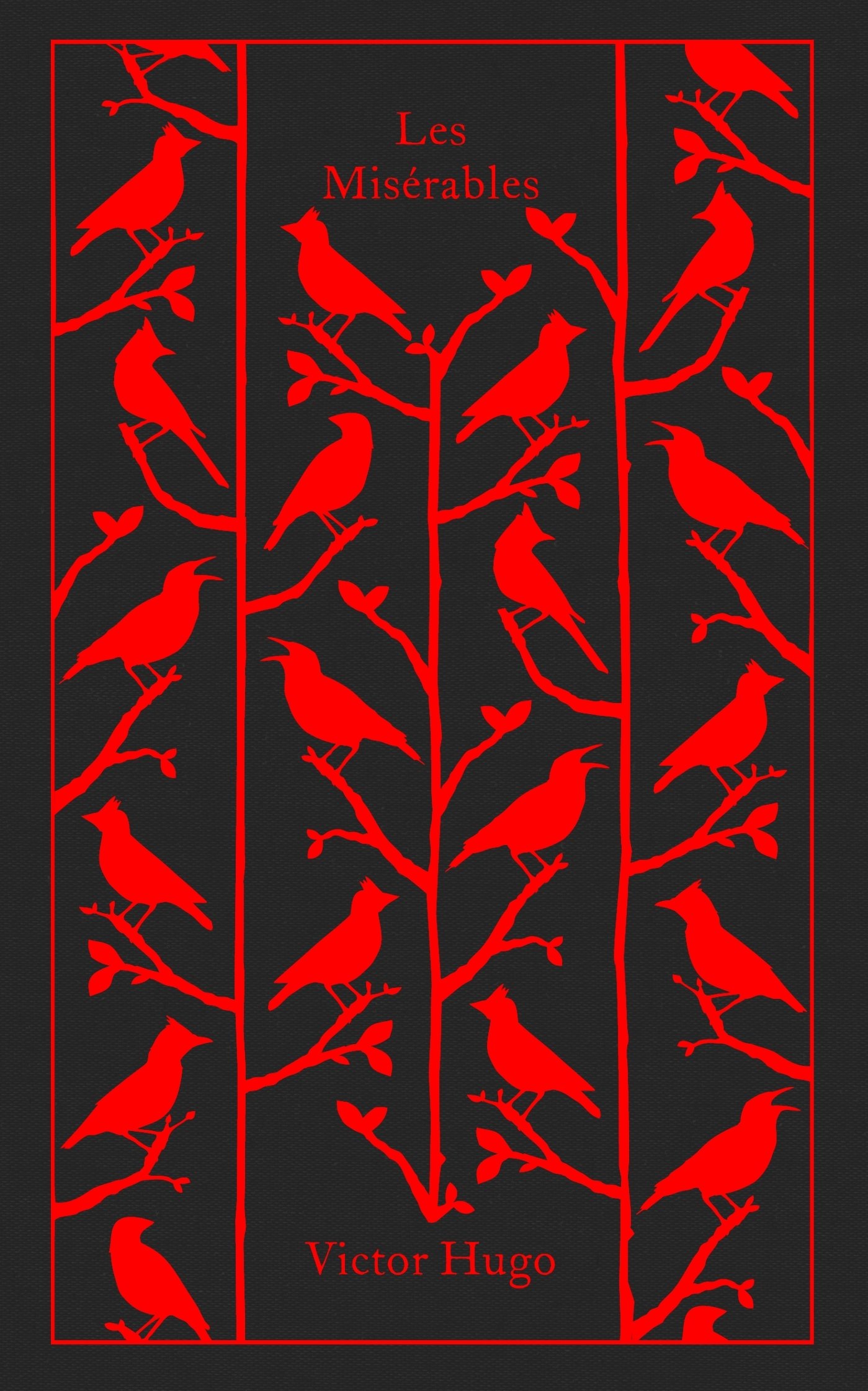



Now a major musical film from Oscar-winning director Tom Hooper (The King's Speech), starring Hugh Jackman, Russell Crowe and Anne Hathaway, and also featuring Amanda Seyfreid, Helena Bonham-Carter and Sacha Baron-Cohen, Victor Hugo's Les Misérables is one of the great works of western literature. Victor Hugo's tale of injustice, heroism and love follows the fortunes of Jean Valjean (Hugh Jackman), an escaped convict determined to put his criminal past behind him. But his attempts to become a respected member of the community are constantly put under threat: by his own conscience, when, owing to a case of mistaken identity, another man is arrested in his place; and by the relentless investigations of the dogged Inspector Javert (Russell Crowe). It is not simply for himself that Valjean must stay free, however, for he has sworn to protect the baby daughter of Fantine (Anne Hathaway), driven to prostitution by poverty. Victor Hugo (1802-85) wrote volumes of criticism, Romantic costume dramas, satirical verse and political journalism but is best remembered for his novels, especially Notre-Dame de Paris (1831), also known as The Hunchback of Notre-Dame and Les Misérables (1862) which was adapted into one of the most successful musicals of all time. 'All human life is here' Cameron Mackintosh, producer of the musical Les Misérables 'One of the half-dozen greatest novels of the world' Upton Sinclair 'A great writer - inventive, witty, sly, innovatory' A. S. Byatt, author of Possession "Hugo's genius was for the creation of simple and recognizable myth. The huge success of Les Misérables as a didactic work on behalf of the poor and oppressed is due to his poetic and myth-enlarged view of human nature." —V. S. Pritchett "It was Tolstoy who vindicated [Hugo's] early ambition by judging Les Misérables one of the world's great novels, if not the greatest… [His] ability to present the extremes of experience 'as they are' is, in the end, Hugo's great gift." —From the Introduction by Peter Washington Victor Hugo (1802-85) was the most forceful, prolific and versatile of French nineteenth-century writers. He wrote Romantic costume dramas, many volumes of lyrical and satirical verse, political and other journalism, criticism and several novels, the best known of which are Les Misérables (1862) and the youthful Notre-Dame de Paris (1831). A royalist and conservative as a young man, Hugo later became a committed social democrat and during the Second Empire of Napoleon III was exiled from France, living in the Channel Islands. He returned to Paris in 1870 and remained a great public figure until his death: his body lay in state under the Arc de Triomphe before being buried in the Panthéon. From the Introduction by Peter Washington- Victor Hugo might be regarded as the Mr Toad of French literature: vain, arrogrant, pompous, selfish, cold and stingy; a windbag, a humbug and a fraud, absurdly puffed up with the immensity of his own greatness. But unlike Mr Toad, he was also an astute and energetic promoter of hisown image as a Great Man. The process began early. Writing in Hugo's lifetime, Virginie Ancelot recalls the reception the young poet received in literary drawing-rooms when he arrived to read his latest ode. "...There was a few moments' silence; then someone rose and approached him with visible emotion, took his hand and raised their eyes to heaven.The multitude listened. A single word was heard, to the great surprise of the uninitiated. And this word, which echoed in every corner of the salon, was:'Cathedral!'Then the orator returned to his place; another rose and cried out: 'Ogive!'A third looked round him and ventured:'Egyptian Pyramid!'The assembly applauded, and then it was lost in profound reflection." To the Anglo-Saxon mind - and, it should be said, to many Frenchmen - this is Parisian literary life at its worst: the posturing, the pretension, the self-regard, masquerading under the name of art. Yet Hugo is the man who wrote a handful of the most exquisite lyrics - 'Victor Hugo, helas!'said Gide when someone asked him to name the finest French poet - and at least one novel judged to be supreme. In his person, he sums up all that is most monsterous in writerly vanity; in his best work he transcended his failings. How did he do it? How did a monster come to write the masterpiece that is Les Miserables? * In an early essay on Scott, Hugo prophesies that"After the picturesque but prosaic novel of Walter Scott, there will still be another novel to create ... It is the novel which is at once drama and epic, picturesque and poetic, real and ieal, true and great, the novel which will enshrine Walter Scott in Homer."These words were written in 1823, just after the publication of his own first novel, Han d'Islande, and there is no doubt that Hugo had himself in mind as the man who could 'enshrine Walter Scott as Homer'. Anyone who can still get through this book may take a rather different view. Set in seventeeth-cen