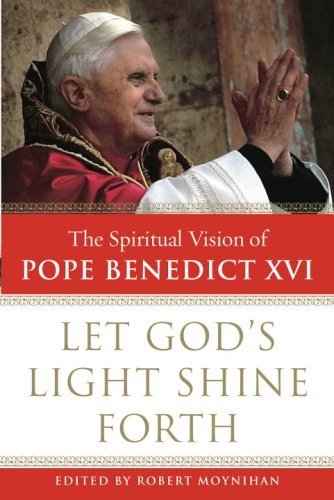
Let God's Light Shine Forth: The Spiritual Vision of Pope Benedict XVI
$16.96
by Robert Moynihan Ph.D



Though he was a familiar Church leader for many years before becoming pope, there has been little awareness of the spiritual side of Benedict XVI. Now for the first time readers are given a brilliant overview of the Pope’s most inspirational teachings in Let God’s Light Shine Forth . Editor Robert Moynihan offers a brief introduction to the life and work of Pope Benedict XVI and then presents an absorbing collection of his most persuasive words. Within these pages, Pope Benedict XVI introduces a God who is good, beautiful, and true, the fountain of all life. The most important thing for each person, in Benedict’s view, is to discover and develop a loving relationship with God, because this is the way to the deepest and most lasting happiness that human beings can experience. Even in our darkest moments, he teaches, we can have hope that all things will ultimately work out in a wonderful way to show God’s glory and bring blessedness to individual men and women. Many of these selections deal specifically with questions such as: Who is God? How we can know him? What does he wants us to do and to be? Having spent his entire life thinking, studying, and praying about such questions, Benedict has become perhaps the leading contemporary theologian (the word literally means “knower of God”) in the Roman Catholic Church. From his earliest work as a teacher to his first words as leader of the Catholic Church, Pope Benedict’s vision of hope is powerfully summarized in Let God’s Light Shine Forth . “In Let God’s Light Shine Forth , Robert Moynihan has made an intelligent selection from [Pope Benedict XVI’s works] . . . the extracts themselves provide a useful window into the characteristic preoccupations of a thinker now uniquely positioned to translate thought into policies that will affect the lives of hundreds of millions.” — The Washington Post “ Let God’s Light Shine Forth is a lovely book that serves two purposes. It is a fine introduction to the pope’s personal and professional life. And the selection of beautifully written (yet relatively short) excerpts from his writings can be fruitfully used for personal meditation and reflection.” — St. Louis Review From the Trade Paperback edition. DR. ROBERT MOYNIHAN is founder and editor of Inside the Vatican magazine, a monthly journal on Church and world affairs from Rome. He is regarded as one of the world’s leading Vatican analysts and has interviewed Pope Benedict XVI more than twenty times. He received his Ph.D. in medieval studies from Yale University and divides his time between Rome and Annapolis, Maryland. He is married and has two sons, Christopher, fifteen, and Luke, twelve, who are both excellent soccer players. CHRISTINA BADDE, who assisted on the book, is a German journalist in Rome who speaks three languages and covers Vatican affairs for numerous publications around the world. Part One THE MAN AND HIS LIFE Robert Moynihan “We are supposed to be the light of the world, and that means that we should allow the Lord to be seen through us. We do not wish to be seen ourselves, but wish for the Lord to be seen through us. It seems to me that this is the real meaning of the Gospel when it says ‘act in such a way that people who see you may see the work of God and praise God.’ Not that people may see the Christians but ‘by means of you, God.’Therefore, the person must not appear, but allow God to be seen through his person.” –Pope Benedict XVI, conversation with Robert Moynihan, February 23, 1993 “The Presence of God” On April 19, 2005, in Rome, Joseph Cardinal Ratzinger, at age 78, was chosen by the cardinals of the Roman Catholic Church to be the 265th successor of the apostle Peter, bishop of Rome and head of the universal Church. The world was genuinely astonished. Why? In large measure, because they were surprised that a group of cardinals representing places like Argentina, Nigeria, and India had not chosen a younger, more “progressive” cardinal from the Third World to “reform” and “modernize” traditional Christian doctrines and emphasize issues of social justice. Instead, they had chosen an elderly German cardinal, Joseph Ratzinger, who, over the previous quarter century as head of the Vatican’s chief doctrinal office (the Congregation for the Doctrine of the Faith), had earned a reputation for defending the traditional teachings of the Church and for emphasizing the priority of the “right worship” of God in any effort to build a just human society. How did this happen? Why did it happen? What does it mean? Over the past 30 years, not only the cardinals who elected Ratzinger as Pope, but many Catholics, and other men and women of good will around the world, have come to agree with Benedict that the greatest “crisis” facing the Church and the world is “the absence of God”–a culture and way of life without any transcendent dimension, without any orientation toward eternity, toward the sacred, toward the divine. And that the