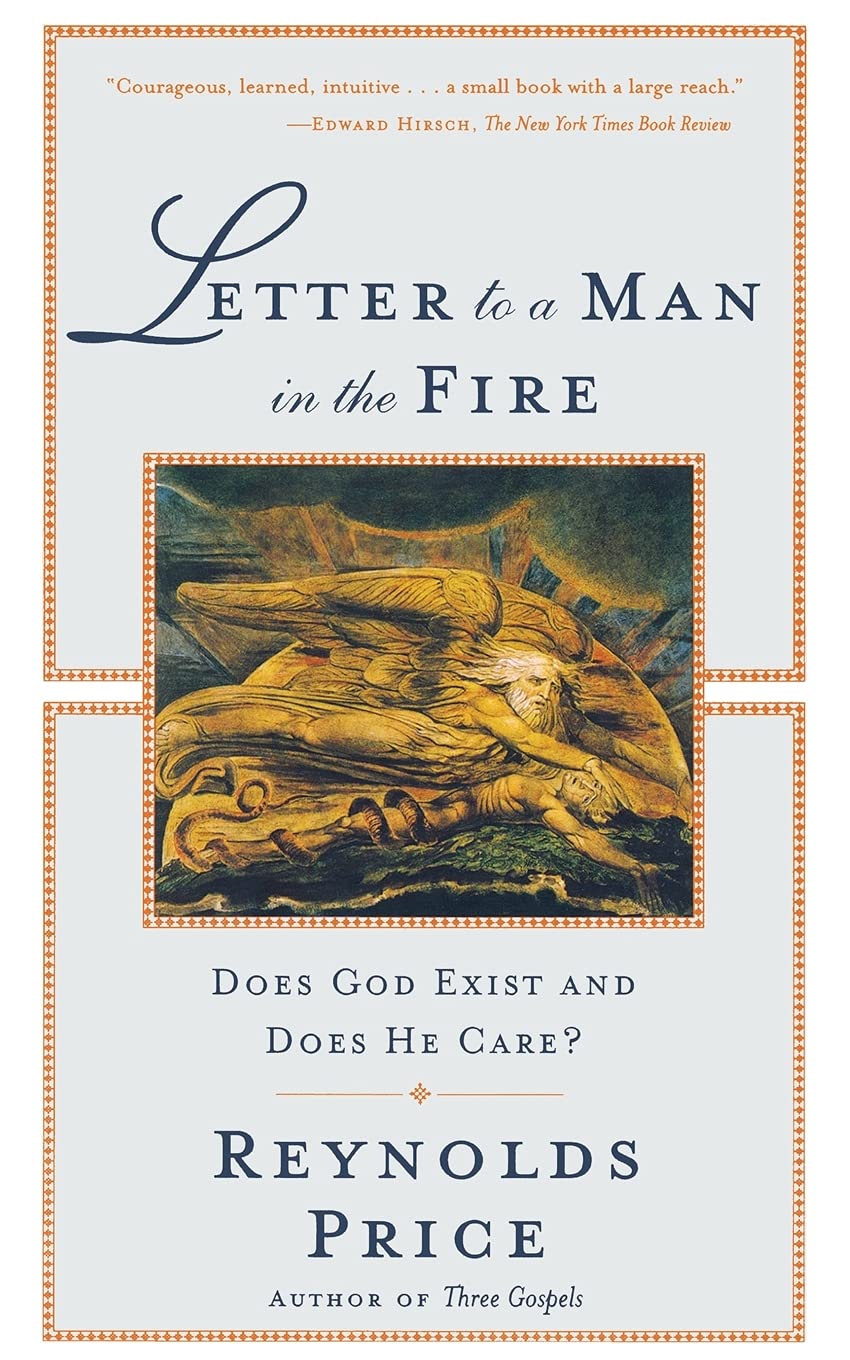



Does God Exist and Does He Care? In April 1997 Reynolds Price received an eloquent letter from a reader of his cancer memoir, A Whole New Life . The correspondent, a young medical student diagnosed with cancer himself and facing his own mortality, asked these difficultQuestions. The two began a long-distance correspondence, culminating in Price's thoughtful response, originally delivered as the Jack and Lewis Rudin Lecture at Auburn Theological Seminary, and now expanded onto the printed page as Letter to a Man in the Fire . Harvesting a variety of sources -- diverse religious traditions, classical and modern texts, and a lifetime of personal experiences, interactions, and spiritual encounters -- Price meditates on God's participation in our fate. With candor and sympathy, he offers the reader such a rich variety of tools to explore these questions as to place this work in the company of other great tetsaments of faith from St. Augustine to C. S. Lewis. Letter to a Man in the Fire moves as much as it educates. It is a rare combination of deep erudition, vivid prose, and profound humanity. Boston Sunday Globe Deeply thoughtful...Price's own faith underlies the whole argument, while his intelligence probes the sources of that belief....comforting and consoling. Craig Nova The Washington Post Book World What is inspiring about his book...is the dignity and honesty of Price's beliefs....The solace comes...in his sensibility, which is one of concern, empathy, and dignity....At once inspiring and profound. Edward Hirsch The New York Times Book Review Courageous, learned, intuitive...a small book with a large reach. In April 1997, Reynolds Price received an eloquent letter from a reader of his cancer memoir, A Whole New Life. The correspondent, a young medical student diagnosed with cancer himself and facing his own mortality, asked these difficult questions. The two began a long-distance correspondence, culminating in Price's thoughtful response, originally delivered as the Jack and Lewis Rudin Lecture at Auburn Theological Seminary, and now expanded onto the printed page as Letter to a Man in the Fire. Harvesting a variety of sources -- diverse religious traditions; classical and modern texts; and a lifetime of personal experiences, interactions, and spiritual encounters -- Price meditates on God's participation in our fate. With candor and sympathy, he offers the reader such a rich variety of tools to explore these questions as to place this work in the company of other great testaments of faith from St. Augustine to C. S. Lewis. Letter to a Man in the Fire moves as much as it educates. It is a rare combination of deep erudition, vivid prose, and profound humanity. Reynolds Price (1933–2011) was born in Macon, North Carolina. Educated at Duke University and, as a Rhodes Scholar, at Merton College, Oxford University, he taught at Duke beginning in 1958 and was the James B. Duke Professor of English at the time of his death. His first short stories, and many later ones, are published in his Collected Stories . A Long and Happy Life was published in 1962 and won the William Faulkner Award for a best first novel. Kate Vaiden was published in 1986 and won the National Book Critics Circle Award. The Good Priest's Son in 2005 was his fourteenth novel. Among his thirty-seven volumes are further collections of fiction, poetry, plays, essays, and translations. Price is a member of both the American Academy of Arts and Letters and the American Academy of Arts and Sciences, and his work has been translated into seventeen languages. Letter To A Man In The Fire Does God Exist And Does He Care By Reynolds Price Scribner Copyright © 2000 Reynolds Price All right reserved. ISBN: 0684856271 Preface One especially fine afternoon in April 1997, I received two letters, both unexpected and each with contents that complicated the pleasures of the day. The first I opened was from Auburn Theological Seminary in New York City. It invited me to give the Jack and Lewis Rudin Lecture at the Seminary sometime in the coming autumn. Their only specification was a lecture on a freely chosen subject of interest to the students of such an institution. Lately, obliged to concentrate, I've declined opportunities to speak in churches or other religious institutions of whatever creed; so I folded the letter from Auburn and thought I'd surely decline it. The second letter of that afternoon, however, was as compelling a communication as I've ever got. It was a blunt inquiry from a young man named Jim Fox -- a stranger to me -- who'd recently been forced to withdraw from medical school because of the recurrence in his body of an avid cancer. He had read a book of mine, A Whole New Life , published in 1994. It's a book that recounts my ordeal in the 1980s with spinal cancer. The young man's letter was of such a brief and un-self-pitying eloquence that -- despite my inadequacy in the face of its enormous