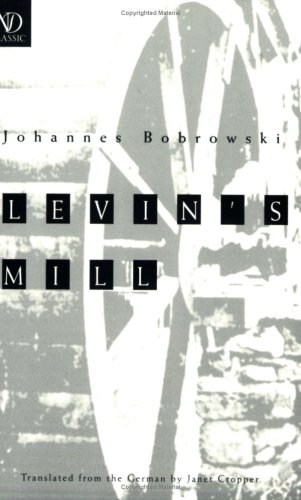



Johannes Bobrowski (1917-1965) is known as one of Germany’s greatest writers. His first novel, set in a West Prussian village in 1874, tells the story of the narrator’s grandfather, who plots and schemes to ruin the Jewish newcomer who has built a mill downstream from him. With splendid irony, Bobrowski describes the diverse characters of the Jews, Poles, Gypsies, and Germans who inhabit the village, and whose affairs mirror the larger history of Poland. As The Irish Times says, “Bobrowski has a marvelous ability to evoke the countryside and a vanished way of life… throughout the entire book there is a keen though understated element of humour, as well as a compelling, dream-like sense of fantasy.” The novel Levin's Mill is the story of an unscrupulous German mill owner's efforts to destroy a Jewish competitor. Its unusual narrative structure conflates past and present: Though set in the last century, it is told by a contemporary descendant of the German from a number of different and rapidly shifting viewpoints; the reader becomes a disconcerted party to the collective life of the village as well as the particular cares of its inhabitants. The book has a strange, persuasive impersonality (one that stands in exemplary contrast to the self-involved Method Acting of the typical modern American novel), a clearsightedness that excuses nothing. Like the wheels of the mill that give the novel its title, the characters are moved by forces, variously economic, ethnic, nationalistic, and religious, that they cannot comprehend -- or so it seems. The carefully inconclusive conclusion of the book makes us all the more painfully aware of what the outcome of that incomprehension would be. Copyright © 1996, Boston Review. All rights reserved. -- From The Boston Review Johannes Bobrowski tells the story of the narrator's grandfather, who plats and schemes to ruin the Jewish newcomer who has built a mill down-stream from him. With splendid irony, Bobrowski describes the diverse characters of the Jews, Poles, Gypsies, and Germans who inhabit the village, and whose affairs mirror the larger history of Poland. Used Book in Good Condition