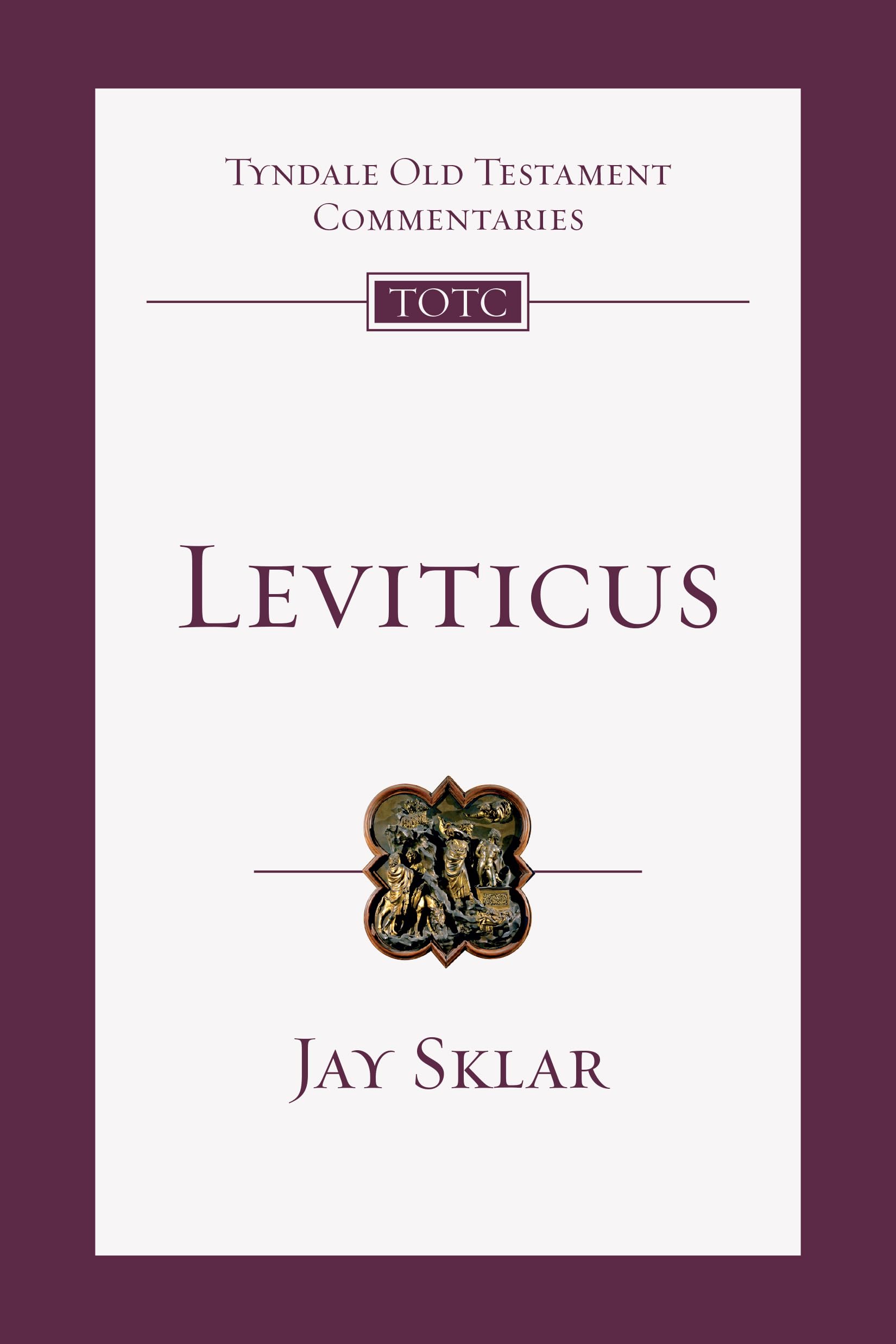



Preaching's Preacher's Guide to the Best Bible Reference for 2014 (Old Testament Commentaries). Levitical rules and regulations can at first appear irrelevant to contemporary Christians--but they provide important Old Testament background for understanding large portions of the New Testament. Leviticus describes a point in human history when God came and dwelt in the midst of the ancient Israelites and taught them what their purpose in life really was. Jay Sklar's commentary makes clear what it is that the Lord said to them and, in so doing, makes clear what he says to us today. "If you have always baulked at reading Leviticus, then get this book, and use it as a guide. It will be money and time well-spent." -- John de Hoog, Vox Reformata, 2016 "Pastors, seminarians, and Bible teachers will surely benefit from this volume, and its readers will likely quote many of Sklar's moder-day analogies." -- Kazuyuki Hayashi, Journal for the Evangelical Study of the Old Testament, 5.1 (2016) "Most Christians find Leviticus rather difficult to grasp. Here is a volume aimed at Bible students and pastors that will provide real help at an economical price. Mr. Skylar has spent much of his career on this portion of Scripture and it shows. . . . In the commentary proper every passage is given sufficient, interesting, and helpful discussion. You could not help but gain by this fine volume." -- Jimmy Reagan, The Reagan Review, April 25, 2015 "Professor Sklar deserves our gratitude for the way in which he has set about his task of providing an entry-level work for what many newcomers to the OT view as a daunting part of the Bible." -- James F. Coakley, Journal of the Evangelical Theological Society, March 2016 "Too often Bible readers overlook the book of Leviticus. By offering a balanced and readable commentary that focuses on the person and purpose of Christ, Sklar reminds us that the rich text of Leviticus loudly proclaims the gospel message." -- Jason Brueckner, Bible Study Magazine, November-December 2014 "This is an outstanding commentary that will serve pastors and preachers well for at least another generation. It opens up the world of ancient Israel's laws and ritual in a clear and understandable way, rejoicing in the grace of the law of the Lord that is more to be desired than gold, a law which leads us to the majesty and glory of Jesus." -- Paul Barker, Themelios, December 2015 Generally speaking, a commentary aims to give the reader an understanding of what a particular verse or passage is trying to say. With this commentary, I have had three further goals in mind. First, I have tried to be aware of issues in the text that will seem strange, or simply wrong, to modern people. As you are aware, Leviticus has many of these! As much as possible, I try to provide the reader with help in terms of how to address these concerns. Here are just a few of the questions we often have in reading Leviticus (and the pages where the questions are addressed): How do we know which laws apply today? And why do Christians say some laws don't apply (like food laws) and others do (like laws on sexual ethics) (pp. 57-62, 237-238)? Why are so many of the penalties so severe (pp. 62-69)? A woman is ritually impure for twice as long after the birth of a female than after the birth of a male; is this a sign of sexism (pp. 177-179)? Are the laws about ritual impurity and menstruation oppressive to women (p. 203)? Does Leviticus condone slavery (pp. 307-301)? In many cases, if these questions are not addressed when teaching or preaching on these passages, our listeners will be unable to hear the rest of what the passage is trying to say. Second, where possible, I have tried to use language throughout the commentary that translates well to the person in the pew. It is easy to describe things in a technical way, but it is far more helpful to the teacher or preacher to describe things using everyday language and examples where possible. For example, in Lev 8 we read about some Israelites becoming priests. Part of the ceremony involves a changing of garments. Now it's possible simply to say, "The people becoming priests change their garments as a way of indicating that they are entering into a new role in society, something that anthropologists might call a rite of passage." That's all well and good, but it seems to me more helpful to the teacher or preacher if the commentary says, "In most societies, we use special clothing to indicate that we have entered into a special state or have a special role. A bride's wedding dress sets her apart as the one who is getting married. A soldier's uniform sets him apart as part of the military. That is what is happening in this chapter: the priests change into special priestly clothes as a way of indicating that they now have a special role." That is what this commentary aims to do. Finally, t he brief application section always begins with the question of how this would have a