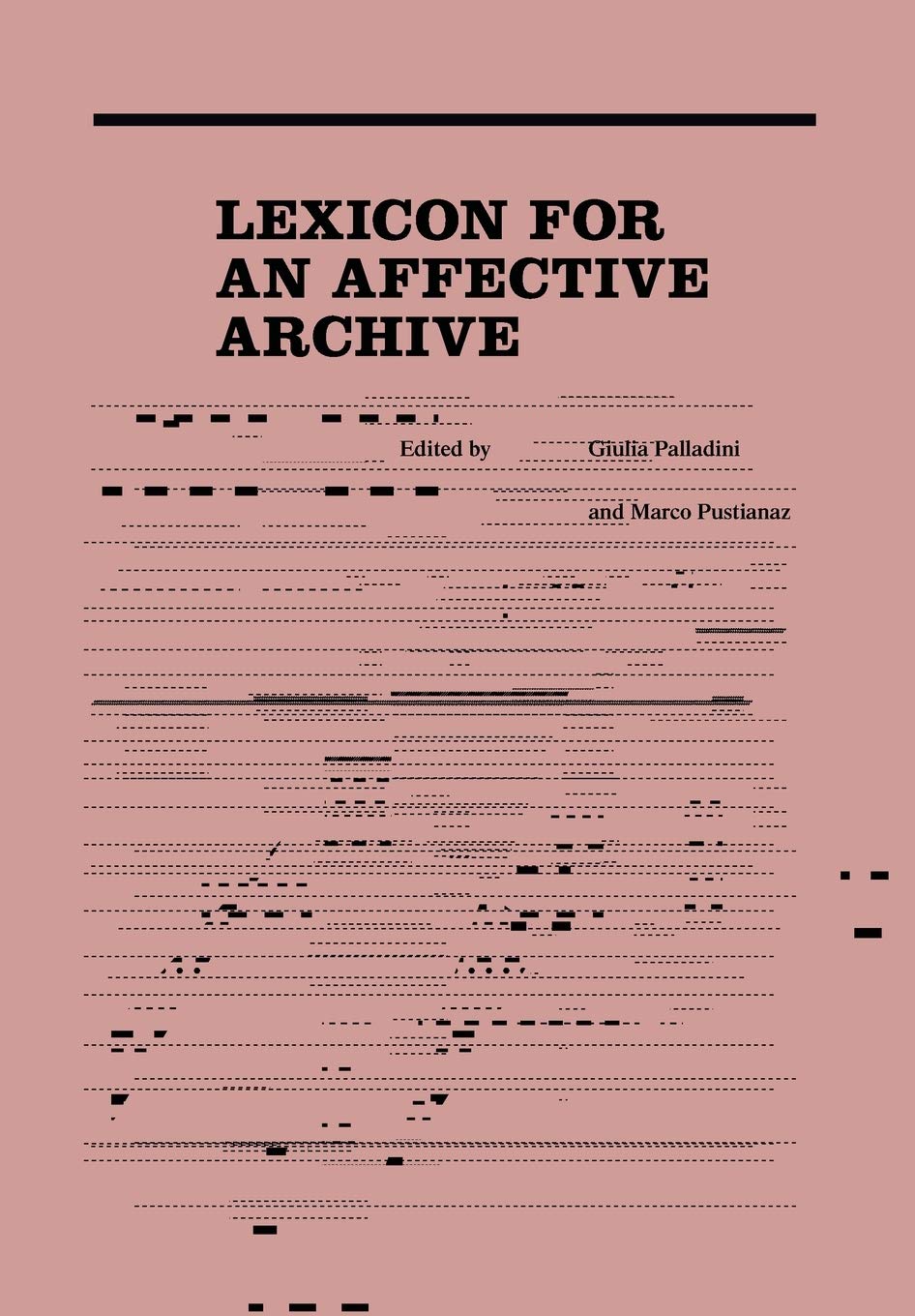



To study an archive or archival materials is to encounter an affective and critical practice involved in the construction of memory. Lexicon for an Affective Archive, edited by Giulia Palladini and Marco Pustianaz, is an international collection of these encounters, offering glimpses into the intimate relations inherent in finding, remembering (or imagining), and creating an archive. Bringing together voices from a variety of fields across the humanities, performance studies, and contemporary art, and engaging in a multidisciplinary analysis, this beautifully designed and fully illustrated volume advances the idea of an “affective archive” as a useful conceptual tool—a tool which contributes to an understanding of an expanded notion of an archive and its central role in contemporary visual and performing arts. A co-publication with NInA and Live Art Development Agency. "This beautiful compilation, which appeals to the senses like an exhibition catalog, invites the reader to engage with multiple reflections on specific archives, to think critically and holistically about the field of archiving, and to contemplate the monograph in itself as an affective archive (i.e., an endless process of memory-making). Interdisciplinary, multinational, multilingual, and multicultural, each of the work's distinguished contributing authors was asked to provide an entry or visual intervention that, to them, represents a particular archive, and to assign one word that sums up its affective core. Together, the entries that make up this lexicon show that the vocabulary of archiving is anything but definitive or prescriptive—it is personal, contextual, and variable. Blank space is also provided in the volume, inviting readers to record their own thoughts and functioning as an impetus to make them notice the impact of their own process of archiving or recording memories. This printing of the English edition is the product of the project's curators Palladini and Pustianaz, and is based on the original 2015 publication, Leksykon Archiwum Afektywnego , edited in part by Katarzyna Tórz, head of programming at the Polish Audiovisual Institute. Highly Recommended." ― Choice Giulia Palladini is an independent researcher and guest professor at Kunsthochschule Weissensee, Berlin. Marco Pustianaz is professor of English and theater at Università del Piemonte Orientale, Vercelli, Italy. Lexicon For An Affective Archive By Giulia Palladini, Marco Pustianaz Intellect Ltd Copyright © 2017 Polish Audiovisual Institute / Narodowy Instytut Audiowizualny (NInA) All rights reserved. ISBN: 978-1-78320-778-7 Contents Katarzyna Tórz FOREWORD, 8, Giulia Palladini and Marco Pustianaz, 10, LEXICON FOR AN AFFECTIVE ARCHIVE, Alessandra Violi BOXES, 21, Katerina Šedá VNUCKA, 27, Dorota Krakowska KRES, 35, Rabih Mroué WARNING, 41, Claudia Castellucci ORDIGNO, 53, Franz Anton Cramer BEWEGUNG, 59, Elisabeth Lebovici SIDA, 65, Bettina Knaup RECOMBINATIONS, 71, Erik Göngrich EINMACHGLAS, 77, Zdenka Badovinac CARDBOARD BOX, 83, Annemarie Matzke / She She Pop SCHUBLADEN, 89, Tim Etchells INDEX CARDS, 95, Paul Clarke STEWARD, 103, Malgorzata Szczesniak BIEL, 113, Malgorzata Dziewulska DRZAZGI, 123, Graeme Miller IMMEMORIAL, 131, Heidi & Rolf Abderhalden / Mapa Teatro TESTIGOS, 137, canecapovolto & Elisa Abela CONDOMINIO, 143, Paola Di Cori VOLVER, 149, Joe Kelleher UNANSWERED, 155, Tina Campt STASIS, 161, Alina Marazzi SPECCHIO, 167, Paolo Vignolo TUMBAS, 173, Ann Cvetkovich EPHEMERA, 179, Ida & Henry Wilde (Keren Ida Nathan & Antonia Baehr) GLOSS, 185, APPENDIX, 191, CHAPTER 1 Alessandra Violi BOXES After you died, your photographs and other bits of your past life — pictures of your dad and mum, your mother's will written by hand on a skin-like piece of paper, scraps of an old advert for Siderexport showing dad smiling among his colleagues, a hair clip made to look like an improbable flower — all ended up in a box. It's funny how we all become curators when dealing with the belongings of our ghosts, literally taking care of their objects by enclosing them in a case or a casket, the box as a safe that is meant to preserve what is precious, the unnumbered lots of our private archive. Come to think of it, though, this boxing is as mortifying as storing items in those filing cartons used for public archiving: the box can be a coffin from which no retrieval is expected; lifeless things may lie there in waiting, but their concealment is, in fact, an intimation of their disappearance, of their social and affective death. I now realize that this is probably why I treated your coffin as if it were a box of a different kind. One of those Cornellian boxes full of toy-like objects and flotsam, faded photographs, marbles, pins, grains of sand and other trivia, all gathered there to perform some secret task. Joseph Cornell imagined them as the homes of ballerinas, opera singers and movie actresses, femal