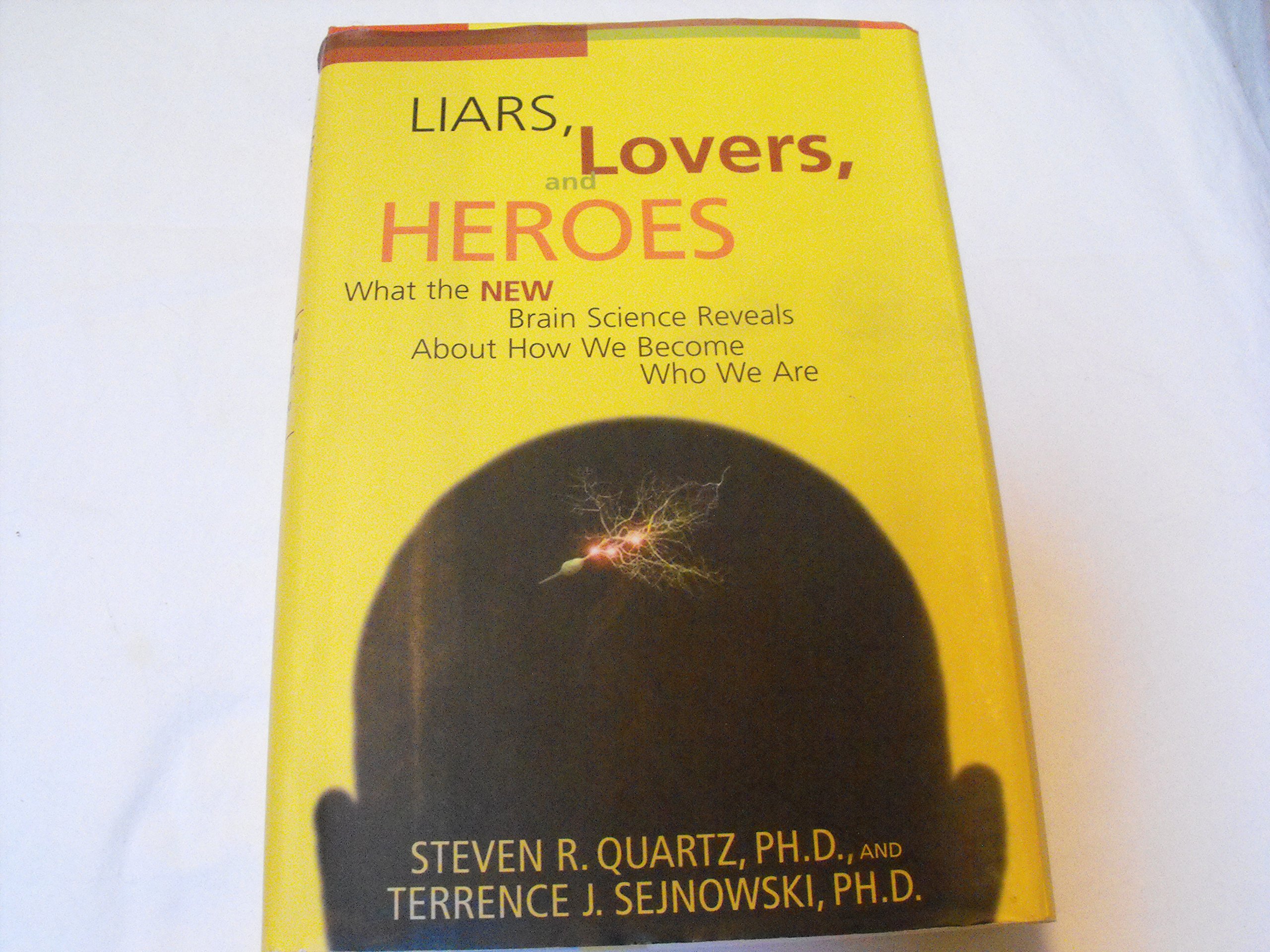
Liars, Lovers, and Heroes: What the New Brain Science Reveals About How We Become Who We Are
$9.92
by Steven R. Quartz



This exciting, timely book combines cutting-edge findings in neuroscience with examples from history and recent headlines to offer new insights into who we are. Introducing the new science of cultural biology, born of advances in brain imaging, computer modeling, and genetics, Drs. Quartz and Sejnowski demystify the dynamic engagement between brain and world that makes us something far beyond the sum of our parts. The authors show how our humanity unfolds in precise stages as brain and world engage on increasingly complex levels. Their discussion embraces shaping forces as ancient as climate change over millennia and events as recent as the terrorism and heroism of September 11 and offers intriguing answers to some of our most enduring questions, including why we live together, love, kill -- and sometimes lay down our lives for others. The answers, it turns out, are surprising and paradoxical: many of the noblest aspects of human nature -- altruism, love, courage, and creativity -- are rooted in brain systems so ancient that we share them with insects, and these systems form the basis as well of some of our darkest destructive traits. The authors also overturn popular views of how brains develop. We're not the simple product of animal urges, "selfish" genes, or nature versus nurture. We survive by creating an ingenious web of ideas for making sense of our world -- a symbolic reality called culture. This we endow to later generations as our blueprint for survival. Using compelling examples from history and contemporary life, the authors show how engagement with the world excites brain chemistry, which drives further engagement, which encourages the development of cultural complexity. They also share provocative ideas on how human development may be affected by changes in our culture. Their insights, grounded in science and far-reaching in their implications, are riveting reading for anyone interested in our past, present, and future. Neuroscience seems prone to coming up with polarizing theories of personality: you are either your genes or your environment. Countering the standard dichotomy, this fresh approach to conceptualizing brain development from a pair of California-based researchers touts "cultural biology." The authors define the meaning of that term while addressing topics such as emotion, sex, and happiness--but Quartz and Sejnowski improve on those themes by informing readers how brain anatomy and neurochemistry work in focusing one's desire. Although the authors discuss serotonin, dopamine, and a reptilian vestige called the ventral basal ganglia, their text is not a clinical parade of jargon, and they are adept at using anecdotes to illustrate their points (such as why motivator Tony Robbins is optimistic and filmmaker Woody Allen is pessimistic). In accessible, conversational language, the authors offer an intriguing investigation of personality Gilbert Taylor Copyright © American Library Association. All rights reserved “A superb book … a breath of fresh air.” (V. S. Ramachandran, M.D. , Ph.D., Professor and Director , Center for Brain and Cognition, University of California, San Diego; adjunct Professor, Salk Institute, author of Phantoms in the Brain) “An evocative solution to a classic problem: which is more important in shaping the human brain, nature or nurture? ” (Sandra Blakeslee, The New York Times) “wide-ranging...linking cutting-edge neuroscience with social history and popular culture...postmodern culture and globalization....” (Publishers Weekly) “Smart authors with a lot of hot stuff to report on.” (Kirkus Reviews) “An entertaining and startling survey of what it means to be human.” (Discover magazine) Steven R. Quartz, Ph.D., is director of the Social Cognitive Neuroscience Laboratory at the California Institute of Technology and an associate professor in the Division of Humanities and Social Sciences and the Computation and Neural Systems Program. He was a fellow of the Sloan Center for Theoretical Neurobiology at the Salk Institute and a recipient of the National Science Foundation's CAREER award, its most prestigious award for young faculty. He lives in Topanga, California. Terrence J. Sejnowski, Ph.D., is regarded as the world's foremost theoretical brain scientist. His demonstration of NETtalk, a neural network that learned to read English words, helped spark the 1980s neural network revolution for which he received the IEEE Neural Network Pioneer Award in 2002. He received his Ph.D. in physics from Princeton University before studying neurobiology at Harvard University School of Medicine. He is an investigator with the Howard Hughes Medical Institute and directs the Computational Neurobiology Laboratory at the Salk Institute. At the University of California at San Diego he is a professor of biology, physics, and neurosciences and directs the Institute for Neural Computation. He has published more than two hundred scientific articles and has been featured in the nat