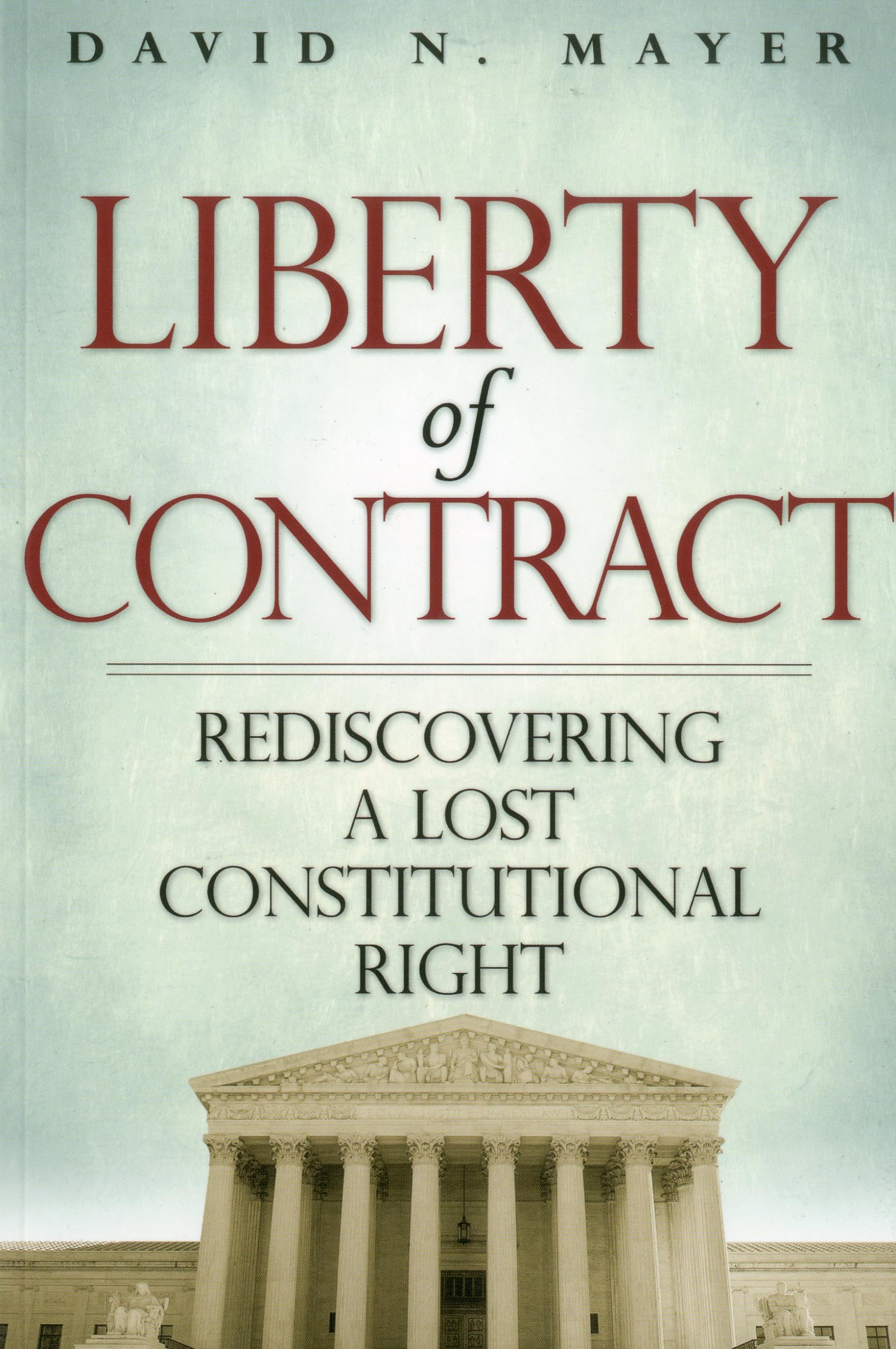



This book shines a powerful light on a fundamental constitutional right that the Supreme Court abandoned more than 70 years ago-the freedom of individuals to bargain over the terms of their own contracts. Vital to economic and personal liberty, this right has been continuously diminished by the country's regulatory and welfare state. Beginning in 1897 with the Supreme Court's historic Lochner decision, the Court safeguarded this right for 40 years by declaring that laws that interfered with the freedom of people to bargain over the terms of their own contracts were unconstitutional. Then in 1937, as part of the New Deal, the Court abandoned its protection for the liberty of contract. This book rediscovers this lost right, identifying the foundations and nature of the Court's Lochner-era legal theories and decisions and shatters myths that scholars have created about this era and subject. LIBERTY OF CONTRACT REDISCOVERING A LOST CONSTITUTIONAL RIGHT By DAVID N. MAYER Cato Institute Copyright © 2011 Cato Institute All right reserved. ISBN: 978-1-935308-39-3 Contents Introduction: The Myth of "Laissez-faire Constitutionalism"..........................11. Historical Foundations of Liberty of Contract.....................................112. Philosophical Foundations of Liberty of Contract..................................433. Liberty of Contract in its Heyday: The Many Facets of Liberty.....................694. The Demise of Liberty of Contract.................................................975. Conclusion: Distinguishing History from Legend or Propaganda......................115Notes................................................................................119Index................................................................................179 Chapter One Historical Foundations of Liberty of Contract Roscoe Pound, one of the Progressive-Era scholars who criticized courts for protecting liberty of contract, did not accept the prevalent view that this practice arose from individual judges projecting their "personal, social and economic views into the law." He observed that "when a doctrine is announced with equal vigor and held with equal tenacity by courts of Pennsylvania and of Arkansas, of New York and of California, of Illinois and of West Virginia, of Massachusetts and of Missouri, we may not dispose of it so readily." He nevertheless asserted that liberty of contract was a "new" doctrine that appeared suddenly in late 19th-century jurisprudence, and he identified seven "causes" for the doctrine's appearance in American jurisprudence—among them, the prevalence of "an individualist conception of justice" and of "mechanical" legal reasoning in late 19th-century legal thought. Contrary to Pound's assertion, however, liberty of contract did not suddenly emerge, as a "new" doctrine, at the end of the 19th century. Rather, it originated in two lines of precedents well established in early American constitutional law. The first was the protection of economic liberty and property rights through substantive use of the U.S. Constitution's due process clauses or equivalent provisions in state constitutions. The second was the limitation of state police powers through the enforcement of certain constitutional rules, both written and unwritten. What was new in the late 19th century was judicial identification of these doctrines, taken together, as the right of "liberty of contract" and the protection of this right through the due process clause of the Fourteenth Amendment. Substantive Due Process in Early American Law Constitutional protection of individual liberty in all its aspects, including economic liberty and the protection of property rights, did not suddenly appear in American law in the late 19th century, the result of classic liberal, laissez-faire ideology. Rather, high regard for economic liberty and property as fundamental rights of the individual was well established in American constitutionalism quite early in the nation's history—indeed, even predating the Constitution itself. "Liberty was the most cherished right possessed by English-speaking people in the eighteenth century," observes one preeminent legal historian: It was both an ideal for the guidance of governors and a standard with which to measure the constitutionality of government; both a cause of the American Revolution and a purpose for drafting the United States Constitution; both an inheritance from Great Britain and a reason republican common lawyers continued to study the law of England. The concept of liberty thus was central to Anglo-American constitutional thought during the era of the American Revolution; indeed, it was central to early American law. The Patriot leaders of the Revolution were influenced profoundly by English radical Whig opposition thought, which departed from mainstream English legal theory in its understanding of both liberty and constitutionalism. Radical Whigs