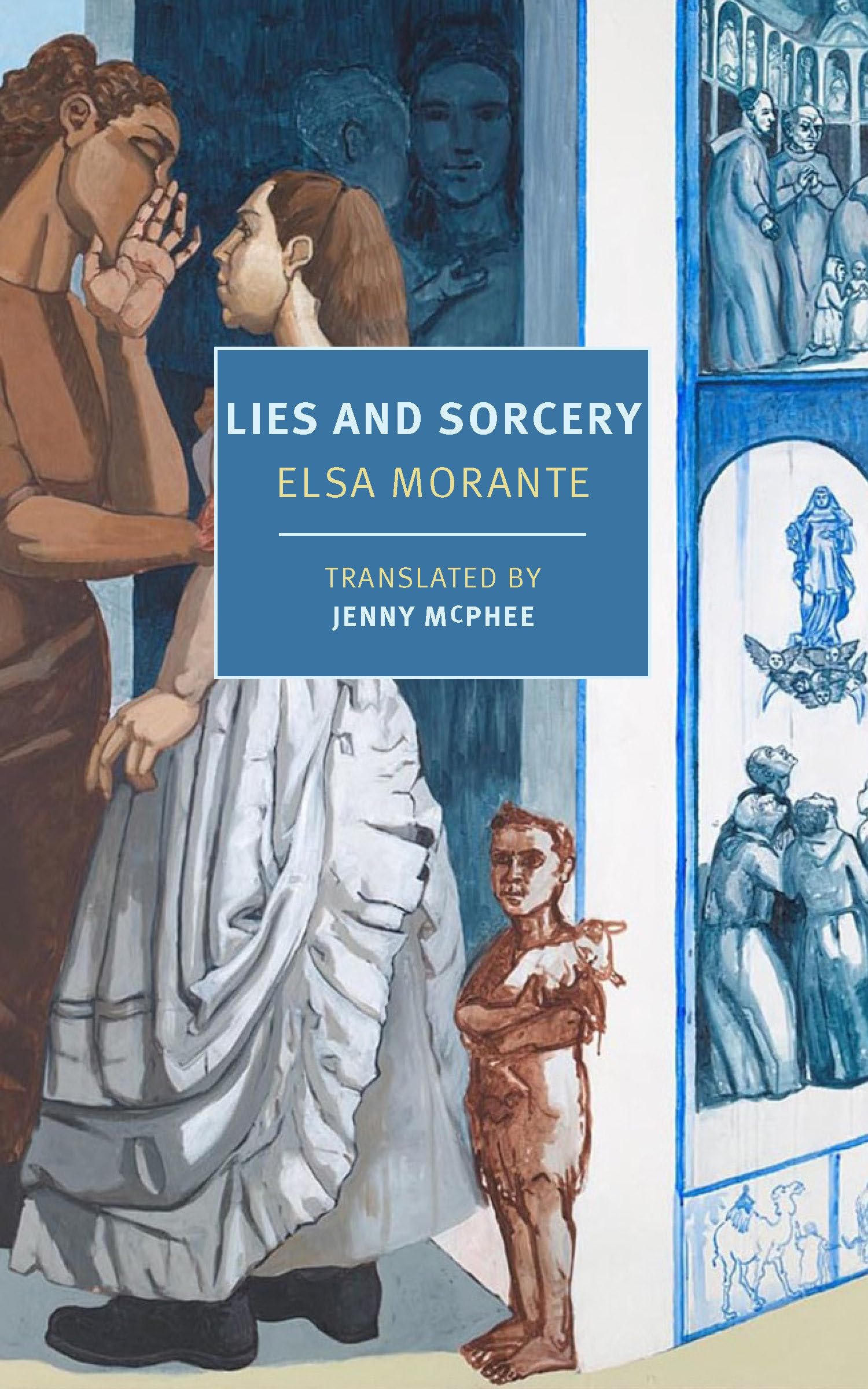



An Italian master's magnum opus about three generations of women, now in the first-ever unabridged English translation. Winner of the 2024 Society of Authors John Florio Prize for for the best translation from Italian and the 2024 American Literary Translator Association's Italian Prose in Translation Prize Elsa Morante is one of the titans of twentieth-century literature—Natalia Ginzburg said she was the writer of her own generation that she most admired—and yet her work remains little known in the United States. Written during World War II, Morante’s celebrated first novel, Lies and Sorcery , is in the grand tradition of Stendhal, Tolstoy, and Proust, spanning the lives of three generations of wildly eccentric women. The story is set in Sicily and told by Elisa, orphaned young and raised by a “fallen woman.” For years Elisa has lived in an imaginary world of her own; now, however, her guardian has died, and the young woman feels that she must abandon her fantasy life to confront the truth of her family’s tortured and dramatic history. Elisa is a seductive, if less than reliable, spinner of stories, and the reader is drawn into a tale of secrets, intrigue, and treachery, which, as it proceeds, is increasingly revealed to be an exploration of a legacy of political and social injustice. Throughout, Morante’s elegant writing—and her drive to get at the heart of her characters’ complex relationships and all-too self-destructive behavior—holds us spellbound. “[In Lies and Sorcery ] I discovered that an entirely female story—entirely women’s desires and ideas and feelings—could be compelling and, at the same time, have great literary value.” —Elena Ferrante “Morante’s work reminds us of this: of the way in which we’re all—men and women, left and right, powerful and powerless—little fascists, exactly because we’re hungry and small. So despite the talking dogs and the fairy-tale castles, Morante’s novels are relentless in telling the truth.” —Rebecca Schultz, LARB "Now, for the first time, Lies and Sorcery is available in full in English, in an electrifying new translation by Jenny McPhee...a melodramatic saga of social climbing and doomed romance, is a deliberate anachronism in both its themes and its style. Its Belle Époque setting, sweeping cast of characters, frequent asides to the reader, and grandiloquence place it firmly in the tradition of the nineteenth-century novel....As Morante reminds us again and again, however, appearances are often deceiving. Despite its nineteenth-century veneer, Lies and Sorcery could have only been written in the twentieth century. The novel is animated by Morante’s hatred of the selfishness and superficiality that she saw in her countrymen. In their masochistic worship of hierarchy, tendency toward idolatry, and susceptibility to kitsch, its characters embody the traits that she believed had enabled Mussolini’s rise." —Jess Bergman, The New Yorker "But what stands out most of all is Morante’s undeviating devotion to the lives of women. Real women, that is, not unbelievable paragons of virtue or grace, but, as my favourite chapter title puts it, “Dissatisfied women, malicious women, and jealous women.” The particular weight she gives to the roiling interior landscapes of her female protagonists is every bit as exhilarating to read now as it must have been radical to encounter nearly 80 years ago." — isa Scholes, The Financial Times "With its attention to human foibles, the book is nothing short of a triumph: a fairy tale of epic proportions and a rightly rediscovered 20th-century classic." —Francesca Peacock, The Spectator (UK) “Morante’s audience had been shaped by the triple-deckers of 19th-century maestros like Dumas, Dickens, Tolstoy and Manzoni. Her novel is a savage spoof of those masterpieces, an enormous work of literary disenchantment... Lies and Sorcery is, then, a phenomenal feat of misanthropy and disillusionment.” —Sam Sacks, The Wallstreet Journal “Set in turn-of-the-century Sicily, [L ies and Sorcery ] is a social epic tinged with fabulism and written in a sensual and highly ornate prose....McPhee translates, expertly, to convey a sense of the original baroque syntax and the heightened register, without feeling fusty or overwrought....[Morante] is, it turns out, that old-fashioned thing, a writer of conscience, and of brilliance besides.”—Bailey Trela, T he Washington Post "This translation of Elsa Morante’s first novel Menzogna e Sortilegio is an extraordinary achievement, not only because of the daunting amount of words that constitute the book, but mostly because of the unpredictable and complex ways in which Morante uses words to represent an insidious reality permeated with deception and self-deception. This often requires the translator to unravel phrases and sentences and to write them again for her audience, something that Jenny McPhee is doing generously and indefatigably throughout the book. Time and again, she travel