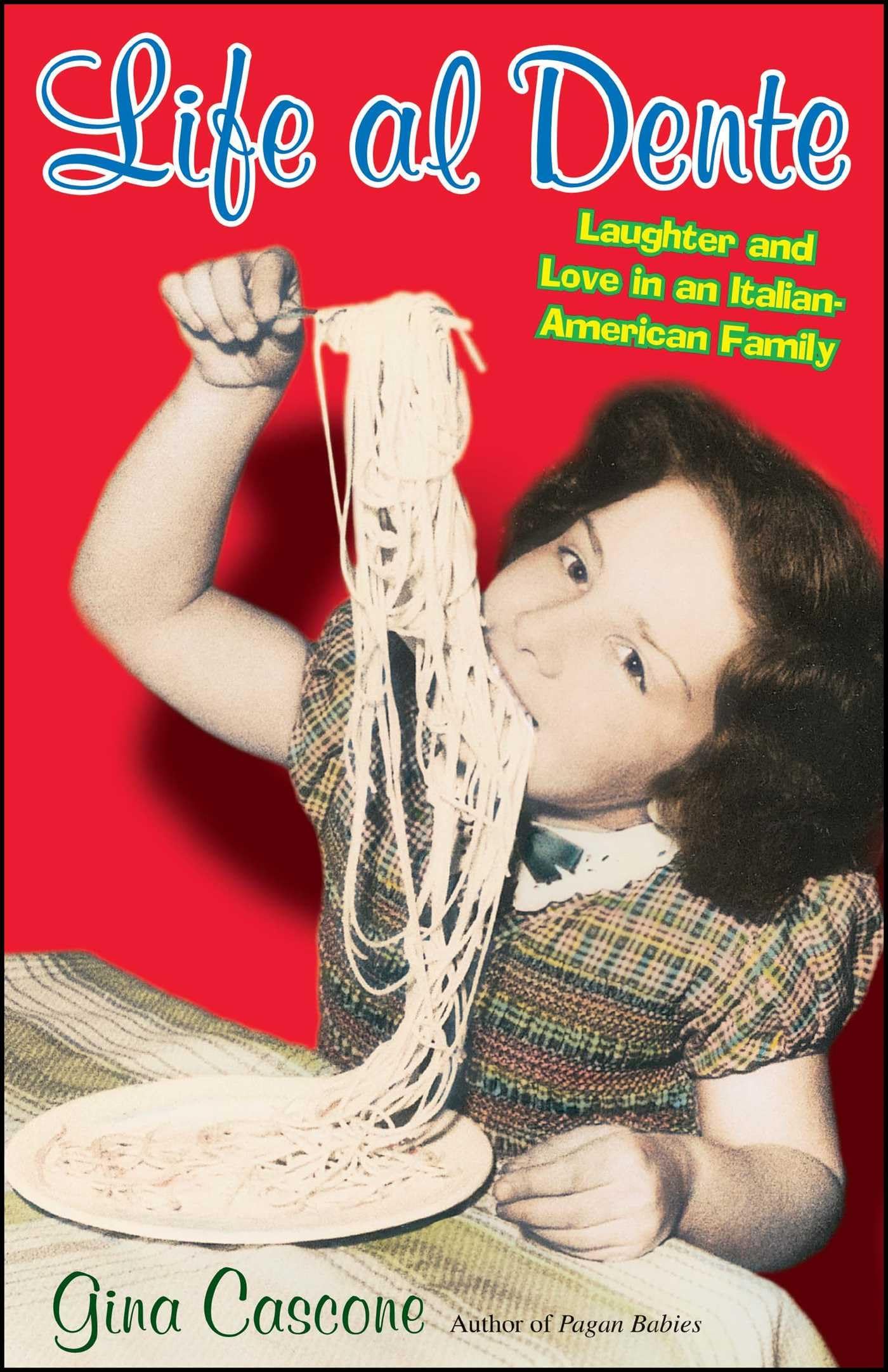



With the irreverence, gutsy spirit, and warmhearted hilarity that made Pagan Babies a classic, here is the Italian-American experience served up by the author who has been crowned the Patron Saint of Humor. Before the Sopranos, there were the Cascones.... Life al Dente, the new memoir from the author of Pagan Babies, brings the same wit and wonder to the telling of Gina Cascone's Italian-American girlhood...well, boyhood actually. In an Italian family, few things are a greater handicap than being born female, but Gina's Dad generously decided to overlook this shortcoming and raise Gina as a boy -- the son he always wanted. As lawyer to numerous "alleged" mobsters, Dad had some colorful clients who would regularly gather around the basement pool table to talk business, drink, and be hustled by junior high Gina. There was no way Gina was going to turn into one of the big hair girls of Italian-American stereotype, but her journey would have all the bumps that come with that cherished immigrant ambition of moving from steerage to the suburbs in three generations. That sense of dislocation came early for Gina as her family moved from the kind of neighborhood where old men play bocce and the pet frogs are named Nunzio to one where Barbies and frozen food prevail. And though Gina's brains got her into the top high school, she quickly made the lonely discovery that she was the only one there whose name ended in a vowel. In our overly pasteurized and homogenized world, there's a real hunger to find and celebrate our connection to old world roots and traditions. Life al Dente abounds in hilarious stories, but also rewards readers with a genuine and poignant contemplation of cultural identity. Gina Cascone grew up in central New Jersey and is the author of Pagan Babies, Mother’s Little Helper, and coauthor of twenty-six books for children. Gina and her husband raised their two children in New Jersey and now live in Manhattan. Chapter 1: One of the Boys I was the firstborn, the son my father always wanted. And so he started almost immediately to mold me into his own image and likeness. For the most part, his efforts were successful. Unfortunately, there was one obstacle, which he could neither overcome nor accept. I was a girl. My father's first words to my mother after visiting the nursery shortly after my birth were, "It looks like a monkey." Who was he kidding? If I'd had a blue blanket wrapped around me, I could have been a monkey and he would have been too delirious with joy to have noticed. Still, son or not, I was his kid. "I guess we'll keep it," he nobly announced to my mother after the next visit. Having thus committed himself, my father tried as hard as he could to protect me from the ugly truth of my genetic makeup for as long as he could. Maybe he even managed to convince himself that it wasn't so. Parents do tend to be blind to their children's shortcomings. And in an Italian family, few things are a greater handicap than being born female. In the early years, I didn't suffer from it at all. My father worked double-time to turn me into a real man. He taught me not to cry "like a girl"; throw a ball underhand, "like a sissy"; or slap -- "if you're going to hit somebody, you punch him." I learned that the secret of winning an argument was turning up the volume of your voice and gesticulating furiously. And I learned to say vaffanculo when I was angry. My mother stood by and let my father have his way as far as my upbringing was concerned. There were two reasons for this. First of all, my mother always let my father have his way. He was her most spoiled child. And secondly, she agreed with him. She wanted me to be strong, quick, and competitive -- not the son she'd always wanted but the daughter she'd always wanted. But sooner or later the horrible truth had to catch up with me and have a real impact on my life. Neither of my parents prepared me for that day. I suppose they meant to and just kept putting it off until it was too late. It certainly would have been easier hearing it from them than from Little Nicky Santucci. Little Nicky ran the neighborhood -- insofar as all activities regarding us kids were concerned. He was, for all intents and purposes, the self-proclaimed mayor of Melrose Avenue. It was a tight little street. The houses and their inhabitants were packed close together. There were maybe half a dozen single-family homes on our block. Most of us lived in semidetached or row houses. Nicky lived in what was by far the biggest house on the corner of the block. It was white stucco with a walled-in patio and garden. A flower shop occupied the front half of the ground floor. Nicky's father, Big Nick, ran the flower shop. He owned it actually. Big Nick did not look like the kind of guy who would be much interested in flowers; but then, Michelangelo didn't look like the kind of guy whose soul drove him to create such great beauty. So who knew? The difference was that I'd never a