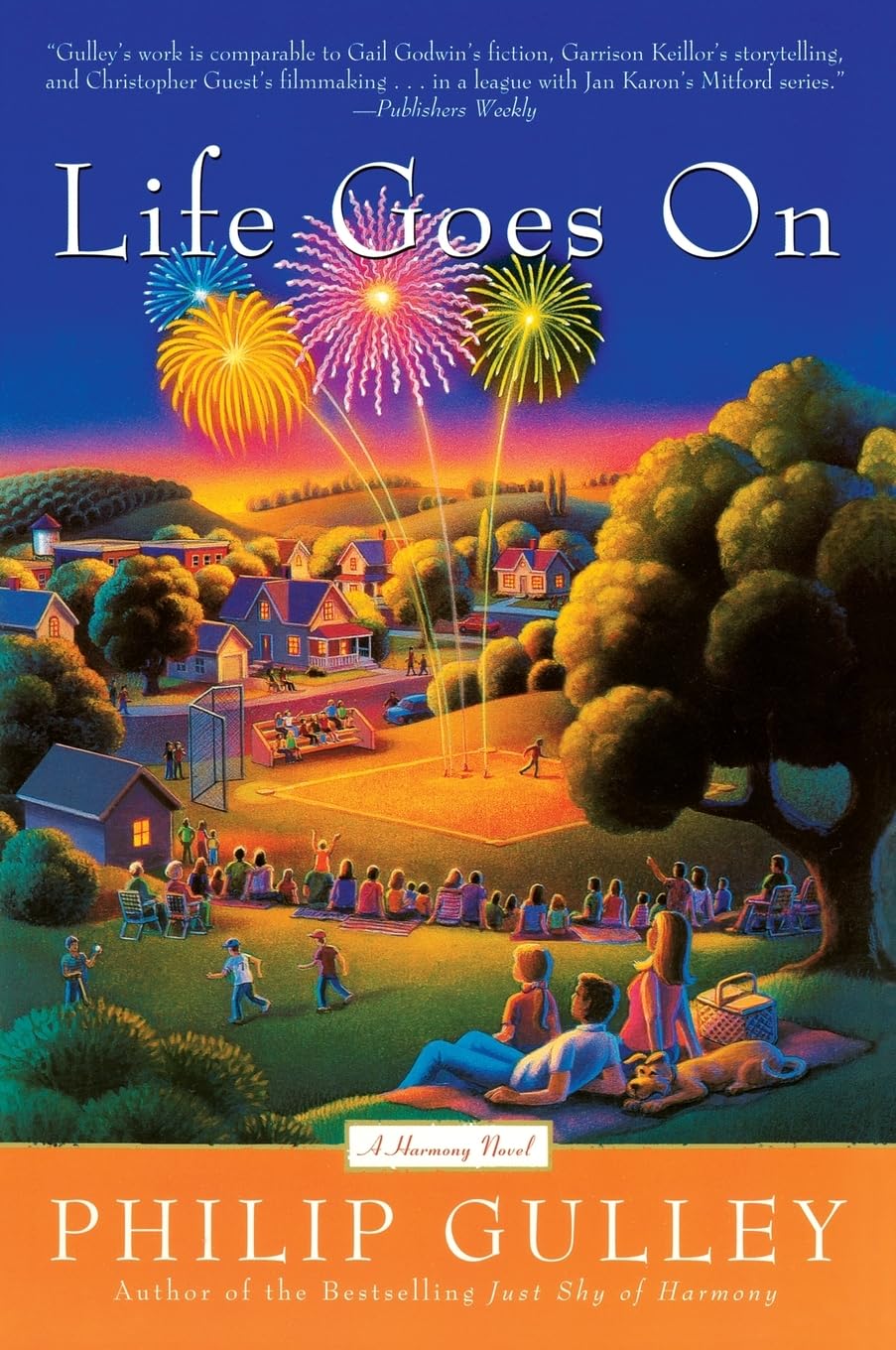
Life Goes On: A Charming Small Town Story of a Pastor and His Lovable Community (A Harmony Novel)
$14.39
by Philip Gulley



Squarely in the crosshairs of the Church's heresy hunters, can Pastor Sam survive? It's a madcap year in Harmony, Indiana, as Sam Gardner struggles through his fourth year as pastor of the Harmony Friends Meeting. Join the thousands of readers who have fallen in love with the charming small town that hosts what BookPage calls "the biggest collection of crusty, lovable characters since James Herriot settled in Yorkshire." “Philip Gulley is a beautiful writer.” - Charles Osgood, anchor, CBS Sunday Morning “Gulley opens up the marvel of being human.” - Vinita Hampton Wright, author of Grace at Bender Springs “Gulley’s delightful series is reminiscent of Garrison Keillor’s Lake Wobegon Days and will, once again, delight his fans.” - Library Journal “Gulley is a splendid storyteller, and….his book abounds with shrewd insights into human character.” - Arkansas Democrat-Gazette “This is sweet, homespun storytelling, as comfy and reassuring as warm socks in a wet spring.” - Publishers Weekly “Life Goes On is a visit with old friends. . . You’ll feel right at home.” - Indianapolis Star Squarely in the crosshairs of the Church's heresy hunters, can Pastor Sam survive? It's a madcap year in Harmony, Indiana, as Sam Gardner struggles through his fourth year as pastor of the Harmony Friends Meeting. Join the thousands of readers who have fallen in love with the charming small town that hosts what BookPage calls "the biggest collection of crusty, lovable characters since James Herriot settled in Yorkshire." Philip Gulley is a Quaker minister, writer, husband, and father. He is the bestselling author of Front Porch Tales , the acclaimed Harmony series, and is coauthor of If Grace Is True and If God Is Love . Gulley lives with his wife and two sons in Indiana, and is a frequent speaker at churches, colleges, and retreat centers across the country. Life Goes on A Harmony Novel By Gulley, Philip HarperSanFrancisco ISBN: 0060760613 Chapter One Easter My earliest memory of Easter was when I was five years oldand looking for Easter eggs in my grandparents' backyard. I'm not sure if what I'm remembering is the event itself or the photograph of it my father took -- my brother, Roger, and me, dressed in our Sunday suits, pausing just long enough from our egg gathering to record the moment for posterity. My grandmother kept the picture on the top of her bureau, ablack-and-white photo with scalloped edges. In the backgroundwas my grandfather's shed, where he had a cot for naps on summer afternoons amidst the pleasant aroma of gasoline, turpentine, and sawdust. I would visit them on Saturday afternoons and sit in the backyard swing with my grandma while Grandpa push-mowed the yard in neat stripes, the blades snicking against the roller. Every now and then he'd happen upon a long-forgotten Easter egg. A rainbow of egg shell would arc up from the mower while a pungent, sulfuric odor filled the air, the delayed resurrection of a half-buried Easter egg. Alice Stout was my Sunday school teacher when I was growing up at Harmony Friends Meeting. When she would ask me why we celebrated Easter, I knew I was supposed to say something about Jesus rising from the tomb. But that struck me as a fanciful yarn the adults concocted to liven up the religion. For me, Easter was about sitting at the kitchen table with my mother and brother the night before, dipping eggs in teacups of dye, then laying them out to dry on that week's copy of the Harmony Herald . Now Alice Stout is in the nursing home at Cartersburg, four eggs short of a dozen. When I went to visit her the week before Easter and read to her from the Scriptures about the Resurrection, she cackled like a madwoman. "Bullfeathers," she said. It is troublesome to struggle all your life believing something, only to have your Sunday school teacher dismiss it as bullfeathers, even if she is out of her gourd. One of the ironies of life is that we often return gladly to what we once fled. I returned to my hometown and became the pastor of my childhood church.Now it's my job to rally the troops and urge them to believe things they might otherwise doubt, at least according to Dale Hinshaw, our self-appointed guardian of doctrinal purity, who's been vigilant about keeping me orthodox, lest I stray into the wilds of rationalism. On my fourth Easter as pastor, I suggested we hold special services during Holy Week. I'm not sure now what possessed me to do that, probably my naive habit of thinking the church is always one program away from vitality. I envisioned a little Scripture reading, some singing, then a spirited theological discussion on certain aspects of the Resurrection. When I presented my idea to the elders, they waded in with their concerns. Asa Peacock wanted to know if we could have cookies. Dale Hinshaw made me promise we'd read from the King James Version of the Bible. Harvey Muldock suggested holding a raffle each night to draw more people, and Fern Hampton decla