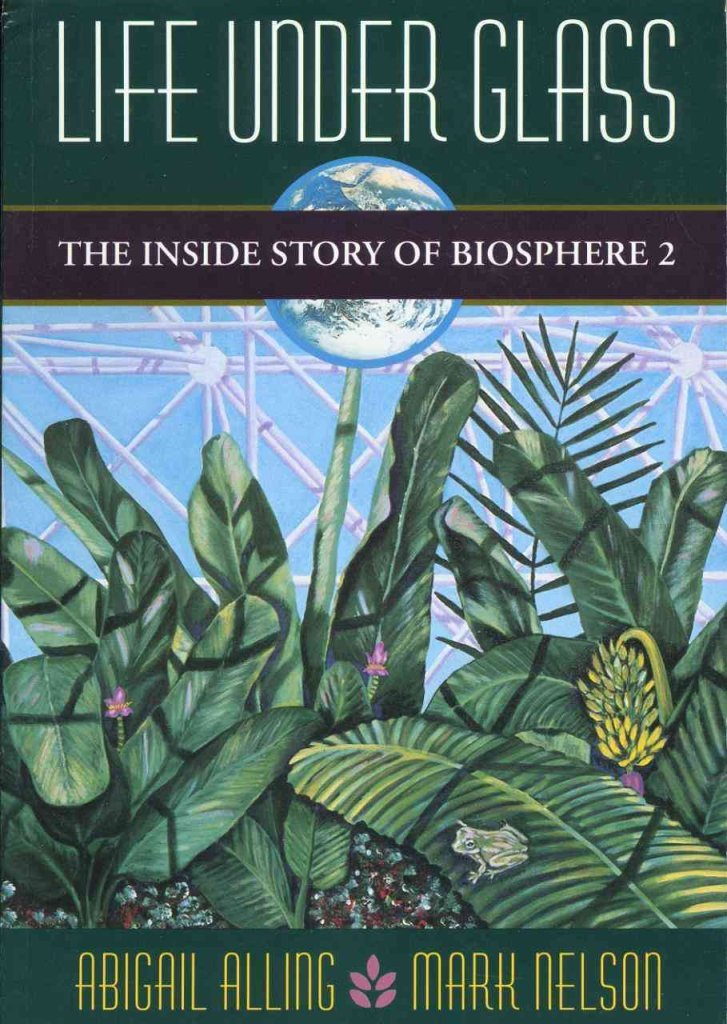



Planet in a bottle. Eden revisited. Laboratory under glass. The largest self-sustaining closed ecological system ever made. Biosphere 2 is many things to many people. From its half-acre farm to its coral reef to its emerald rainforest―this unique research facilty has proven itself a marvel of human engineering and a testament to the human imagination. For two years, four men and four women lived and worked inside the structure, recycling their air, water, food, and wastes, and setting a world record for living in an isolated environment. But what has this giant glass-and-steel greenhouse been to those most intimately involved with it? What has it meant to the first crew who studied and cared for it? What was it really like sealed inside a giant laboratory for twenty-four months? In Life Under Glass crew members, Abigail Alling and Mark Nelson with co-captain Sally Silverstone present the full account of those two remarkable years. From the struggles of growing their own food, to learning how to help sustain their life-giving atmosphere, the general reader is offered a rare glimpse into how a group of dedicated researchers managed to surprise the world and fulfill their dream. Other crews may come and go, but no one else will face the risks, the uncertainties, and the challenges that this new breed of explorers did on Biosphere 2's maiden voyage. Here is the fascinating story of how it all appeared―living under glass. Selected as one of the top ten science experiments in 1993 by Time Magazine and Good Morning America. This project probably pioneered the transformation of ecology into an experimental science, while the crew has survived a unique social experiment: the longest voluntary tenure in a confined environment on record. -- USA Today We have to pay tribute to the imagination and determination and the vision of the people who have made this project a reality. -- Jane Goodall Your book depicting the day-to0day life is lively reading and should become a best seller. -- Eugene Odum Dr. Mark Nelson was a founding director of the Institute of Ecotechnics and has worked for several decades in closed ecological system research, ecological engineering, the restoration of damaged ecosystems, desert agriculture and orchardry and wastewater recycling. He is Chairman and CEO of the Institute of Ecotechnics (www.ecotechnics.edu), a U.K. non-profit organization, which consults to several demonstration projects working in challenging biomes around the world. For the past 23 years, Ms. Alling has actively engaged in marine, environmental and closed system research and development projects. Presently, she is co-founder and CEO of Biosphere Foundation and its division, the Planetary Coral Reef Foundation (PCRF), a non-profit corporation dedicated to the study of Earth's coral reef ecosystems. PCRF maintains a research base in Akumal, Mexico and a research ship, the RV Heraclitus, which is now on its second mission to study coral reefs worldwide, a decade long, (2000 ― 2010) "Planetary Coral Reefs and Cultures Expedition." From foreword: I am also intrigued by this enormous experiment because, for the first time, it addresses the missing link of space colonies. By the missing link I mean the understanding of the closed sustainable ecologies needed for human habitation in space. All other technologies needed to live off Earth - rocket travel, for example- were proven during the golden years of the Space Age. But no understanding about closed ecologies was gained in those years because all space missions to date have relied on a rigid system of consumable stores: food, water, propellants, and so on carried according to a complicated flight plan and meted out piece by piece until they are exhausted about the time, one hopes, of Earth re-entry. (Joseph P. Allen, former astronaut Executive Vice-President of Space Industries International, August 1993, Houston, Texas) Used Book in Good Condition