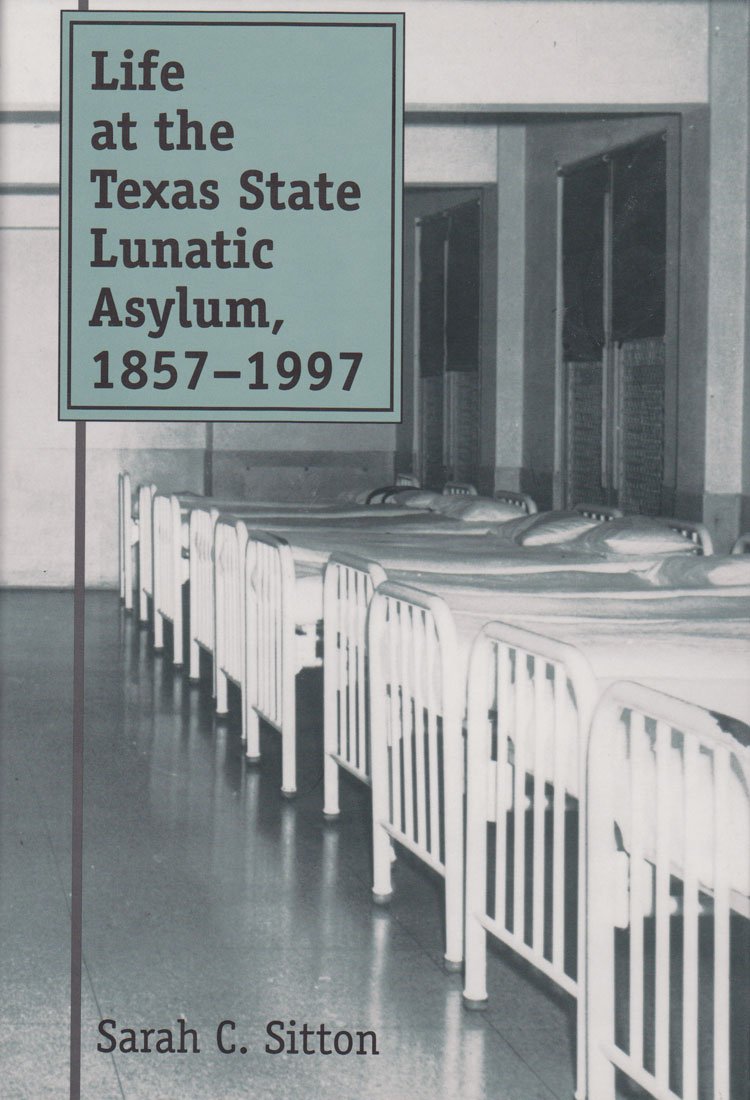
Life at the Texas State Lunatic Asylum, 1857-1997 (Centennial Series of the Association of Former Students, Texas A&M University)
$77.94
by Sarah C. Sitton



The nineteenth-century "cult of curability" engendered the optimistic belief that mental illness could be cured under ideal conditionsremoval from the stresses of everyday life to asylum, a pleasant, well-regulated environment where healthy meals, daily exercise, and social contact were the norm. This utopian view led to the reform and establishment of lunatic asylums throughout the United States. The Texas State Lunatic Asylum (later called the Austin State Hospital) followed national trends, and its history documents national mental health practices in microcosm. Drawing on diverse sourcespatient records from the nineteenth century, papers and reports of the institution's various superintendents, transcripts of interviews of former employees, newspaper accounts, personal memoirs, and interviewsSarah C. Sitton has recreated what life in "our little town" was like from the institution's opening in 1861 to its de-institutionalization in the 1980s and 1990s. For more than a century, the asylum community resembled a self-sufficient village complete with its own blacksmith shop, icehouse, movie theater, brass band, baseball team, and undertakers. Beautifully landscaped grounds and gravel lanes attracted locals for Sunday carriage drives. Patients tended livestock, tilled gardens, helped prepare meals, and cleaned wards. Their routines might include weekly dances and religious services, as well as cold tubs, paraldehyde, and electroshock. Employees, from the superintendent on down, lived on the grounds, and their children grew up "with inmates for playmates." While the superintendent exercised almost feudal power, deciding if staff could date or marry, a multigenerational "clan" of several interlinked families controlled its day-to-day operations for decades. With the current emphasis on community-based care for the mentally ill and the negative consequences of de-institutionalization increasingly apparent, the debate on how best to care for the state’sand the nation’smentally ill continues. This examination offers historical and practical insights which will be of interest to practitioners and policy makers in the field of mental health as well as to individuals interested in the history of the state of Texas. The care of persons with severe and persistent mental disorders is full of uncertainty and controversy. There is a crisis in public health and safety today because of the many thousands of such persons who are homeless or incarcerated and in need of treatment and support. To a great extent, we have regressed as a society to an era of 150 years ago, when a moral crusade on behalf of the homeless and incarcerated "insane" led to the asylum movement in the United States. Sarah Sitton's history, Life at the Texas State Lunatic Asylum, 1857-1997, recalls that earlier era of reform and the vicissitudes of institutional care over a 140-year period, as reflected in archives and the memories of staff members, patients, and concerned citizens. Although there is much in this account that reminds us of the reasons for deinstitutionalization in the 1970s and 1980s, some of the positive aspects of asylum care are also given prominence in this lively and well-written narrative. The idea that a place of safety in a beautiful location would have curative power derived from concepts articulated by Dorothea Dix, a prominent social reformer from Massachusetts, in the mid-19th century. Sitton's history neglects Dix's contribution to the establishment of asylums in Texas and elsewhere, a major omission from any history of the asylums founded in the 19th century. "Moral treatment," as it was called, emphasized kindness, persuasion, and a daily routine rather than coercion, punishment, and restraint. Asylums were intended to be curative, not custodial, but changing concepts of mental illness and the economics of care undermined the original concept, as is illustrated by the change that took place at the Texas State Lunatic Asylum in the latter part of the 19th century. Families and local communities took the opportunity offered by the creation of a state-supported institution to shift the responsibility for the care of chronically ill, senile, and mentally retarded relatives to the state facility, and what had originally been an asylum designed for the care of several hundred acutely ill patients rapidly became an institution providing care for several thousand patients. Throughout this narrative, Sitton describes the daily grim routines of the handful of physicians who were responsible for the care of many thousands of patients. She describes the power of attendants over the lives of patients, the lack of physical and medical resources to treat them, and the abuses that occurred in addition to loss of liberty. Over the years of incarceration, many patients became unpaid workers in these institutions, and although they regarded such places as home, theirs was indeed a very impoverished existence. The power of