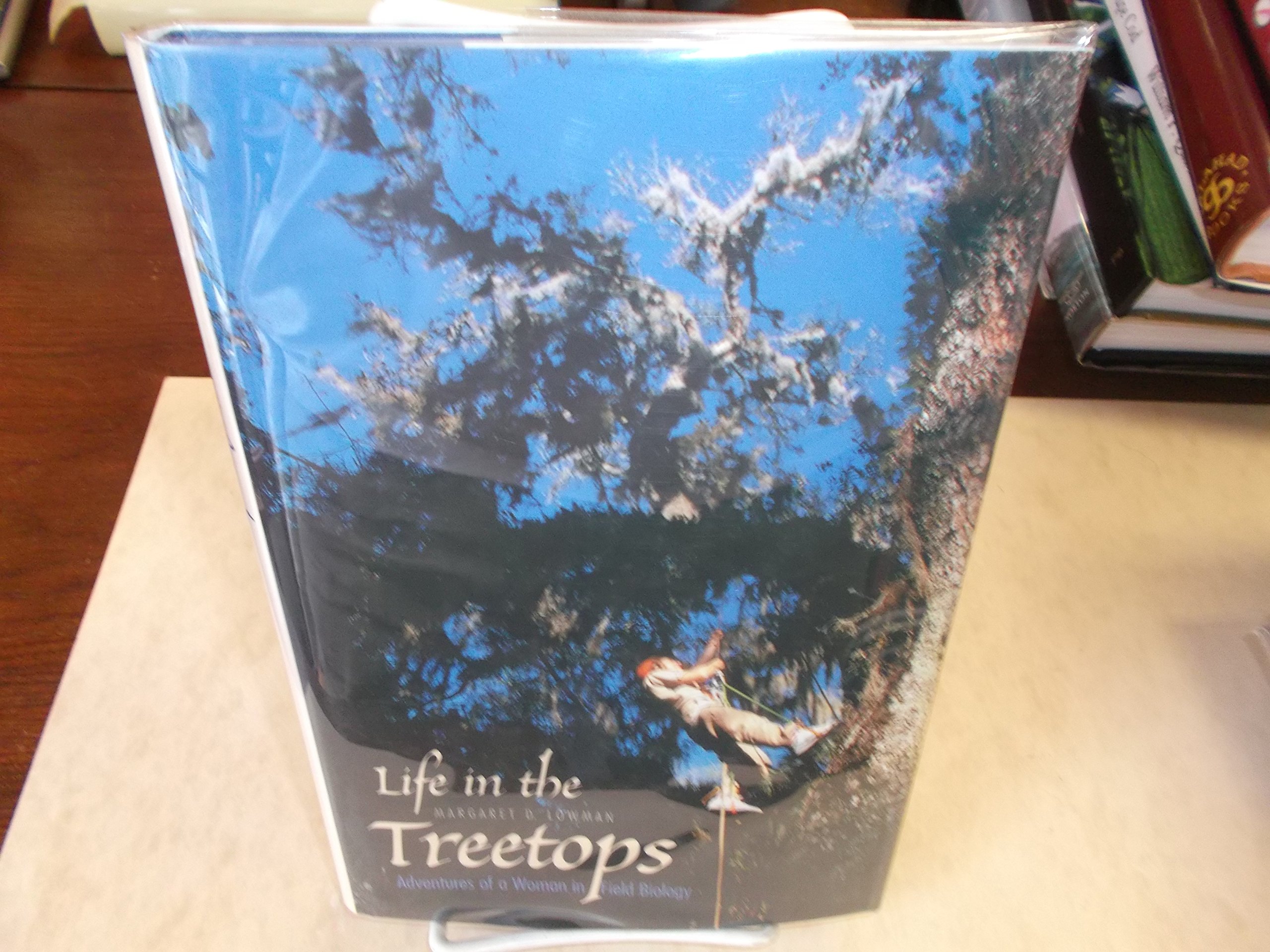
Life in the Treetops: Adventures of a Woman in Field Biology
$35.55
by Dr. Margaret D. Lowman



The tropical botanist shares the story of her adventues doing pioneering ecological research in forest canopies of Australia, Africa, Belize, and the United States. Life in the Treetops reflects many of the difficulties faced by women scientists in all fields. Margaret Lowman, a field biologist specializing in forest-canopy research, shows how dealing with the emotional challenges is as tough as or tougher than dangling from a precarious perch counting beetles or facing down a deadly sea snake. This chronicle of her adventures (and misadventures) among the treetops encourages readers to understand both the science and the scientist. One can't help but sympathize with Lowman as she struggles to be a good researcher and a traditional rural housewife at the same time, and fails. Luckily, her kids and parents always remain supportive, taking care of the house during her long absences and accompanying her to faraway research stations when possible. Lowman studies small things--leaves and insects, mostly--and getting to them can be tricky. She chronicles the history of forest-canopy research techniques (which have grown apace with her career), starting with simple climbing gear and ending with treetop walkways and giant construction cranes. Life in the Treetops is an engaging look at one woman's struggle to find balance, whether she's high up in a tree or on the ground with her fellow humans. --Therese Littleton In this engaging mix of science and autobiography, botanist Lowman recalls her pioneering research in the forest canopies of Australia, Africa, Belize, and the United States. She also details her struggle to be a good wife and mother in light of her Australian in-laws' disapproval of her career. A wonderful look at the rigors of fieldwork--from a woman's perspective. (LJ 5/15/99) Copyright 2000 Reed Business Information, Inc. [Lowman's] story is part science, part autobiography. She tells of studying leaf growth dynamics in Australia, canopy herbivory in Cameroon, canopy vines in Panama and plant-insect relations in Belize. And she tells of her struggle to balance her career and her tasks as a wife and mother. What goes on in the canopy (the uppermost layer) of a forest? How do you reach the crown of a rain forest tree 70 feet above the ground? Lowman is a botanist who studies the canopy ecosystem, teasing apart the complex relationships among organisms that never touch the ground. Lowman uses techniques to access the canopy world that range from the prosaic (climbing ropes) to feats of engineering (giant cranes and canopy walkways resembling suspension bridges) to the exotic (dirigibles and inflatable "canopy sleds"). She describes the hypotheses and the research that went with each technique. Interwoven with her narrative of field work is the story of how she balanced the needs of marriage, housewifery, children, and eventual single parenthood with college teaching and research trips to locales such as Panama, Australia, and Cameroon. How Lowman succeeded in a male-dominated field makes for inspiring reading. Nancy Bent An exuberant celebration of biology in the wild, far from labs, classrooms, and offices. Lowman is a tropical botanist, but, she explains disarmingly, what she really does is climb trees. I did not intend to climb trees for a career, she writes. In fact, I tried desperately to think of alternatives to climbingsuch as training a monkey, utilizing large telephoto cameras on pulleys, or working along cliff edges where rain-forest treetops were at eye level before cascading into valleys below. She had ample reason to become what she calls an arbornaut, however: For a tropical biologist, the forest canopy is where the action is, where evolution happens. Such canopies have in fact been characterized as being among the Earths final biotic frontiers, places of astonishing biodiversity that shelter countless unknown or incompletely described species. Her work, she admits, has not always been thrilling; one of her early projects involved marking thousands of leaves in a forest canopy in eastern Australia to serve as a sample base for a study of leaf growth dynamicsa project that occupied her for several years. But later projects, as she recounts in her easygoing narrative, have taken her to nearly every jungle in the world, where she has pondered such matters as the long odds of a seedlings reaching maturity (one percent of a tropical forests crop of seedlings makes it to treehood) and where she has helped build tall walkways that have promoted canopy-level ecotourism and saved a few patches of forest from the chainsaw. While acknowledging the dangers of working at high altitude in the tropics, where diseases and sometimes unfriendly animals lurk, Lowman emphasizes the pleasures and intellectual rewards of studying the natural world. Besides, she adds, learning to exclaim instead of complain has been my most valuable lesson. Young women interested in careers in science will especially benefi