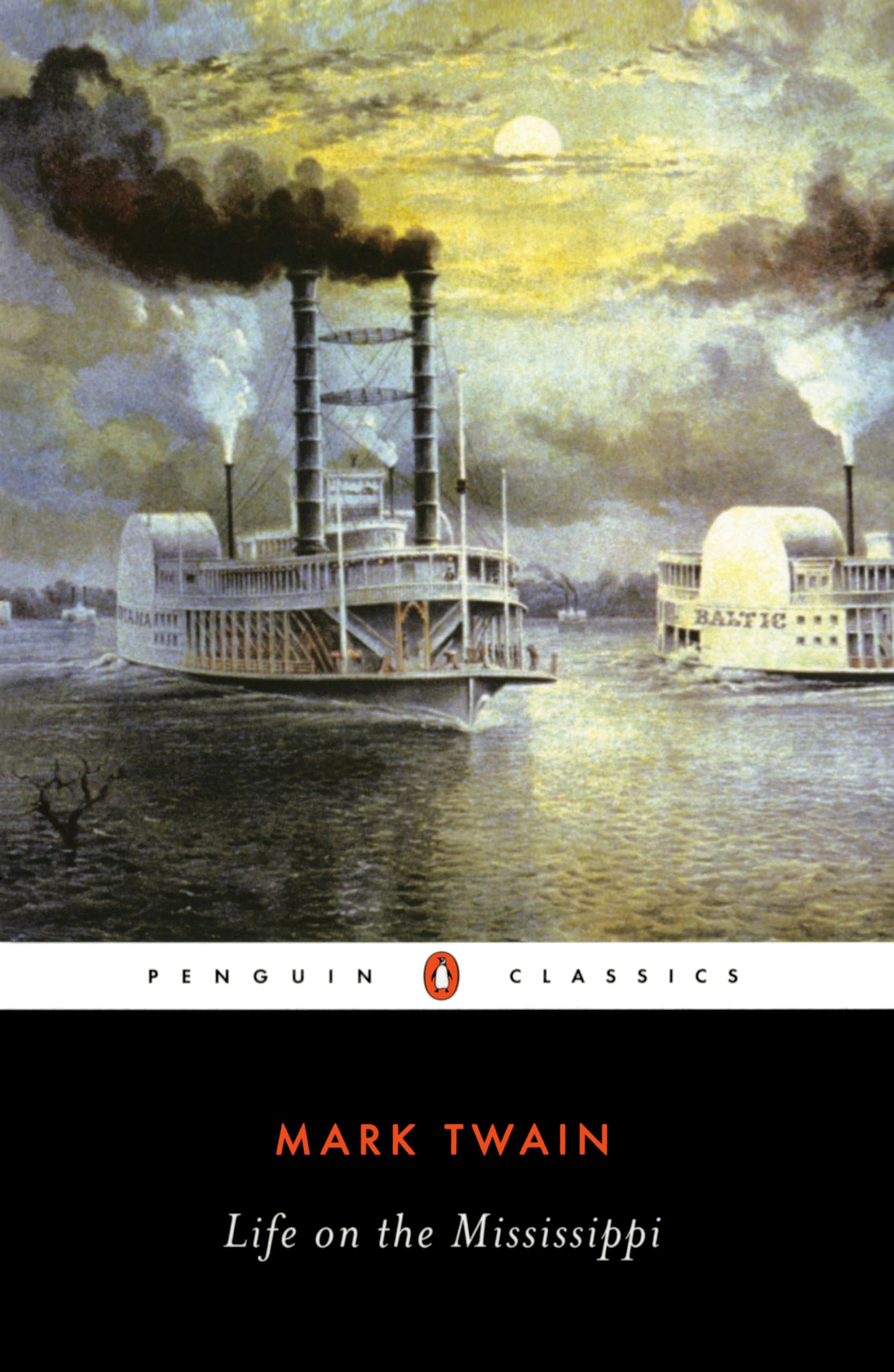



In 1882 Mark Twain returned to the river of his childhood, determined to write the definitive travel book on the Mississippi. Life on the Mississippi is no ordinary guided tour, for every page is expressive of the structure, style and high humour that is the very essence of Twain the writer. Spiced with Twain's pungent observations and commentaries on the culture and society of the great river valley, the book is a wonderful collection of lively anecdotes, tall tales and character sketches; historical facts and information; and reminiscences of the author's boyhood and experiences as a steamboat pilot. Life on the Mississippi , in its composition and substance, is intricately related to The Adventures of Huckleberry Finn . In his introduction, James M. Cox suggests that in writing this travelogue Twain discovered the truths that form the heart of the odyssey depicted in his masterpiece, Huckleberry Finn. For more than seventy years, Penguin has been the leading publisher of classic literature in the English-speaking world. With more than 1,700 titles, Penguin Classics represents a global bookshelf of the best works throughout history and across genres and disciplines. Readers trust the series to provide authoritative texts enhanced by introductions and notes by distinguished scholars and contemporary authors, as well as up-to-date translations by award-winning translators. Part travel book, part autobiography, and part social commentary, Life on the Mississippi is a memoir of the cub pilot's apprenticeship, a record of Twain's return to the river and to Hannibal as an adult, a meditation on the harsh vagaries of nature, and a study of the varied and sometimes violent activities engaged in by those who live on the river's shores. Mark Twain was born Samuel Langhorne Clemens in Florida, Missouri, in 1835, and died at Redding, Connecticut in 1910. In his person and in his pursuits he was a man of extraordinary contrasts. Although he left school at twelve when his father died, he was eventually awarded honorary degrees from Yale University, the University of Missouri, and Oxford University. His career encompassed such varied occupations as printer, Mississippi riverboat pilot, journalist, travel writer, and publisher. He made fortunes from his writing but toward the end of his life he had to resort to lecture tours to pay his debts. He was hot-tempered, profane, and sentimental and also pessimistic, cynical, and tortured by self-doubt. His nostalgia helped produce some of his best books. He lives in American letters as a great artist, the writer whom William Dean Howells called “the Lincoln of our literature.” Chapter One. The River and Its History The Mississippi is well worth reading about. It is not a commonplace river, but on the contrary is in all ways remarkable. Considering the Missouri its main branch, it is the longest river in the world--four thousand three hundred miles. It seems safe to say that it is also the crookedest river in the world, since in one part of its journey it uses up one thousand three hundred miles to cover the same ground that the crow would fly over in six hundred and seventy-five. It discharges three times as much water as the St. Lawrence, twenty-five times as much as the Rhine, and three hundred and thirty-eight times as much as the Thames. No other river has so vast a drainage-basin; it draws its water-supply from twenty-eight states and territories; from Delaware on the Atlantic seaboard, and from all the country between that and Idaho on the Pacific slope--a spread of forty-five degrees of longitude. The Mississippi receives and carries to the Gulf water from fifty-four subordinate rivers that are navigable by steamboats, and from some hundreds that are navigable by flats and keels. The area of its drainage-basin is as great as the combined areas of England, Wales, Scotland, Ireland, France, Spain, Portugal, Germany, Austria, Italy, and Turkey; and almost all this wide region is fertile; the Mississippi valley, proper, is exceptionally so. It is a remarkable river in this: that instead of widening toward its mouth, it grows narrower; grows narrower and deeper. From the junction of the Ohio to a point half-way down to the sea, the width averages a mile in high water; thence to the sea the width steadily diminishes, until, at the "Passes," above the mouth, it is but little over half a mile. At the junction of the Ohio the Mississippi's depth is eighty-seven feet; the depth increases gradually, reaching one hundred and twenty-nine just above the mouth. The difference in rise and fall is also remarkable--not in the upper, but in the lower river. The rise is tolerably uniform down to Natchez (three hundred and sixty miles above the mouth)--about fifty feet. But at Bayou La Fourche the river rises only twenty-four feet; at New Orleans only fifteen, and just above the mouth only two and one-half. An article in the New Orleans Times-Democrat, based upon reports of abl