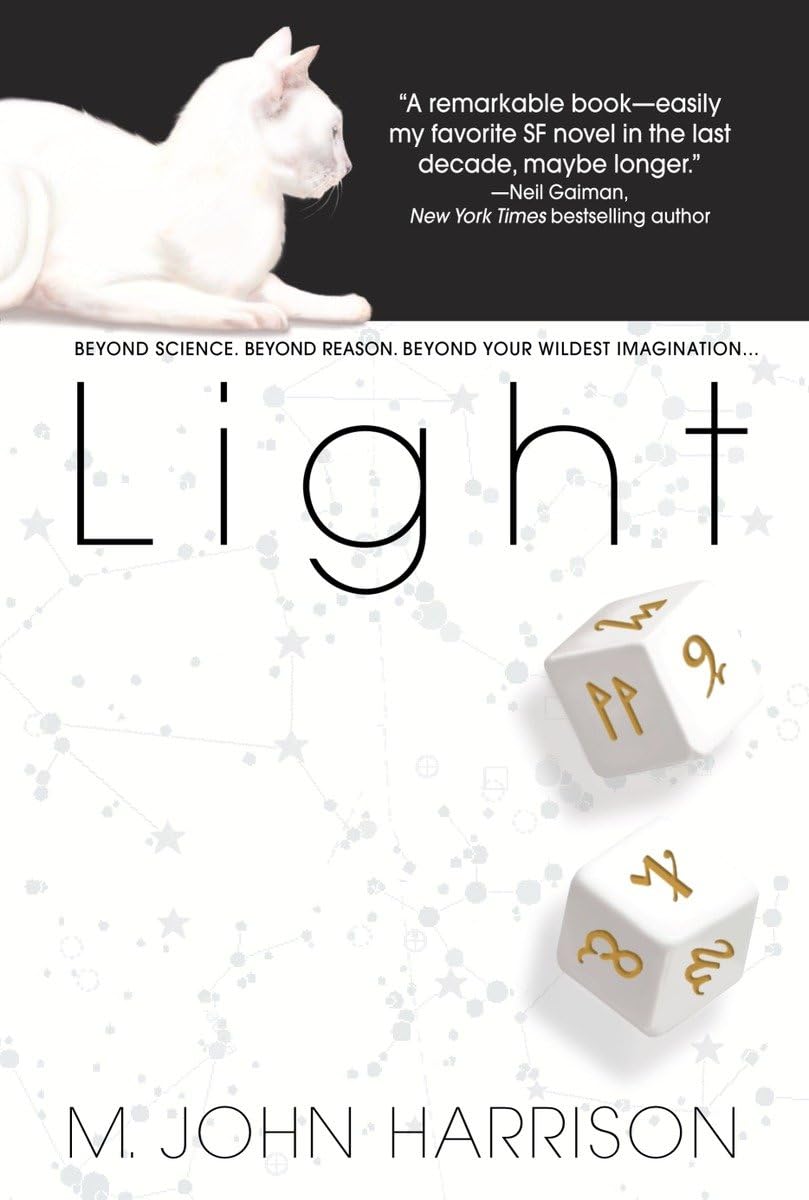



In M. John Harrison’s dangerously illuminating new novel, three quantum outlaws face a universe of their own creation, a universe where you make up the rules as you go along and break them just as fast, where there’s only one thing more mysterious than darkness. In contemporary London, Michael Kearney is a serial killer on the run from the entity that drives him to kill. He is seeking escape in a future that doesn’t yet exist—a quantum world that he and his physicist partner hope to access through a breach of time and space itself. In this future, Seria Mau Genlicher has already sacrificed her body to merge into the systems of her starship, the White Cat. But the “inhuman” K-ship captain has gone rogue, pirating the galaxy while playing cat and mouse with the authorities who made her what she is. In this future, Ed Chianese, a drifter and adventurer, has ridden dynaflow ships, run old alien mazes, surfed stellar envelopes. He “went deep”—and lived to tell about it. Once crazy for life, he’s now just a twink on New Venusport, addicted to the bizarre alternate realities found in the tanks—and in debt to all the wrong people. Haunting them all through this maze of menace and mystery is the shadowy presence of the Shrander—and three enigmatic clues left on the barren surface of an asteroid under an ocean of light known as the Kefahuchi Tract: a deserted spaceship, a pair of bone dice, and a human skeleton. Praise for Light “Uproarious, breath-taking, exhilarating . . . This is a novel of full spectrum literary dominance. . . . It is a work of—and about—the highest order.” — Guardian “An increasingly complex and dazzling narrative . . . Light depicts its author as a wit, an awesomely fluent and versatile prose stylist, and an SF thinker as dedicated to probing beneath surfaces as William Gibson is to describing how the world looks when reflected in them. . . . SF fans and skeptics alike are advised to head towards this Light .” — Independent “ Light is a literary singularity: at one and the same time a grim, gaudy space opera that respects the physics, and a contemporary novel that unflinchingly revisits the choices that warp a life. It’s almost unbearably good.” —Ken MacLeod, author of Engine City Reviewers call Light complex, yet seemed more than willing to forgive the complexityas well as the shortage of sympathetic major charactersbecause of the award-winning authors style and sheer intelligence. They also lauded the ending, deemed suitably transformational and connection-rich ( Guardian ). Harrison brings a far deeper wisdom and maturity to science fiction than other writers typically do, and poses important questions that reach far beyond the old conceits of the genre. Most intriguing of these: By what moral calculus is [Harrisons] mad scientist any madder than the legions of researchers who kiss their families goodbye each morning and spend their workdays developing weapons of mass destruction? ( New York Times ). Its an eternal mystery. Copyright © 2004 Phillips & Nelson Media, Inc. Michael Kierney works in developing useful quantum computing. He is also a serial killer who uses an alien set of dice stolen from the Shander, a monster he has spent years fleeing, to randomize choices in his life. His work and the help of a white cat that sees something in data-noise make the society of Seria Mau Genlicher and Ed Chianese possible. Seria Mau is part of a k-ship; she gave up her body and then stole the k-ship, which, like several other strange things, is an alien artifact. Ed Chianese was a virtual reality junkie until he ran out of money and had to start coping with the real world, a strange enough place even without withdrawal pains. The Shander, which is a monster only because Kierney fears what he doesn't comprehend, links these three in the end. Sometimes space opera, sometimes a kind of noir fiction, Harrison's novel is a cleverly assembled contemplation of how choices make lives and of opening quantum mechanical doors on bizarre potential futures. Regina Schroeder Copyright © American Library Association. All rights reserved “Uproarious, breath-taking, exhilarating . . . This is a novel of full spectrum literary dominance. . . . It is a work of—and about—the highest order.” — Guardian “An increasingly complex and dazzling narrative . . . Light depicts its author as a wit, an awesomely fluent and versatile prose stylist, and an SF thinker as dedicated to probing beneath surfaces as William Gibson is to describing how the world looks when reflected in them. . . . SF fans and skeptics alike are advised to head towards this Light .” — Independent “ Light is a literary singularity: at one and the same time a grim, gaudy space opera that respects the physics, and a contemporary novel that unflinchingly revisits the choices that warp a life. It’s almost unbearably good.” —Ken MacLeod, author of Engine City “At last M. John Harrison takes on quantum mec