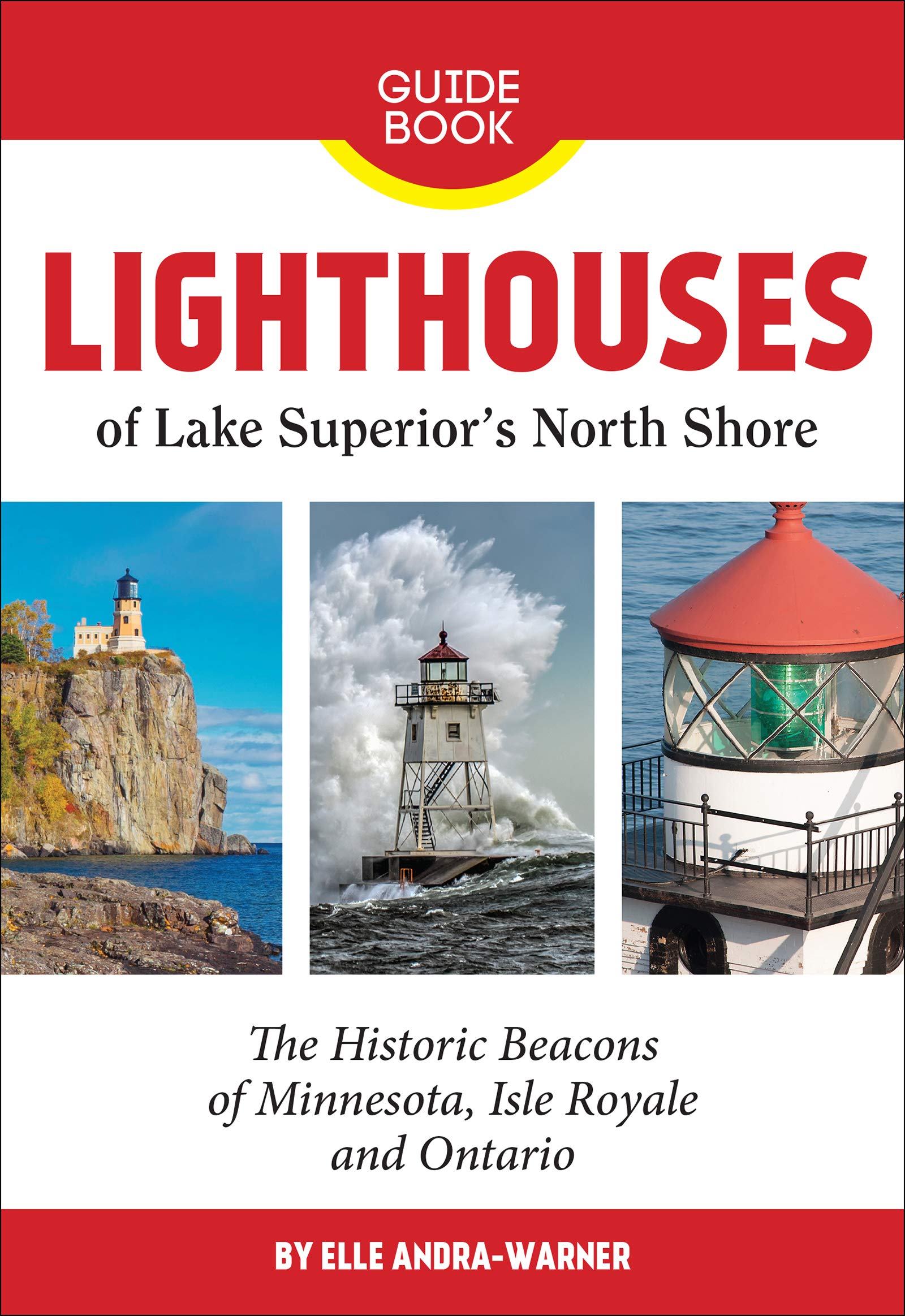
Lighthouses of Lake Superior's North Shore: The Historic Beacons of Minnesota, Isle Royale and Ontario
$13.49
by Elle Andra-Warner



This full-color guide presents photographs and history of 41 lighthouses and navigational beacons between Duluth, Minnesota, and Sault Ste. Marie, Ontario. Lighthouses of Lake Superior’s North Shore is the first comprehensive guide to the lighthouses and navigational beacons from Duluth, Minnesota, to Sault Ste. Marie, Ontario. Noted author and Lake Superior historian Elle Andra-Warner of Thunder Bay, Ontario, spent several years researching the North Shore’s maritime history to create this well organized and highly readable addition to anyone’s Lake Superior library. Amply illustrated with color photography of nearly every lighthouse, as well as rarely seen historical photos, the book includes chapters for 41 lighthouses located in Minnesota, on Michigan’s Isle Royale and in Ontario. Discover the lighthouses you can visit, from locations in state and national parks to remote wilderness islands. Learn about the storms and shipwrecks that led to their construction, the lonely lives of the light keepers and the role the lighthouses play in present-day maritime navigation. Included are stories of famed lights such as Minnesota’s Split Rock Lighthouse, Isle Royale’s Rock of Ages and Ontario’s former “Lighthouse of Doom.” Lighthouse lovers will find Lighthouses of Lake Superior’s North Shore to be a treasure trove of photos and information, while tales told by Andra-Warner will captivate anyone who loves the big lake. Elle Andra-Warner was born in a castle in Europe, while in a post-war Estonian displaced-persons camp. She lived for a time in England, then came to Canada with her parents in the 1950s. Her family settled on the Lake Superior shoreline in Port Arthur, Ontario (now part of the city of Thunder Bay). The sounds and sights of Great Lakes shipping were an everyday part of her Canadian childhood. She is the author of several books, including Edmund Fitzgerald: The Legendary Great Lakes Shipwreck. SPLIT ROCK LIGHTHOUSE Location: Western Lake Superior, situated on top of a 130-foot (39.6 m) rock cliff along the north shore of Lake Superior in Split Rock Lighthouse State Park, Beaver Township, Lake County, Minnesota Built: 1909–1910 Lit: August 1, 1910 Coordinates: N 47.20005, W 91.3669 Status: Station deactivated in 1969; Split Rock Lighthouse was listed in the National Register of Historic Places in 1969, and designated a National Historic Landmark in 2011 Owned by: Since 1976, the lighthouse and facilities have been operated as a historic site by the Minnesota Historical Society Open to Public: Open daily mid-May to mid-October Getting There: It is easy to get to Split Rock Lighthouse by car on U.S. Highway MN61-N. From Duluth, the drive is northeast 48 miles (77.2 km); from Two Harbors, northeast 20 miles (32.2 km); from Grand Marais, southwest 64 miles (103 km); and from the Canadian border, southwest 104 miles (167.4 km). Address: Split Rock Lighthouse 3713 Split Rock Lighthouse Road Two Harbors, MN 55616 Tel. 218-226-6372 Background Split Rock Lighthouse, which sits on a sheer 130-foot (39.6 m) cliff, owes its existence largely to a brutal 1905 storm that left shipwrecks along the north shore, in particular the barge Madeira , less than a mile away. In the early hours of November 28, 1905, a raging blizzard sunk 29 ships on Lake Superior. Pittsburgh Steamship Company’s 436-foot (132.9 m) steel barge Madeira was being towed by the company’s 478-foot (145.7 m) steel steamer William Edenborn . At about 3:00 a.m., the towline broke, leaving Madeira drifting and helpless. Three hours later, the Madeira was being smashed broadside against a cliff at Gold Rock Point (near the cliff of today’s Split Rock Lighthouse). One crew member was lost (drowned after falling overboard), and Madeira broke in two and sank. The wreckage is now a popular dive site. At the same time, a few miles away, the Edenborn slammed its bow at full speed onto the shore at the mouth of the Split Rock River. She also lost one crew member as the ship cracked mid-ship. After the 1905 storm, a delegation of steamship owners led by the president of the Pittsburgh Steamship Company, which had a number of vessels lost or substantially damaged along the north shore because of the storm, successfully lobbied U.S. Congress for a lighthouse and fog signal to be built near Split Rock, then called Stoney Point. Construction and Design Construction on the lighthouse began in May 1909, and was completed in the summer of 1910 at a cost of $72,540. Ten buildings were constructed, including three yellow brick, two-story lighthouse keeper’s houses, a fog building, and light tower. The building of the lighthouse is a story in itself. Because there were no roads to the remote Minnesota site, all the workers, building materials (including tons of bricks), and supplies were shipped by boat to a dock built below the cliff and then loaded into a box crate called a “skip.” They were then hoisted up to the cliff top by