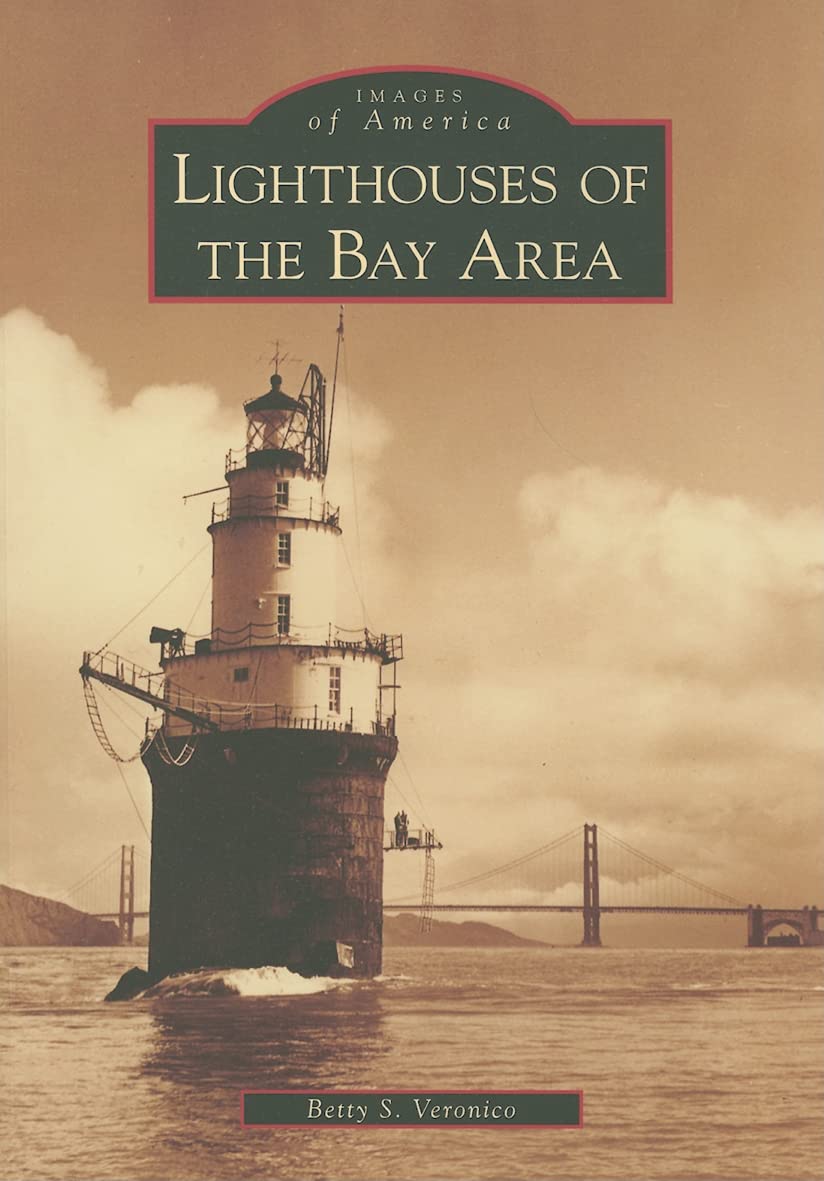



The 1848 discovery of gold in the hills of California brought prospectors and adventurers west; many came across the country on the treacherous western trails, while others came by sea. The rugged coast of California and the dangers of the San Francisco Bay waters claimed many ships and their passengers. The loss of these ships and the ever-increasing number of vessels converging in the San Francisco Bay made it evident that navigational aids were desperately needed. To enhance maritime safety in the region, the San Francisco Bay's first light, located on Alcatraz Island, began construction in 1852. Light stations soon followed at Fort Point, Point Bonita, and the Farallon Islands. An additional 15 lights later served the bay, and two lightships were stationed outside the Golden Gate. Title: Allen: Book about Bay Area lighthouses a beacon for readers Author: Annalee Allen Publisher: The Oakland Tribune Date: 1/3/2009 A new book for history buffs is "Lighthouses of the Bay Area," by Betty S. Veronico, another in Arcadia Publishing's "Images of America" series. This is Veronico's second project for Arcadia. She is a co-author of Arcadia's history volume on the city of San Carlos, and she works as a commercial property manager on the San Francisco Peninsula. As a longtime member of the U.S. Lighthouse Society, the author was able to draw upon rare public and private collections for the 200 images used in her latest book. In addition to the volume's many interesting and seldom viewed photographs of lighthouses, Veronico includes basic and easy-to-understand technical information on how these unique structures accomplish their job a which is to provide mariners with a guiding light to safely pass rocky coasts and enter harbors and Bay waters. The first lighthouse in America was built in 1716 off Boston and later was destroyed by the British. By the time America became a nation in 1776, there were 12 lighthouses along the East Coast, history files state. Many East Coasters headed to California, starting in 1848 when gold was discovered, files say. Most came by sea and encountered first the rugged coast of California and the dangers of San Francisco Bay waters while attempting to make it to the gold fields. Records show there were a number of ships, crew member cargo and passengers lost because of the hazards, making it evident that navigational aids such as lighthouses were urgently needed. Congress authorized funds tobe used to survey the entire 1,300 miles of the Pacific Coast from Mexico to Canada to determine the best locations for lighthouses and then, in 1852, paid for the first of what would grow to be the initial 16 lighthouses established in California, Oregon and Washington. The sum of $148,000 was allocated for the construction of these navigational aides, most of which would be located on hazardous and craggy promontories. At least one would be entirely surrounded by water and only approachable only by boat. In later years, the Bay Area would be home to as many as 19 lighthouses, six on the approach to the Bay and 13 within it. There also were lightships stationed outside the Golden Gate, tasked with directing ships safely into the Bay. One of those, "The Relief," is among the last surviving vessels of its kind and is moored near Jack London Square for public viewing. Because of its rarity, "The Relief" is listed on the National Register of Historic Places. The first lighthouse facility to be built on the West Coast was located on Alcatraz Island in the center of the Bay. It was completed and put into service in July 1853. It was equipped with the latest technology for the time, say the files, the so-called Fresnel lens, manufactured and shipped all the way from France. The light beam could be seen for up to 19 miles in all directions. By the late 1800s, Oakland's harbor in the East Bay fast was becoming known as a transcontinental shipping terminal, says the author, and an additional $5,000 was allocated for a new lighthouse and fog signal to be built outside the approach to the estuary. According to the files, nearly 119 years ago, on the night of Jan. 27,1890, a light in a simple cottage-like structure built on stilts at the entrance to the harbor shone for the first time, guiding shippers into Oakland's estuary port area. One of the requirements of its light keeper a keepers were known as "wickies" because they tended the wicks of the early oil lamp burning lights a was the ability to row a boat. Since the first Oakland Harbor light was entirely surrounded by water, rowing a boat was the only way to get on or off the structure. After only 12 years of service, the wood pilings became riddled with wood-boring organisms that prevented the lighthouse from being used safely. In 1902, a new structure with concrete-filled pilings was installed. By this time the Western Pacific Railroad had built its ferry landing out to where the new lighthouse was, making the facility one of o