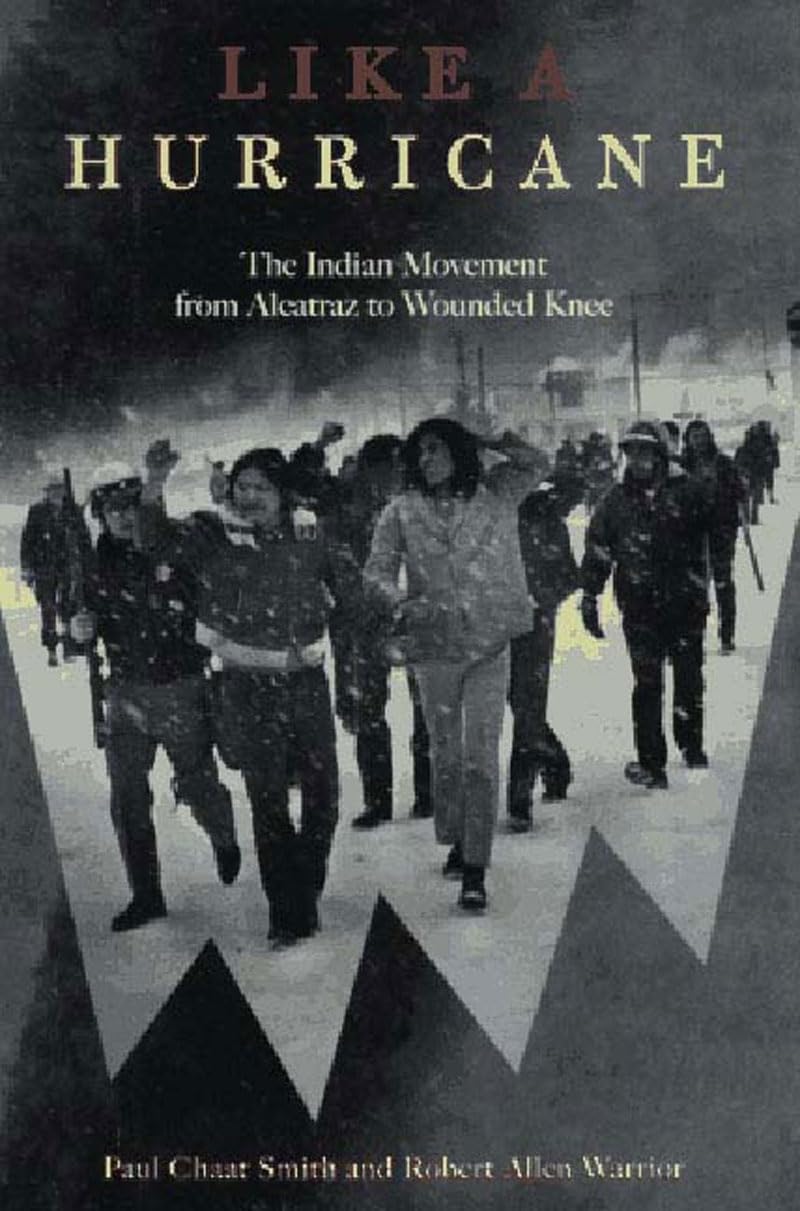
Like a Hurricane: The Indian Movement from Alcatraz to Wounded Knee
$105.41
by Paul Chaat Smith



It's the mid-1960's, and everyone is fighting back. Black Americans are fighting for civil rights, the counterculture is trying to subvert the Vietnam War, and women are fighting for their liberation. Indians were fighting, too, though it's a fight too few have documented, and even fewer remember. At the time, newspapers and television broadcasts were filled with images of Indian activists staging dramatic events such as the seizure of Alcatraz in 1969, the storming of the Bureau of Indian Affairs building on the eve of Nixon's re-election in 1972, and the American Indian Movement (AIM)-supported seizure of Wounded Knee by the Oglala Sioux in 1973. Like a Hurricane puts these events into historical context and provides one of the first narrative accounts of that momentous period. Unlike most other books written about American Indians, this book does not seek to persuade readers that government polices were cruel and misguided. Nor is it told from the perspective of outsiders looking in. Written by two American Indians, Paul Chaat Smith and Robert Allen Warrior, Like a Hurricane is a gripping account of how for a brief, but brilliant, season Indians strategized to change the course and tone of American Indian-U.S. government interaction. Unwaveringly honest, it analyzes not only the period's successes but also its failures. This highly readable history documents three turbulent years in the history of Native America, beginning in the early winter of 1969, when a few dozen activists occupied Alcatraz Island in San Francisco Bay. The American Indian Movement became prominent by that action, and Chaat and Warrior chart its fortunes through the three years culminating in both Nixon's reelection and the siege at Wounded Knee, South Dakota, where armed AIM sympathizers held off federal agents for eight weeks. The period between Alcatraz and Wounded Knee, the authors write, "was for American Indians every bit as significant as the counterculture was for young whites, or the civil rights movement for blacks." During the 1960s and 1970s, a new national identity was forged for Native Americans through demonstrations led by militant leaders. Activist Smith and academic Warrior (Tribal Secrets: Recovering Indian Intellectual Traditions, Univ. of Minnesota, 1994) relate three events central to those changes during the fast-paced, chaotic, and frequently disappointing movement: the takeovers of Alcatraz, the national Bureau of Indian Affairs headquarters, and Wounded Knee. The authors discuss all three heavily symbolic and media-dependent events with clear-eyed scrutiny, lauding personal heroism while recognizing instances of flawed leadership. The authors take up contradictory views in the national Indian community and trace the growth of the American Indian Movement (AIM) from its Chippewa beginnings to national influence under the charismatic leadership of Russell Means. Based on archival sources and personal accounts, this work joins another recent title, Means's autobiography, Where White Men Fear To Tread (LJ 10/15/95), in reconstructing events during a turbulent phase of modern Native American history. Recommended for academic and public libraries.?Margaret W. Norton, Morton West H.S., Berwyn, Ill. Copyright 1996 Reed Business Information, Inc. Smith, an activist, and Warrior, a history professor at Stanford University, sharpen our understanding of what exactly went on during the brief but passionate and paradigm-shifting Indian rights movement between 1969 and 1973. Their thoroughly researched, fast-paced chronicle focuses on three main events that held the attention of people all over the world: the gutsy takeover of Alcatraz, the spontaneous occupation of the Bureau of Indian Affairs in Washington, D.C., and the traumatic siege at Wounded Knee. As they present day-by-day coverage of these unprecedented acts of civil disobedience, Smith and Warrior profile the movement's diverse leaders, including Richard Oakes, Russell Means, and Clyde Warrior, the first activist to publicly challenge the trend toward assimilation by advocating pride in and respect for Indian culture. Such deep change takes time, however, hence the sudden outbreak of dramatic and dangerous confrontations. As the authors analyze the strengths and weaknesses of the Indian movement and the unrelenting vehemence of government opposition, they make it clear that this era of flamboyant protest and "guerrilla theater" is of great and lasting significance. Donna Seaman A well-documented, highly readable history of three turbulent years in the history of Native America. American Indian radical politics first drew international attention in the early winter of 1969, when an unknown number of activists, certainly fewer than a hundred, occupied Alcatraz Island in San Francisco Bay. The American Indian Movement, an activist organization, grew to prominence through that action, bringing fame (or notoriety, depending on your viewpoint) to Richard Oakes, Russe