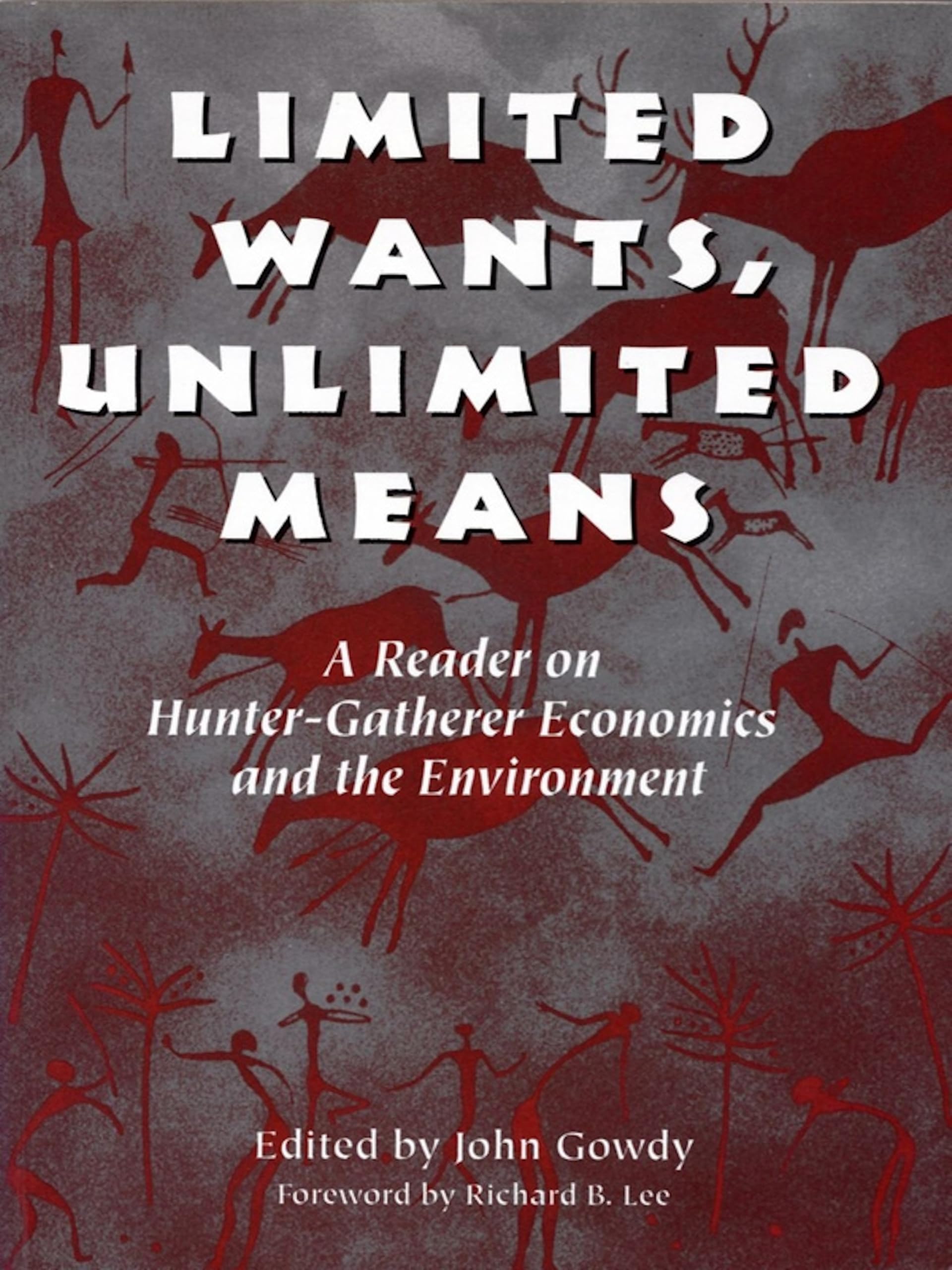
Limited Wants, Unlimited Means: A Reader On Hunter-Gatherer Economics And The Environment
$35.95
by John Gowdy



For roughly 99% of their existence on earth, Homo sapiens lived in small bands of semi-nomadic hunter-gatherers, finding everything they needed to survive and thrive in the biological richness that surrounded them. Most if not all of the problems that threaten our own technologically advanced society -- from depletion of natural capital to the ever-present possibility of global annihilation -- would be inconceivable to these traditional, immediate-return societies. In fact, hunter-gatherer societies appear to have solved problems of production, distribution, and social and environmental sustainability that our own culture seems incapable of addressing. Limited Wants, Unlimited Means examines the hunter-gatherer society and lifestyle from a variety of perspectives. It provides a brief introduction to the rich anthropological and sociological literature on non-agricultural societies, bringing together in one volume seminal writings on the few remaining hunter-gatherer cultures including, the !Kung, the Hadza, and the Aborigines. It examines the economics of traditional societies, and concludes with a multifaceted investigation of how such societies function and what they can teach us in our own quest for environmental sustainability and social equality. Limited Wants, Unlimited Means is an important work for students of cultural anthropology, economic anthropology, environmental studies, and sustainable development, as well as for professionals, researchers, and anyone interested in prehistoric societies, environmental sustainability, or social justice. For roughly 99% of their existence on earth, Homo sapiens lived as small bands of hunter-gatherers in societies that appear to have solved problems of production, distribution, social equity, and environmental sustainability that our own culture seems incapable of addressing. Limited Wants, Unlimited Means examines the hunter-gatherer society and lifestyle, providing a brief introduction to the rich literature on non-agricultural societies. It examines the economics of traditional societies and presents a multifaceted investigation of how such societies function and what that can teach us in our own quest for sustainability and equality. John Gowdy is Professor and Chair of the Department of Economics at Rensselaer Polytechnic Institute in Troy, New York. Limited Wants, Unlimited Means A Reader on Hunter-Gather Economics and the Environment By John M. Gowdy ISLAND PRESS Copyright © 1998 Island Press All rights reserved. ISBN: 978-1-55963-555-4 Contents ABOUT ISLAND PRESS, Title Page, Copyright Page, Foreword, A Note from the Editor, INTRODUCTION - Back to the Future and Forward to the Past, Part I - ORIGINAL AFFLUENT SOCIETIES, ONE - The Original Affluent Society, TWO - What Hunters Do for a Living, or, How to Make Out on Scarce Resources, THREE - Sharing, Talking, and Giving: Relief of Social Tensions Among the !Kung, FOUR - Egalitarian Societies, PART II - THE ORIGINAL AFFLUENT SOCIETY: ASSESSMENT AND EXTENSIONS, FIVE - Beyond "The Original Affluent Society": A Culturalist Reformulation, SIX - Women's Status in Egalitarian Society: Implications for Social Evolution, SEVEN - Art, Science, or Politics? The Crisis in Hunter-Gatherer Studies, EIGHT - The Future of Hunter-Gatherer Research, PART III - HUNTER–GATHERERS AND VISIONS OF THE FUTURE, NINE - The Transformation of the Kalahari !Kung, TEN - So Varied in Detail—So Similar in Outline, ELEVEN - Future Primitive, TWELVE - A Post-Historic Primitivism, About the Contributors, Index, Island Press Board of Directors, CHAPTER 1 The Original Affluent Society * * * Marshall Sahlins If economics is the dismal science, the study of hunting and gathering economies must be its most advanced branch. Almost universally committed to the proposition that life was hard in the Paleolithic, our textbooks compete to convey a sense of impending doom, leaving one to wonder not only how hunters managed to live, but whether, after all, this was living? The specter of starvation stalks the stalker through these pages. His technical incompetence is said to enjoin continuous work just to survive, affording him neither respite nor surplus, hence not even the "leisure" to "build culture." Even so, for all his efforts, the hunter pulls the lowest grades in thermodynamics—less energy/capita/year than any other mode of production. And in treatises on economic development he is condemned to play the role of bad example: the so-called "subsistence economy." The traditional wisdom is always refractory. One is forced to oppose it polemically, to phrase the necessary revisions dialectically: in fact, this was, when you come to examine it, the original affluent society. Paradoxical, that phrasing leads to another useful and unexpected conclusion. By the common understanding, an affluent society is one in which all the people's material wants are easily satisfied. To assert that the hu