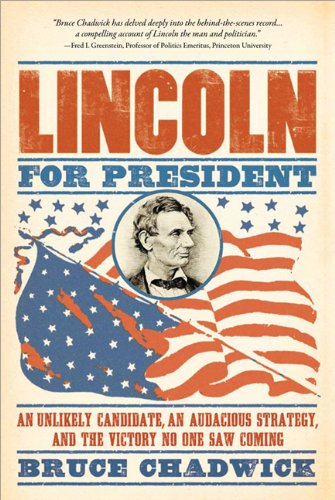
Lincoln for President: An Unlikely Candidate, An Audacious Strategy, and the Victory No One Saw Coming
$19.99
by Bruce Chadwick Ph.D



The untold story of the drama, controversy, and incredible political genius of Lincoln's first presidential campaign In May of 1860, Republican delegates gathered in Chicago for their second-ever convention, with the full expectation of electing William Seward their next presidential candidate. But waiting in the wings was a dark horse no one suspected, putting the final touches on a plan that would not only result in a most unexpected candidacy, but the most brilliant, innovative, and daring presidential campaign in American history. He went by the name of Lincoln. Lincoln for President is the incredible story of how Lincoln overcame overwhelming odds to not only capture his party's nomination but win the presidency. His amazingly modern strategy included the first media campaign blitz, convention tactics that originated the concept of "Chicago politics," and a deft manipulation of the electoral college. His bold tactics changed forever the way presidential campaigns are won…not to mention the course of American history. PRAISE FOR BRUCE CHADWICK Triumvirate: "Dr. Chadwick tells an exciting story… His analysis will provoke further debate about this momentous period in American history." Dr. Paul Clemens, Chairman of the Rutgers University Department of History "In this remarkable new book, Bruce Chadwick reminds us of the three extraordinary men who worked state by state, individual by individual, to ensure passage of the Constitution. It's a fascinating tale, well told." Terry Golway, author of Washington's General and Ronald Reagan's America 1858: "This book is a gem." Curled Up With a Good Book "A gripping narrative." Kurt Piehler, author of Remembering War the American Way The First American Army: "To understand the Revolutionary War, really understand it, read this book." Dave R. Palmer, Lieutenant General, U.S. Army (Ret); author of The Way of the Fox George Washington's War: "Chadwick pierces the fog of myth that has always surrounded our nation's father." Michael Aaron Rockland, professor, Rutgers University Bruce Chadwick is a former journalist and author of seven works of history including 1858, The First American Army, George Washington’s War, The General and Mrs. Washington, Brother Against Brother, Two American Presidents, Traveling the Underground Railroad, and The Reel Civil War. He lectures in American history at Rutgers University and also teaches writing at New Jersey City University. From the Prologue: The 1860 presidential election, one of the most critical in United States history, has often been presented as a rather staid four-man race in which Abraham Lincoln, through little effort of his own, was able to slip in the back door of the White House, even though he won only 39 percent of the popular vote. In many books, movies, plays, and stories he is wrongly depicted as a man far above politics whom the nation naturally turned to in its hour of need. His Republican Party won the 1860 election, of which the key issue was presented exclusively as slavery, most agreed, because the country had split into two camps―North and South. The slavery forces won in the Southern states, and the antislavery forces, the Republicans, took the Northern states and their huge electoral votes and won the election. Lincoln won, historians seemed to suggest, because the Democratic Party was torn apart and its three different candidates―Stephen Douglas, John Breckinridge, and John Bell―split the opposition vote, giving Lincoln victory. Subsequently, the conventions and election were thought to have provided little drama. The major biographers of Lincoln paid little attention to them. One of his earliest biographers, Carl Sandburg, in his Abraham Lincoln: The Prairie Years, devoted just 40 of 900 pages, or just 5 percent of the book, to the election. Later history works followed suit. David Herbert Donald's 1995 Pulitzer Prize–winning Lincoln devoted only 14 of its 600 pages to the 1860 race, or just 2 percent of the work. Richard Carwardine gave only 9 percent of his Lincoln Prize–winning book, Lincoln: A Life of Purpose and Power , to the campaign, and Doris Kearns Goodwin, in Team of Rivals: The Political Genius of Abraham Lincoln, only spent 38 of 754 pages on the campaigns. A new look shows, however, that Abraham Lincoln did not back into the presidency but avidly chased and finally captured it after prodigious work in what was a dramatic and often gripping race filled with feuds, jealousies, secret agreements, lies, failed promises, and betrayals among both parties and all four candidates. Lincoln's biggest strength was not simply that he was opposed to slavery. His greatest asset was that he was an outsider, from the distant reaches of Illinois, the western rim of America's population center at that time, far from the politicians in Washington who had maneuvered the nation into the mess it found itself in 1860. Over the previous twelve years, Lincoln held no national office, did no