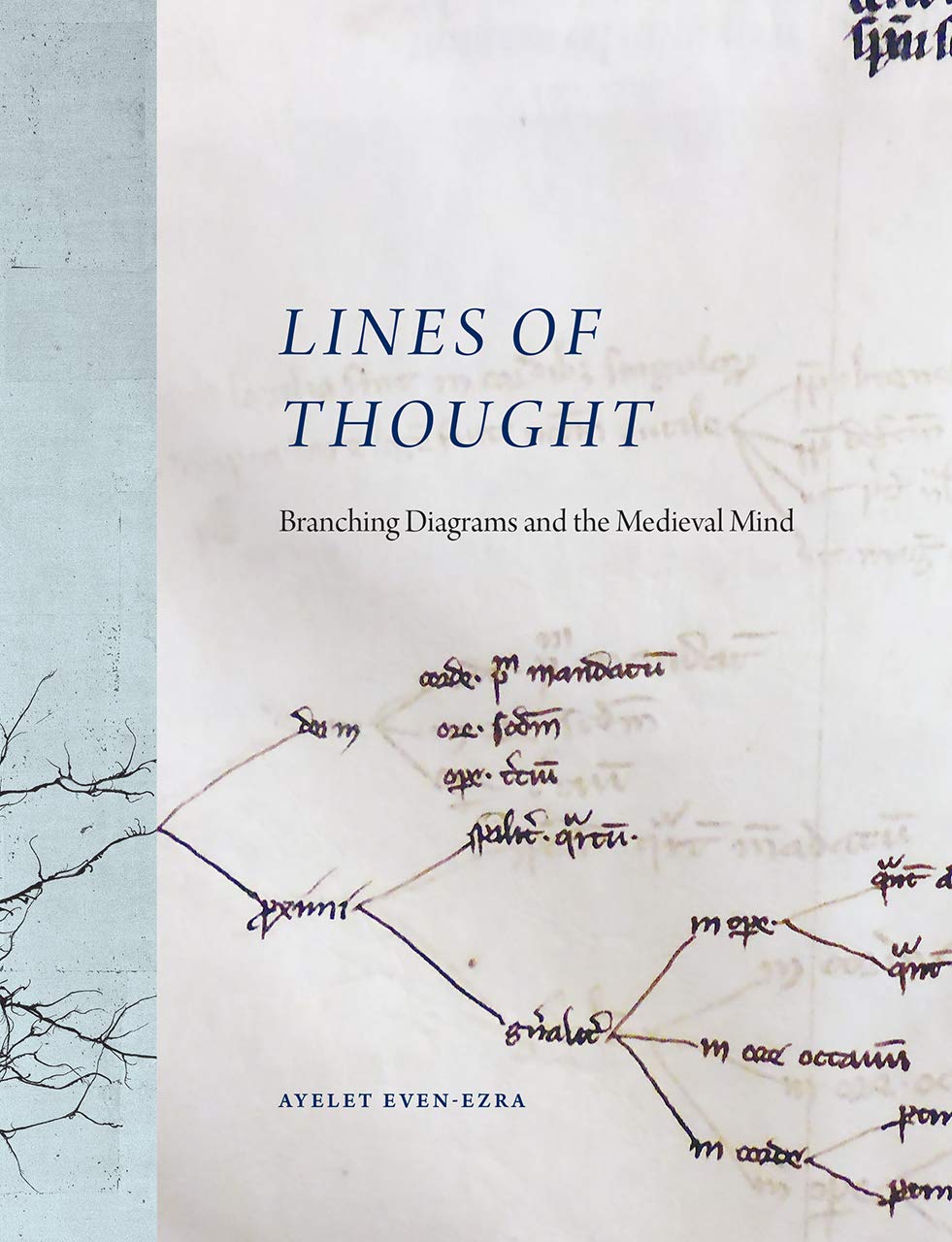



We think with objects—we conduct our lives surrounded by external devices that help us recall information, calculate, plan, design, make decisions, articulate ideas, and organize the chaos that fills our heads. Medieval scholars learned to think with their pages in a peculiar way: drawing hundreds of tree diagrams. Lines of Thought is the first book to investigate this prevalent but poorly studied notational habit, analyzing the practice from linguistic and cognitive perspectives and studying its application across theology, philosophy, law, and medicine. These diagrams not only allow a glimpse into the thinking practices of the past but also constitute a chapter in the history of how people learned to rely on external devices—from stone to parchment to slide rules to smartphones—for recording, storing, and processing information. Beautifully illustrated throughout with previously unstudied and unedited diagrams, Lines of Thought is a historical overview of an important cognitive habit, providing a new window into the world of medieval scholars and their patterns of thinking. “[Even-Ezra] parses the parsing of long-gone readers with depth and relish, emerging from the thicket with a judicious and companionable discussion of HTs and their ramifications (pun essential) for our understanding of how reading, thinking, pen work, and the book medium may be inextricably entwined . . . . From cover to close, the argument of the book is fused with its design. Should an engaged reader annotate their copy with words, lines, or schemata, they would actively extend the lively subject of this welcome work.” ― Modern Philology "This handsome, well-informed study of a seemingly esoteric subject, horizontal tree diagrams that populate the margins of medieval manuscripts and sometimes whole folios, should prove illuminating to all medievalists, as it offers insight not only into the conceptual processes of the age, but also into medieval readers' engagement with texts. . . . The erudite subject matter is conveyed in a clear and lively style sprinkled with personal remarks, and illustrated with numerous reproductions of HTs in both Latin and translated, plus beautiful manuscript photos in black and white and color. . . . Recommended." ― Choice “Offers a rich, transdisciplinary study, both broad and precise, qualitative and quantitative, of [horizontal tree] diagrams. . . . This book will be of great value to any medieval historian interested in the history of ideas and cultural practices, and will undoubtedly constitute a reference work in this field, while at the same time opening up new avenues for research.” ― Metascience “A thought‑provoking and stimulating book to read and an elegant publication to explore. . . . [the] monograph succeeds in raising awareness and stimulating interest in the understudied topic of the use of branching diagrams on scholastic texts.” ― Comptes rendus de l'Académie des Sciences "[ Lines of Thought ] is a triumph of the printer’s art and typography. . . There can be no doubt that Ayelet Even-Ezra has made an important contribution to our understanding of medieval scholasticism and academic culture in this thought-provoking volume, which will spur discussion and further studies." ― The Vatican Library Review “A provocative account of the medieval use of branching, dichotomous diagrams with important implications for our understanding of the medieval mind and its processes of cognition. . . . The book is intricately crafted and delightfully illustrated throughout with Even-Ezra’s own branching diagrams, demonstrating their power, versatility, and appeal to the modern as much as medieval mind.” ― Renaissance Quarterly “Remember the story of Thamus, that sceptical Egyptian god who predicted that young minds would be ruined by writing? The branching diagram, in Even-Ezra’s account, represents one good outcome of the invention of writing. These diagrams could facilitate deeper reflection, especially of an abstract kind, during sessions of intensive reading. They could also be aids to memory, rather than its substitutes, because they repackaged information in formal patterns that could stick in the mind. Medieval note-takers filled the margins of medieval books with these diagrams, and many are evidence of careful attention and a desire to crystalize new knowledge. Even-Ezra describes how the rise of these diagrams—a new kind of writing technology—reshaped cognition.” ― Aeon “Although focused entirely on horizontal tree diagrams, Lines of Thought feels expansive. This is, in part, due to its subject matter: HTs were nearly ubiquitous; their investigation is, perforce, equally wide ranging. Yet [the book’s] breadth is also a function of Even-Ezra’s desire to understand the perceived efficacy of HTs in their own time as well as their potential efficacy in ours, today. To this end, she weaves the work of modern linguists, cognitive scientists, and psychologists into histo