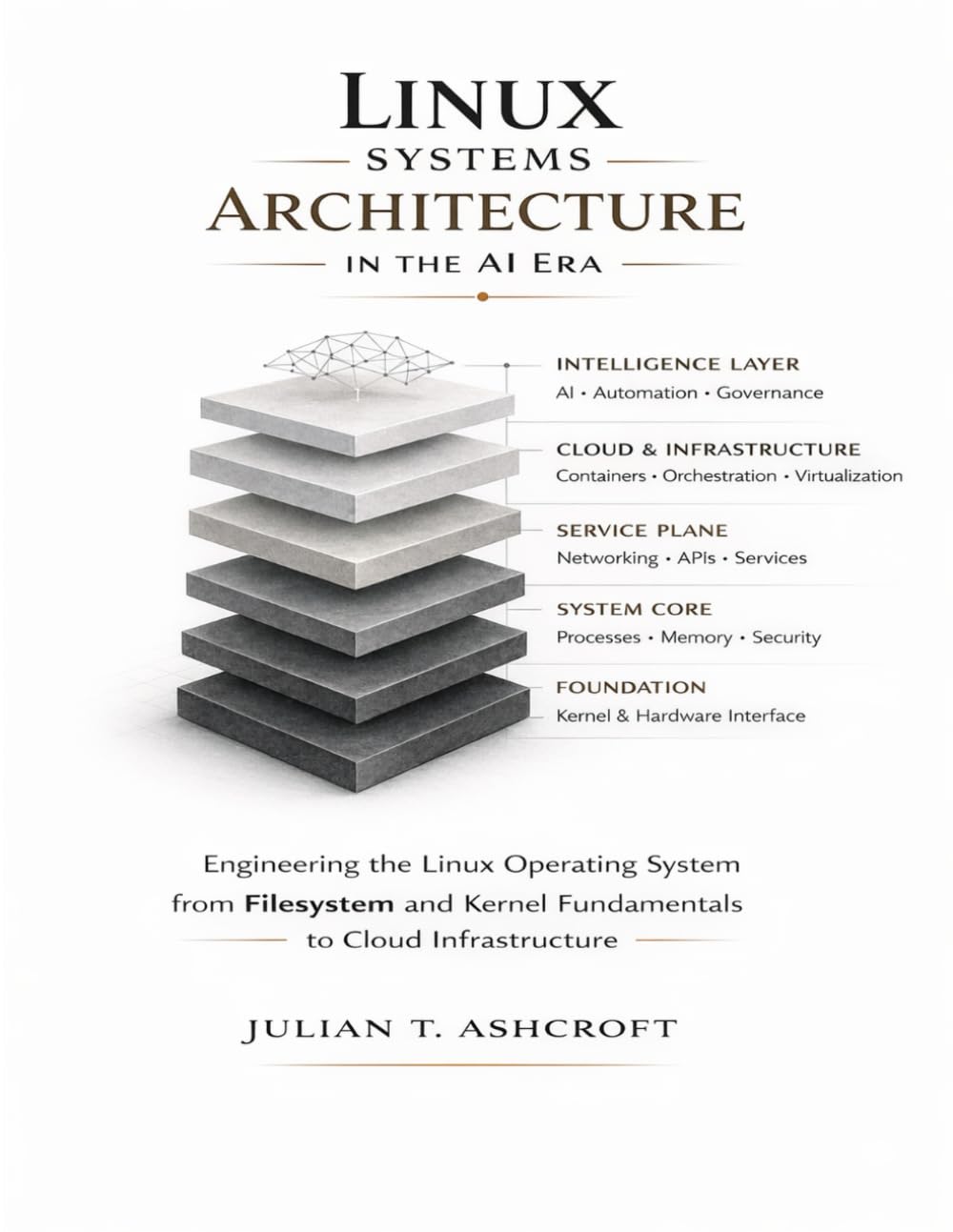
Linux Systems Architecture in the AI Era: Engineering the Linux Operating System from Filesystem and Kernel Fundamentals to Cloud Infrastructure
$24.99
by Julian T. Ashcroft



Modern infrastructure runs on Linux — and increasingly, it runs with AI assistance. From cloud-native platforms and container orchestration systems to production clusters and intelligent automation pipelines, Linux remains the deterministic substrate of modern computing. Yet many engineers learn Linux as a collection of commands rather than as a coherent architectural system. Linux Systems Architecture in the AI Era reframes Linux as it truly is: a layered, enforceable, observable, and governable system architecture. This book connects kernel-level mechanics to cloud-scale infrastructure and shows how classical operating system principles make safe AI-assisted operations possible. You will move from core primitives — processes, memory management, scheduling, filesystems, networking, and privilege enforcement — into modern operational models such as immutability, infrastructure as code, structured observability, disciplined troubleshooting, and bounded AI agents. What You Will Learn How Linux kernel primitives create deterministic control over compute, storage, and networking - Why mutable systems drift — and how immutable design improves reliability - How to separate configuration intent from runtime state for operational clarity - How logging, monitoring, and structured observability enable disciplined troubleshooting - Why human-only operations fail at scale — and how automation must be governed - How to integrate AI as a diagnostic and automation assistant without surrendering control - How to design bounded AI agents with least privilege, auditability, and rollback safety - How to evolve from Linux user to operator to systems architect What This Book Is An architectural guide to understanding Linux as a systems foundation - A bridge between kernel fundamentals and cloud-scale infrastructure - A disciplined approach to automation, reproducibility, and governance - A practical framework for integrating AI as a diagnostic and automation assistant - A progression from user → operator → architect in modern Linux environments What This Book Is Not Not a beginner Linux command reference - Not a distribution-specific tutorial - Not a DevOps tools crash course - Not an AI hype book detached from operational reality - Not a collection of shortcuts without architectural reasoning Who This Book Is For Infrastructure engineers and DevOps practitioners - Site Reliability Engineers (SREs) - Cloud and platform architects - Security-focused systems engineers - Technical leaders designing scalable Linux-based systems - Experienced practitioners ready to move beyond command fluency If you already understand basic Linux usage and want to reason about systems at scale — this book is for you. Who This Book May Not Be For Readers looking for step-by-step beginner tutorials - Those seeking distribution-specific installation guides - Readers wanting quick command cheatsheets without architectural depth As AI tools begin generating scripts, correlating logs, and proposing remediation actions, engineering discipline becomes more important — not less. This book demonstrates how to integrate AI into Linux-based workflows while preserving privilege boundaries, auditability, reproducibility, and deterministic rollback. If you want to design scalable Linux infrastructure, govern automation safely, and integrate AI without surrendering architectural control, this book provides the structured foundation required to lead in the intelligent era.