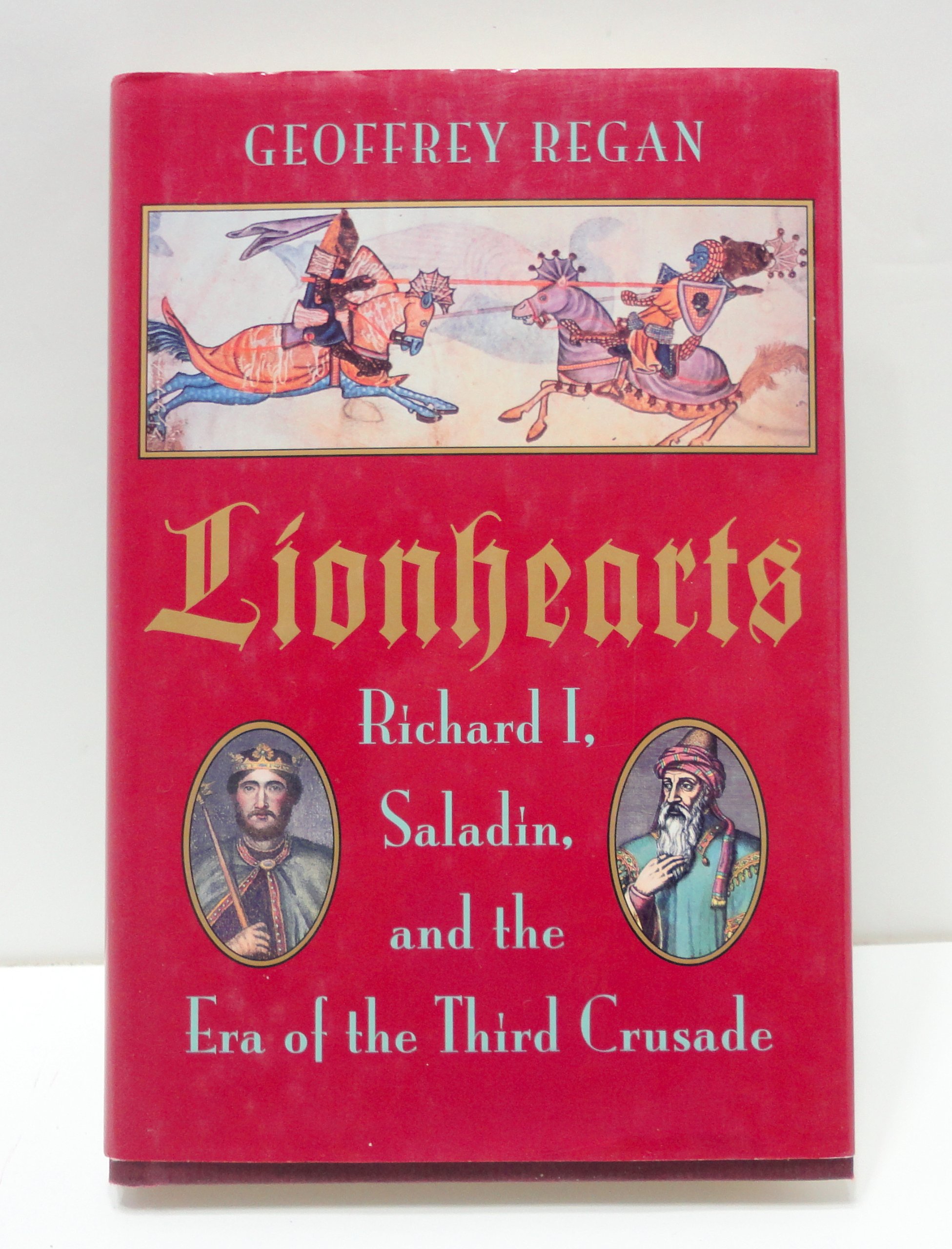



Discusses the geopolitics of Europe and the Middle East at the time of the Third Crusade When the Muslims captured Jerusalem in 1187, Christian rulers across Europe responded to the call. While they raised funds and mustered armies, priests preached that killing "infidels" was morally proper and that crusaders would be guaranteed a place in heaven. Lionhearts is the story of the Third Crusade (1189 to 1192), which sent thousands of men into a holy war. Geoffrey Regan details the day-to-day life of the common crusader--long sieges, marches through swamps, lost supplies, and occasional fierce battles--and the political squabbles between leaders sworn to fight together. Though Regan is a fine military historian, Lionhearts is, at its center, really a rose-colored dual biography of the Third Crusade's two main antagonists: Richard the Lionhearted and Saladin. Alternating chapters focus on each leader's rise to power, noting similarities between them. Regan is clearly enamored of his subjects, and spends a great deal of time enumerating their noble qualities. This is all well and good (and common in biography), but it's difficult to stomach Regan's description of Richard's massacre of 3,000 Muslim prisoners after the siege of Acre as an action "requiring the greatest moral courage." Regan is a skillful writer, and his pages are peppered with vivid odds and ends: pious crusaders operating "God's own catapult"; Saladin sending a gift of snow and fruit to Richard I, preparing to besiege Acre; small rodents called jerboas leaping up and alarming the crusaders. With its maps, concise chronology, modern photographs, and handy list of the main personalities, Lionhearts is an excellent introduction to the history of the Third Crusade. --Sunny Delaney Saladin was Christendom's favorite infidel. Medieval Christian literature portrayed the struggles between Saladin and Richard I during the Third Crusade as a chivalrous duel between two brave, noble gentlemen. To a degree, Regan, a military historian, buys into the legend; he clearly admires both men, both their military acumen and their personal qualities. Thus, he tends to rationalize some of their moral outrages, including their notorious mass murdering of each other's captives. Still, this is a useful and generally enjoyable work, particularly for those readers with interest but not great technical knowledge of the era of the Crusades. The military campaigns are described in detail, but in easily understandable, nontechnical jargon. Regan provides generally accurate portrayals of some of the lesser-known but important characters on both sides of the conflict, and he consistently conveys the spirit and rhythm of life during a brutal but captivating age. Jay Freeman In this brisk account of the Third Crusade (11891192), Regan, author of numerous popular military histories, shines a soft, flattering light on the leaders of the two opposing forces in the greatest of all oxymorons: holy war. Early chapters focus first on the boyhood and rise to power of King Richard I (the Lionheart), then on the analogous biographical aspects of Saladin, the Muslim leader. (Though joined in history, the two principals never met.) Saladin's capture of Jerusalem in 1187 precipitated the Third Crusade, details of whichpreparations, alliances, journeys, strategies, battlescomprise most of the book. A patent admirer of military strategy, technology, and leadership (both Saladin and Richard occupy prominent spots in Regan's pantheon), of the accomplishments of individual warriors, Regan can manage only a perfunctory condemnation of Richard's murder of 3,000 Muslim captives after the siege of Acre; almost droll are his descriptions of Richard collecting enemy heads. Nonetheless, Regan's considerable narrative gifts guide readers gracefully across unfamiliar and unforgiving terrain in company with exotic 12th-century people whose loyalties to one another are startlingly evanescent and whose harsh pieties permit wholesale human slaughter in the names of Jesus and Mohammed. Piquant anecdotes frequently enliven the prose (Frederick Barbarossa drowned in a foot of water on his way to the Holy Land; Richard nearly lost his life when he stole a peasant's falcon), but general readers will need to scurry to their dictionariesbig ones!to look up much of the archaic martial terminology (e.g., mangonel, fascine, haqueton, gambeson, and trebuchet). And some might wonder why Regan is so determined to demonstrate that Richard Lionheart was not a homosexual (he raises the issue in three separate places), or why he comments a couple of times on the quality of prostitutes in the Christian encampment. A paean to Richard and Saladin and desert warfarethe clashes of cultures resound as loudly as those of the weapons. (8 pages photos, not seen; 5 maps) -- Copyright ©1999, Kirkus Associates, LP. All rights reserved. Used Book in Good Condition