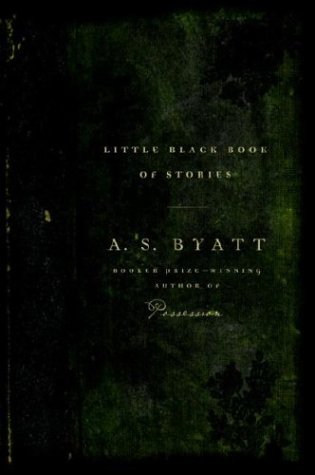



The Booker Prize—winning author of Possession and A Whistling Woman is at her best in this dazzling collection of five new tales. Little Black Book of Stories offers shivers along with magical thrills. Leaves rustle underfoot in a dark wood: two middle-aged women walk into a forest, as they did when they were girls, confronting their childhood fears and memories and the strange thing they saw–or thought they saw–so long ago. A distinguished male obstetrician and a young woman artist meet in a hospital, but they have very different ideas about body parts, birth, and death. A man meets the ghost of his living wife; a woman turns to stone. And an innocent member of an evening creative writing class turns out to have her own decided views on the best way to use “raw material.” These unforgettable stories are by turns haunting, funny, sparkling, and scary. Byatt’s Little Black Book adds a deliciously dark note to her skill in mixing folk and fairy tales with everyday life. Byatt’s readers fall into two camps. Some find her enthusiasm for minutiae in these Gothic tales infuriating—not everyone wants to read an extended description of the proper treatment of stoves. These detractors find this collection too smart for its own good, its many facts and metafictional digressions obstructing real emotion. Most readers, however, fell under Byatt’s spell. For all her book-learning, many agree that Byatt can spin a story that’s captivatingly scary—and perhaps more. Several praised these stories—“A Stone Woman” and “Body Art” in particular—as funny, poignant, and even uplifting. Byatt, award-winning author of Possession , may be only too willing to show off her knowledge of a variety of subjects. But for many, this knowledge only adds to her power. Copyright © 2004 Phillips & Nelson Media, Inc. Byatt is commanding. Her prose is crisp and astringent. Her insights are lacerating, her approach sly, her visions searing, her wit honed, and her imagination peripatetic and larcenous, feasting on art, myth, fairy tales, and science. While her novels, including the brilliant A Whistling Woman (2002) and the Booker Prize-winning Possession (1990) , are complex and powerful, her short stories are dazzling concentrates. As in her earlier collections, The Matisse Stories (1995), The Djinn in the Nightingale's Eye (1997), and Elementals (1999), Byatt creates, in her newest set of gems, a palimpsest of art and life as she examines how each shapes the other, and how trauma, be it personal or the mass psychosis of war, irrevocably transforms personalities and lives. In several galvanizing and highly original tales, including "Body Art," in which a gynecologist reluctantly gets involved with an angry young artist, she postulates deeply intriguing conflicts over the sacredness and profanity of the body and the vulnerability of the mind. And once again, Byatt proves herself to be the queen of fractured fairy tales. In "The Thing in the Woods," two young girls evacuated from London at the start of World War II see something loathsome in the forest, a grotesque embodiment of evil, while "A Stone Woman" stands as a gloriously beautiful evocation of grief and metamorphosis. Donna Seaman Copyright © American Library Association. All rights reserved “A delight. . . . Byatt's stories are provoking and alarming, richly yet tautly rendered. . . .[She] has the sheer narrative skill to raise the hairs on the back of your neck and make your pulse race.” – The New York Times Book Review “Bewitching . . . immensely readable, fiercely intelligent, and studded with astonishing, refracting images. . . . A virtuoso performance by a master storyteller.” – Los Angeles Times Book Review “Supremely elegant. . . . Byatt peels back the surface of everyday life–and what she reveals may disturb your sleep.” – Entertainment Weekly “Striking . . . marvelous . . . impressive. . . . Byatt’s Gothic touch transforms commonplace English settings and characters into unsettling zones of loss and fear.” – The Boston Globe “A storyteller who could keep a sultan on the edge of his throne for a thousand and one nights.” – The New York Times Book Review “Scrumptious . . . these are raw, tough, disruptive stories about memory, duty, madness, guilt, cruelty and loss, stories that grope and reel, that throb with secret longings, secret histories, artistic yearnings and the thrashes and groans of a stinking damnation in the underbrush.”– Miami Herald “Her finest collection yet. . . . Bleak then surprisingly funny, very dark indeed then full of inconceivable sources of light.” – The Guardian “Beautifully crafted. . . [ Little Black Book of Stories ] prods at the tender points where art, pain, and desire intersect.” –The Financial Times “A potent alchemy of magic, horror and sensual delight.” – Elle “Captivating . . . disturbing yet funny . . . an utterly compelling read.” – Harper’s Bazaar “A delightful surprise. . . . A heady infusion