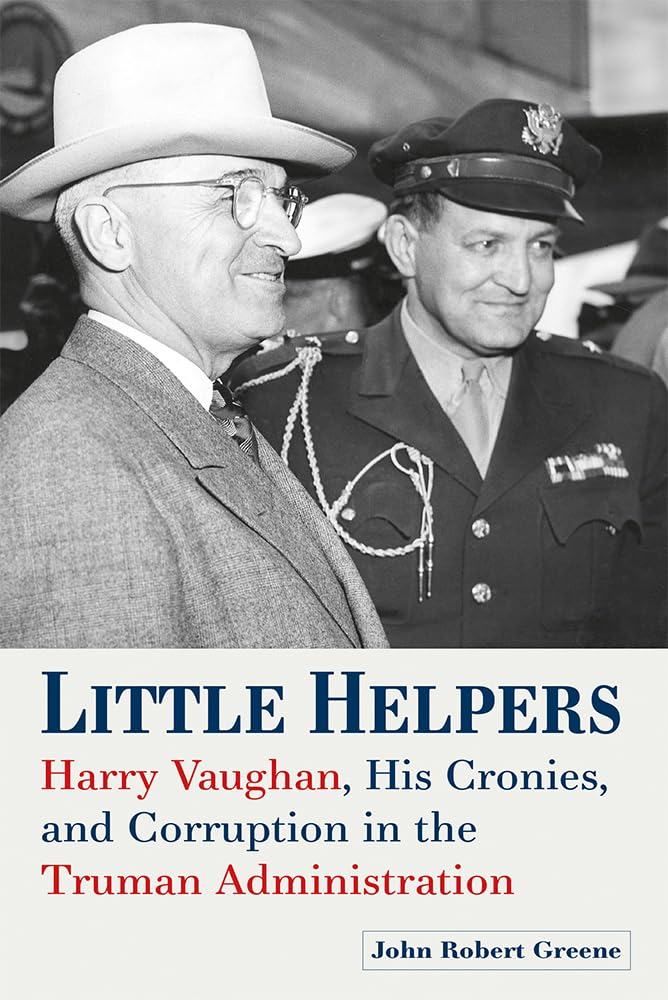
Little Helpers: Harry Vaughan, His Cronies, and Corruption in the Truman Administration
$40.00
by John Robert Greene



In Little Helpers , historian John Robert Greene encourages us to rethink the scandals of Harry Truman’s presidency by providing the first political biography of the man who precipitated them—Gen. Harry H. Vaughan. As the former president’s close friend and military aide, Vaughan brought a number of disreputable figures into the White House, in addition to committing plenty of misconduct on his own. Although aware of Vaughan’s misdeeds, Truman remained unwilling to rid his administration of him and his hangers on. Vaughan’s scandals have largely gone overlooked by historians—a tendency that Little Helpers corrects. Greene begins with the story of how Truman and Vaughan met during World War I, then examines Vaughan’s support for Truman for the Senate and later as President. The majority of the book, however, considers the various cronies that surrounded Vaughan and illustrates the significance of his relationship with Truman—and the president’s inability to rein him in. Drawing from primary and archival sources, many never before published, Little Helpers is further distinguished by its use of the correspondence between Vaughan and Truman. Greene also provides a dramatic narrative account of the inner workings of the Truman administration, making the book accessible to the general reader as well as the specialist. Included on National Review's annual Year in Reading list. “ Little Helpers sheds light on a dark corner of presidential history. With lively prose and thorough documentation, this book shows that Harry Truman stood by an aide who abused his power to benefit unsavory characters. It is an important contribution to our understanding of the Truman administration and the dangers of misplaced loyalty.” — John J. Pitney, Jr. , Claremont McKenna College, author of After Reagan: Bush, Dukakis, and the 1988 Election “John Robert Greene has written a riveting short book about the dangers of cronyism. Little Helpers focuses on a little remembered but pivotal player in the Truman years, Major General Harry Vaughan, a press-leaking, Ike-irking, gaffe-making, infighting presence in the Truman White House. Despite his liabilities, Vaughan had one essential asset: Truman liked him. Greene is a great storyteller, and the story of Truman's first meeting with Vaughan alone makes the book worth reading. But there is much more to it. Little Helpers teaches us about Vaughan's importance to the Truman story, and shows why he was largely forgotten by history.” — Tevi Troy , Presidential historian, former White House aide, author of Fight House: Rivalries in the White House from Truman to Trump “It takes nothing away from Harry Truman’s Cold War statesmanship to be reminded of his sometimes misplaced sense of loyalty to the likes of Harry Vaughan, World War I comrade, lifelong friend, and sometime presidential advisor. Vaughan was also a Washington influence peddler, a congenial sort who would have been at home in Warren Harding’s White House. Drawing on primary sources and his own vast knowledge of the era, John Robert Greene dives deeply into the Vaughan story. The result is that rarity—a work of original scholarship that is also a page turner. Highly relevant for its foreshadowing of today’s pay for play politics, this is a major contribution to our understanding of the Truman presidency.”— Richard Norton Smith, Presidential historian, author of An Ordinary Man: The Surprising Life and Historic Presidency of Gerald R. Ford “ Little Helpers is a well-written account that is quickly read. . . . Highly recommended.”— Journal of American’s Military Past “Greene’s history of Vaughan’s role in the Truman White House sheds new light on postwar politics, particularly how changing dynamics between the media, Congress, and the president redefined how corruption was addressed at the highest levels.”— Congress & the Presidency "Overall, Greene makes a persuasive case for reevaluating Vaughan’s role in the Truman White House."— Missouri Historical Review “ Little Helpers reveals how small incidents launch careers and contribute to bigger political developments. While this book does not include the intrigue of high organized crime or the drama of a major political scandal, it will still be of interest to scholars researching the Truman administration or looking for a broader view of Washington’s dark side.”— Kansas History John Robert Greene is Professor Emeritus of History and Humanities at Cazenovia College, where he taught for forty-two years. He specializes in American political history, particularly the American Presidency. Greene is the author or editor of twenty books, including The Presidency of George W. Bush and I Like Ike: The Presidential Election of 1952 .