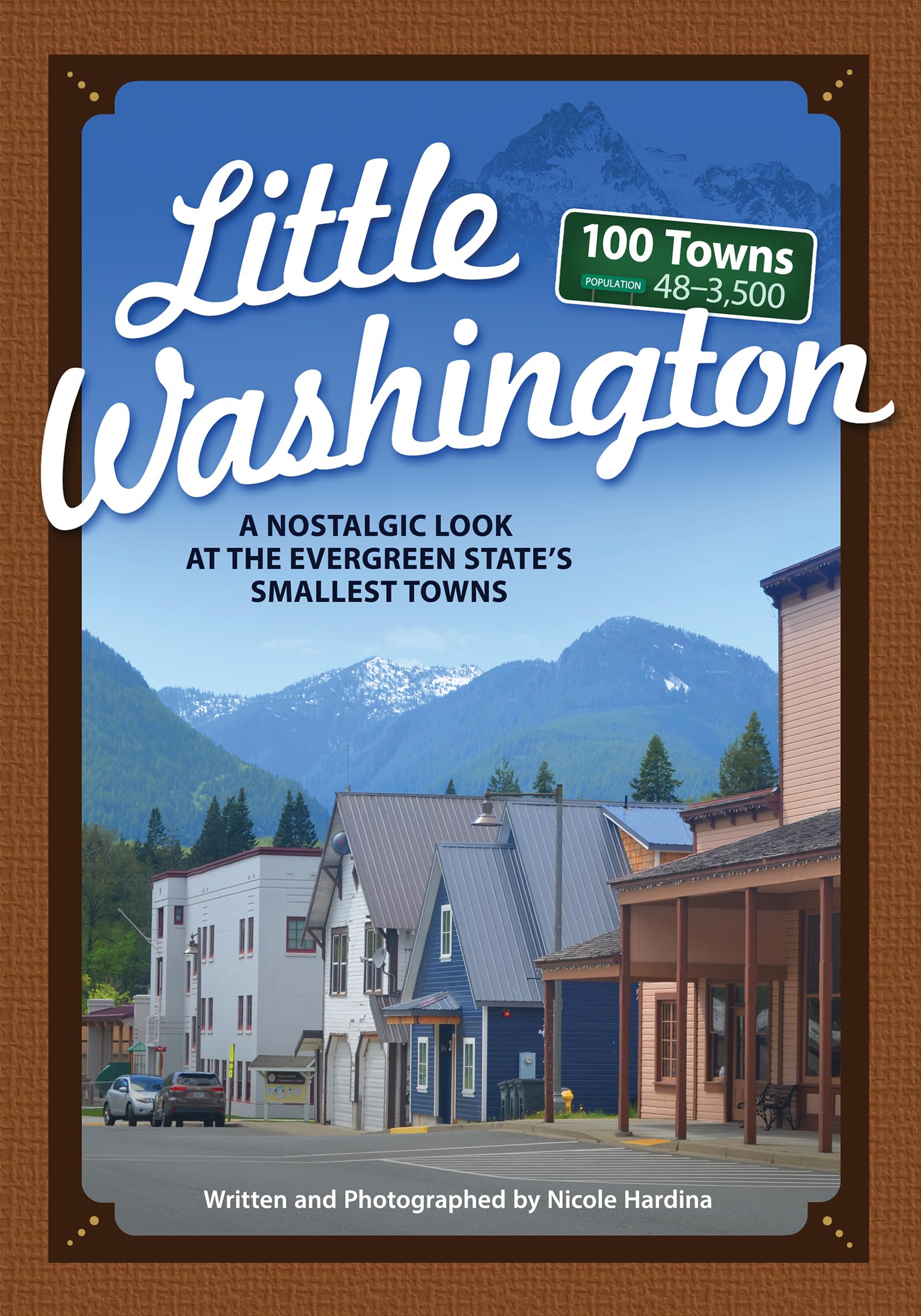
Little Washington: A Nostalgic Look at the Evergreen State's Smallest Towns (Tiny Towns)
$11.06
by Nicole Hardina



Washington’s Small Towns Have Great Stories. Little Washington presents 100 of the state’s tiniest towns. With populations under 3,500, these charming and unique locations dot the entire state―from Neah Bay along the Northwest coast to LaCrosse, a farming community in the eastern county of Whitman. With full-color photographs, fun facts, and fascinating details about every locale, it’s almost as if you’re walking down Main Street, waving hello to folks who know all of their neighbors. Inside You'll Find Details about 100 small towns―with entries from every county - Full-color photographs, fun facts, and fascinating locations - Guide to exploring these quaint and historic locations - Insights from an author who has lived in various parts of the state The selected locations help readers to appreciate the broader history of small-town life in Washington. Yet each featured town boasts a distinct narrative, as unique as the citizens who call these places home. These residents are innovators, hard workers, and―most of all―good people. The locations range from quaint to historic, and they wonderfully represent the Evergreen State. Little Washington , written by Nicole Hardina, is for anyone who grew up in a small town and for everyone who takes pride in being called a Washingtonian. They may be small towns, but they have huge character! “Hardina’s book is part history, part travelogue and all love letter to the Evergreen State.” ―Tim Johnson, Cascadia Weekly Nicole Hardina has lived in Washington for over 20 years, in towns big and small. Alaska-grown, she is a Seattle-based writer sharing an apartment with two cats, a guitar, and several overflowing bookcases. Her writing has appeared in Scope, Months to Years, Out There Outdoors, the Bellingham Review, Proximity, and elsewhere. She received a Grant for Artist Projects award from Artist Trust in 2016 and is working on a memoir that is equal parts grief account and love letter to the Pacific Northwest. Neah Bay Population: 994 Unincorporated People of the Cape The community of Neah Bay is home to the Makah Tribe and located on the Makah Reservation. The Makah, whose name variously translates as “people of the cape” and “people who are generous with their food,” inhabit their traditional lands, minus the 300,000 acres they lost in the 1855 Treaty of Neah Bay. But unlike treaties between Washington’s territorial governor, Isaac Stevens, and other Indigenous groups, the Treaty of Neah Bay affirmed the Makah people’s rights to maintain their villages and lifeways, including whaling, sealing, and fishing, on land the Makah did not cede. Sixty years prior to the treaty, Salvador Fidalgo established the first non-Native settle- ment in Neah Bay, but it failed within a year after conflict with the British. The area now known as Neah Bay was at the time called Deah (or Di·ya in Makah), named for Makah Chief Dee-ah. Deah was one of five permanent Makah villages that stretched along the northern and western coasts of what became Washington State. Pre–European contact, as many as 4,000 Makah lived in these villages. Cedar longhouses 30 feet wide and 70 feet long housed multiple generations of extended families. Summer brought travel to Tatoosh Island, Ozette Lake, and other seasonal camps, fishing grounds, and gathering places. The Makah designed canoes made from western red cedar for whaling, fishing, and war. Selling baskets woven from cedar and grasses became a source of income for the Makah after the treaty and remained important into the 20th century. From the late 1700s through the time of the Treaty of Neah Bay, diseases introduced by non-Native settlers ravaged the Makah population, and by 1877 the Makah numbered fewer than 1,000 people. Neah Bay was home to an Indian Agency, a reservation trading post, a school, and a lifeboat station. One hundred years had passed since Captain James Cook sailed to Tatoosh Island, and 80 years since a lighthouse went up on the island to guide non-Native sailors through the Strait of Juan de Fuca to and from Puget Sound, to the east. white people began homesteading in Neah Bay in the 1890s. One of the first, a man named W. W. Washburn, established a general store which, after a fire and rebuilding, still stands today as the only store in Neah Bay. Despite significant losses of both population and land, Makah culture remains vibrant today. The tribe welcomes visitors to their reservation to learn about their past and present. The Buried Village Makah legend tells of a great landslide long ago in Ozette, one of the tribe’s ancient villages. In 1969, a winter storm shifted the land again, uncovering preserved artifacts and proving the oral history true, and more than 4,000 hours of painstaking excavation began. In a combined effort between the Makah and Washington State University, archaeologists worked without shovels, using only water from a hose to rinse delicate artifacts clean. Their efforts recovered more than