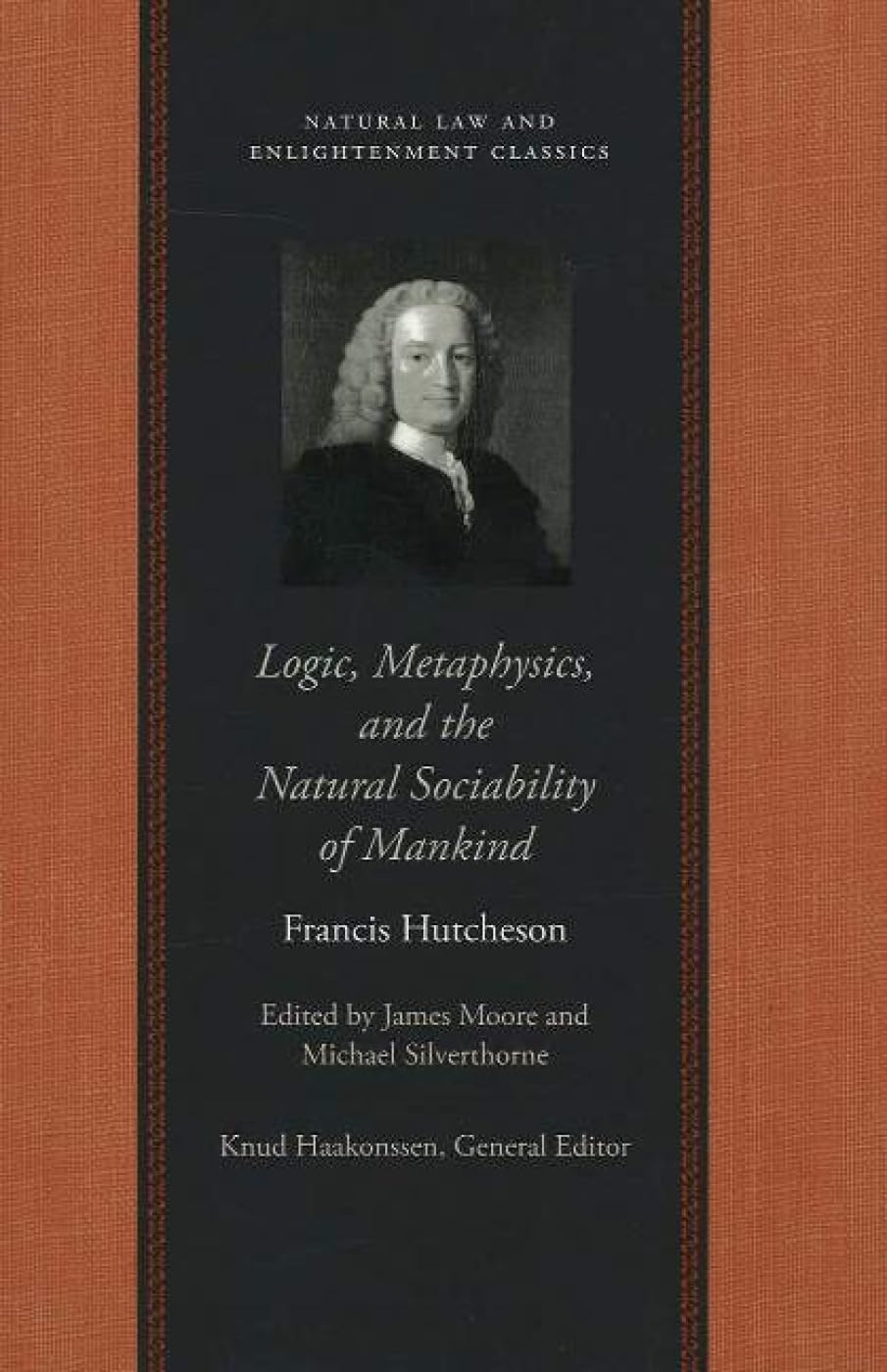
Logic, Metaphysics, and the Natural Sociability of Mankind (Natural Law and Enlightenment Classics)
$24.00
by Francis Hutcheson



Until the publication of this Liberty Fund edition, all but one of the works contained in Logic, Metaphysics, and the Natural Sociability of Mankind were available only in Latin. This milestone English translation will provide a general audience with insight into Hutcheson’s thought. Francis Hutcheson (1694–1746) was educated at the University of Glasgow, where he assumed the chair of moral philosophy in 1729. James Moore is Emeritus Professor of Political Science at Concordia University in Montreal. Michael Silverthorne is Honorary University Fellow in the School of Classics at the University of Exeter. Moore (political science, Concordia U., Montreal) and Silverthorne (classics, ancient history, and theology; U. of Exeter) offer the first complete English translation of Hutcheson's (1694-1746) Logicae Compendium (1756) and Metaphysicae Synopsis (1742). They say the two works were considered indispensable texts for instruction during the 18th century, and remain required reading for a full understanding of his philosophy, but have not figured prominently in studies of him partly because they were written in Latin, and partly because they were written for students; his English-language texts for adult readers published in the 1720s are more popular. Reference & Research Book News August 2006 Much evidence stacked up on my bookshelves suggests-- pace Hawes--a determination to scrutinize and respect claims for the Enlightenment: Liberty Press's ongoing series Natural Law and Enlightenment Classics (which saw new editions this year of John Millar's An Historical View of the English Government: From the Settlement of the Saxons in Britain to the Revolution in 1688 and The Origin of the Distinction of Ranks , Francis Hutcheson's Logic, Metaphysics, and the Natural Sociability of Mankind , and Jean-Jacques Burlamaqui's The Principles of Natural and Politic Law ); the several books that revalue Enlightenment aspirations as they make philosophy the master key for unlocking cultural preoccupations. Studies in English Literature Summer 2007 Logic, Metaphysics, and the Natural Sociability of Mankind includes English translations of three of Francis Hutcheson's writings that originally appeared in Latin. In A Compound of Logic To which is prefixed a Dissertation On the Origin of Philosophy And Its Principal Founders and Exponents (Logicae Compendium , Glasgow, 1756) Hutcheson classifies philosophy into logic (rational philosophy), natural philosophy, and moral philosophy, following the prototype of the Stoa. By logic, he understands "the art which directs the mind in its acquisitions of Knowledge of things, and may also be called science (scientia). Others define it as 'the art of investigating and expressing truth" (p. 9). The division of the work mainly follows the example of Antoine Arnauld's The Art of Thinking (concept, judgment, syllogism, method); however, Hutcheson deals with method in an appendix "on Topics, Fallacies, and Method." Regarding content, he combines Aristotelian logic with the new doctrine of ideas. Accordingly, logic is to be understood in a very wide sense, as in the early example of the Compendium Logicae (1729) of John Loudon, who taught philosophy in Glasgow between 1699 and 1750 (cf. p. xi). Loudon's work had an immediate impact on Hutcheson's treatise, which presumably had been written, according to James Moore, in the 1720s for the instruction of students in his Dublin academy. Supposedly, A Synopsis of Metaphysics Comprending Ontology and Pneumatology ( Metaphysicae Synopsis , Glasgow, 1742; 2nd, enlarged edn., 1744) was also written in the 1720s in connection with Hutcheson's teachings at Dublin. In this tripartite work, Hutcheson deals with ontology ("On Being and the Common Attributes of Things") and, under the notion of pneumatology, with the doctrine of the human mind and God. In Glasgow, as a professor of moral philosophy, Hutcheson only taught on the third part because ontology and pneumatology were Loudon's field of responsibility as a professor of logic. In his introduction, James Moore points out that Loudon held his lectures on metaphysics according to Determinationes Pneumatologicae et Ontologicae by the Dutch philosopher Gerard de Vries, and that Hutcheson designed his metaphysics as a "counterpart to the work of de Vries" (p. xiii). Hutcheson intended to replace de Vries's Aristotelianism with the new doctrine of ideas. As James Moore puts it: "Hutcheson's ontology consisted very largely in the translation of scholastic terms of being into the language of ideas" (p. xiv). Both writings are of particular interest for the Hutcheson scholar, since they are the only writings in which Hutcheson addresses logic and metaphysics in the form of a textbook. The third work in this volume is an English translation of On the Natural Sociability of Mankind , Hutcheson's Glasgow inaugural oration of 1730, where he tries to defend a notion of