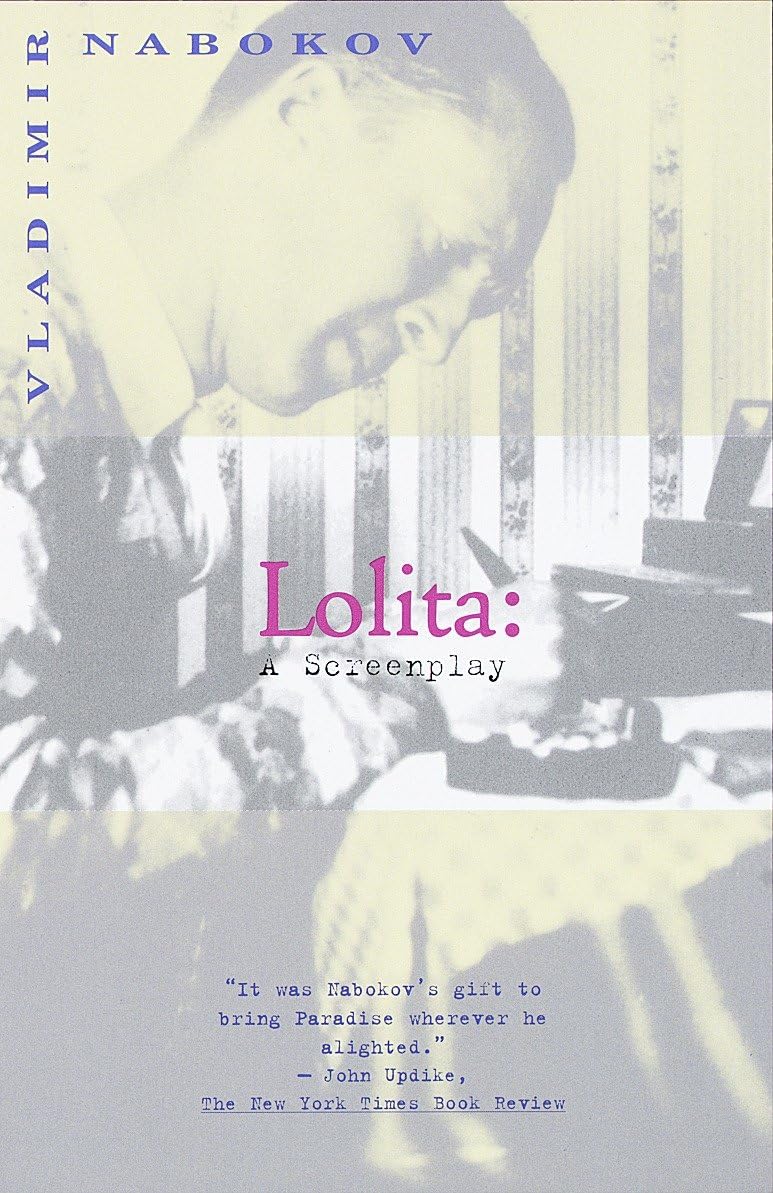



The screenplay for Kubrick’s 1962 film tells the story of an older man’s obsession with a young girl. • This is the purely Nabokov version of the screenplay and not the same version which was produced as the motion picture Lolita, distributed by Metro-Goldwyn-Mayer, Inc. “A few days before, at a private screening, I had discovered that Kubrick was a great director, that his Lolita was a first-rate film with magnificent actors, and that only ragged odds and ends of my script had been used. The modifications, the garbling of my best little finds, the omission of entire scenes, the addition of new ones, and all sorts of other changes may not have been sufficient to erase my name from the credit titles but they certainly made the picture as unfaithful to the original script as an American poet’s translation from Rimbaud or Pasternak. I hasten to add that my present comments should definitely not be construed as reflecting any belated grudge, any high-pitched deprecation of Kubrick’s creative approach. When adapting Lolita to the speaking screen he saw my novel in one way, I saw it in another – that’s all, nor can one deny that infinite fidelity may be an author’s ideal but can prove a producer’s ruin.” --- From the foreword "It was Nabokov's gift to bring Paradise wherever he alighted." —John Updike, The New York Times Book Review As it charts the hypnotized progress of Humbert Humbert, a hypercivilized and amoral European emigre, into the orbit of a treacherously lovely and utterly unimpressionable preteen, Lolita: A Screenplay gleefully demolishes a host of stereotypes - sexual, moral, and aesthetic. Not least among the casualties is the notion that cinema and literature are two separate spheres. For in his screenplay, Nabokov married the structural and narrative felicities of great cinema to prose as sensuously entrancing as any he had ever written, resulting in a work that will delight cineasts and Nabokovians alike. Vladimir Nabokov was born on April 23, 1899, in St. Petersburg, Russia. The Nabokovs were known for their high culture and commitment to public service, and the elder Nabokov was an outspoken opponent of anti-Semitism and one of the leaders of the opposition party, the Kadets. In 1919, following the Bolshevik Revolution, he took his family into exile. Four years later he was shot and killed at a political rally in Berlin while trying to shield the speaker from right-wing assassins. The Nabokov household was trilingual, and as a child Nabokov was already reading Wells, Poe, Browning, Keats, Flaubert, Verlaine, Rimbaud, Tolstoy, and Chekhov alongside the popular entertainments of Sir Arthur Conan Doyle and Jules Verne. As a young man, he studied Slavic and romance languages at Trinity College, Cambridge, taking his honors degree in 1922. For the next 18 years he lived in Berlin and Paris, writing prolifically in Russian under the pseudonym "Sirin" and supporting himself through translations, lessons in English and tennis, and by composing the first crossword puzzles in Russian. In 1925, he married Vera Slonim, with whom he had one child, a son, Dmitri. Having already fled Russia and Germany, Nabokov became a refugee once more in 1940, when he was forced to leave France for the United States. There he taught at Wellesley, Harvard, and Cornell. He also gave up writing in Russian and began composing fiction in English. His most notable works include Bend Sinister (1947), Lolita (1955), Pnin (1957), and Pale Fire (1962), as well as the translation of his earlier Russian novels into English. He also undertook English translations of works by Lermontov and Pushkin and wrote several books of criticism. Vladimir Nabokov died in Montreux, Switzerland, in 1977. Lolita A Screenplay By Vladimir Nabokov Vintage Books USA Copyright © 1997 Vladimir Nabokov All right reserved. ISBN: 9780679772552 Chapter One 1 Lolita, light of my life, fire of my loins. My sin, my soul. Lo-lee-ta: the tip of the tongue taking a trip of three steps down the palate to tap, at three, on the teeth. Lo. Lee. Ta. She was Lo, plain Lo, in the morning, standing four feet ten in one sock. She was Lola in slacks. She was Dolly at school. She was Dolores on the dotted line. But in my arms she was always Lolita. Did she have a precursor? She did, indeed she did. In point of fact, there might have been no Lolita at all had I not loved, one summer, a certain initial girl-child. In a princedom by the sea. Oh when? About as many years before Lolita was born as my age was that summer. You can always count on a murderer for a fancy prose style. Ladies and gentlemen of the jury, exhibit number one is what the seraphs, the misinformed, simple, noble-winged seraphs, envied. Look at this tangle of thorns. 2 I was born in 1910, in Paris. My father was a gentle, easy-going person, a salad of racial genes: a Swiss citizen, of mixed French and Austrian descent, with a dash of the Danube in his veins. I a