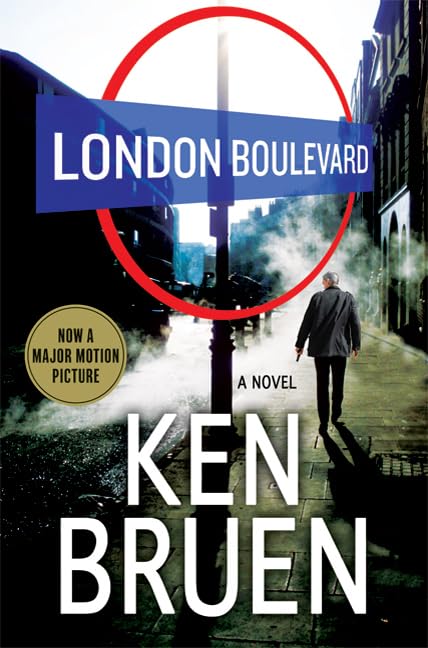



When Mitchell is released from prison after serving three years for a vicious attack he doesn’t even remember, Billy Norton is there to pick him up. But Norton works for Tommy Logan, a ruthless loan shark lowlife with plans Mitchell wants nothing to do with. Attempting to stay out of Logan’s way, he finds work at the Holland Park mansion of faded movie actress, Lillian Palmer, where he has to deal with her mysterious butler, Jordan. It isn’t long before Mitchell’s violent past catches up with him and people start getting hurt. When his disturbed sister Briony is threatened, Mitchell is forced to act. Academy Award-winning screenwriter William Monahan ( The Departed ) has teamed with Quentin Curtis to acquire rights to London Boulevard . Monahan plans to co-produce, write, and make his directorial debut with the movie. This is a masterful work of double dealing and suspense from one of the great crime writers of our time. "This is a strong solo effort from Irish noir master Bruen, whose prose floats like a butterfly and stings like bejesus." --Library Journal "First published in the U.K. in 2001 and presently being adapted for the movies, Bruen's gritty reimagining of Billy Wilder's Sunset Boulevard transplants the action from glitzy Hollywood to the rough and tumble London streets...Noir fans will enjoy this rapid-fire thrill ride." --Publishers Weekly KEN BRUEN has been a finalist for the Edgar and Anthony Awards, and has won a Macavity Award, a Barry Award, and two Shamus Awards for the Jack Taylor series. He has been an English teacher in Africa, Japan, Southeast Asia, and South America. He lives in Galway, Ireland. From The Washington Post's Book World/washingtonpost.com Reviewed by by Patrick Anderson The prolific Irish crime novelist Ken Bruen writes books that are by no means profound, but are violent, cynical, irreverent, often hilarious and always fast-moving and fun. In his new "London Boulevard," Bruen makes an interesting departure by combining his usual bloody crime drama with the plot of Billy Wilder's 1950 movie classic, "Sunset Blvd." Briefly, a London criminal, the charming but lethal Mitchell, is released after three years in prison and is soon in trouble with various gangsters, whereupon he takes refuge in the mansion of the fading stage actress Lillian Palmer, who is modeled on Wilder's Norma Desmond. Like Desmond, Palmer has a mysterious butler, called Jordan here, who is in fact her husband and is dedicated to keeping alive her fantasies of renewed stardom. ("The West End shall hail my return.") One major difference between the two versions of the story is that in "Sunset Blvd." sex between Desmond and the young screenwriter Joe Gillis was only hinted at; this was, after all, 1950, when sex had barely been invented. In "London Boulevard," the sex between the 40-something ex-convict and the 60-something actress is not left to the imagination, not at all. Another difference is that most of the drama in the movie takes place within Desmond's mansion; Gillis's life elsewhere in Los Angeles is only briefly glimpsed. Bruen reverses that balance. Most of his novel takes place on the streets of London, where Mitchell and various gangsters confront, threaten and kill one another. The star's mansion is his refuge -- until, inevitably, violence follows him there. That leads to another innovation. Desmond's butler/ex-husband is a strong-minded man but not a violent one. In the novel, Jordan proves to be quite handy with a gun and becomes Mitchell's partner in dealing with the villains who unwisely invade the actress's gloomy home. I lost track of the killings in the novel but they number around 10, and that's not counting the soccer player who pays a high price for offending Mitchell: "I had the Glock out and pumped both his knees from behind." Bruen's prose is often a delight. Here Mitchell sits down to dinner with a gangster: "He had arrogance and contempt finely mixed. Plus, he was an ugly bastard. Prison has its share of them. . . . They're the wardens." Here he finds himself falling for a lovely Irish woman: "She was feeding me the most treacherous poison of all: hope." He starts out lusting for the well-preserved actress but soon finds her insatiable demands "about as appealing as a prison breakfast." The author also likes to play games with typography by making each word a separate line, as with Mitchell's summary of one encounter with Lillian: "Over under sideways on the floor over a table on the bed Like that." That's harmless fun, perhaps intended to lend a quasi-poetic aura to prose that is anything but, and to stretch out a short novel. Bruen also has the mildly annoying habit of having Mitchell refer to each beer he drinks -- and he drinks many -- as a "brewski" and of endlessly dropping the names of crime writers he admires. They're fine writers -- Pelecanos, Ellroy, Leonard, Willeford, Sallis, Harvey -- but it starts to be self-indulgent, an in-group thing. Ultimately, the s